Chapter 2 / 3
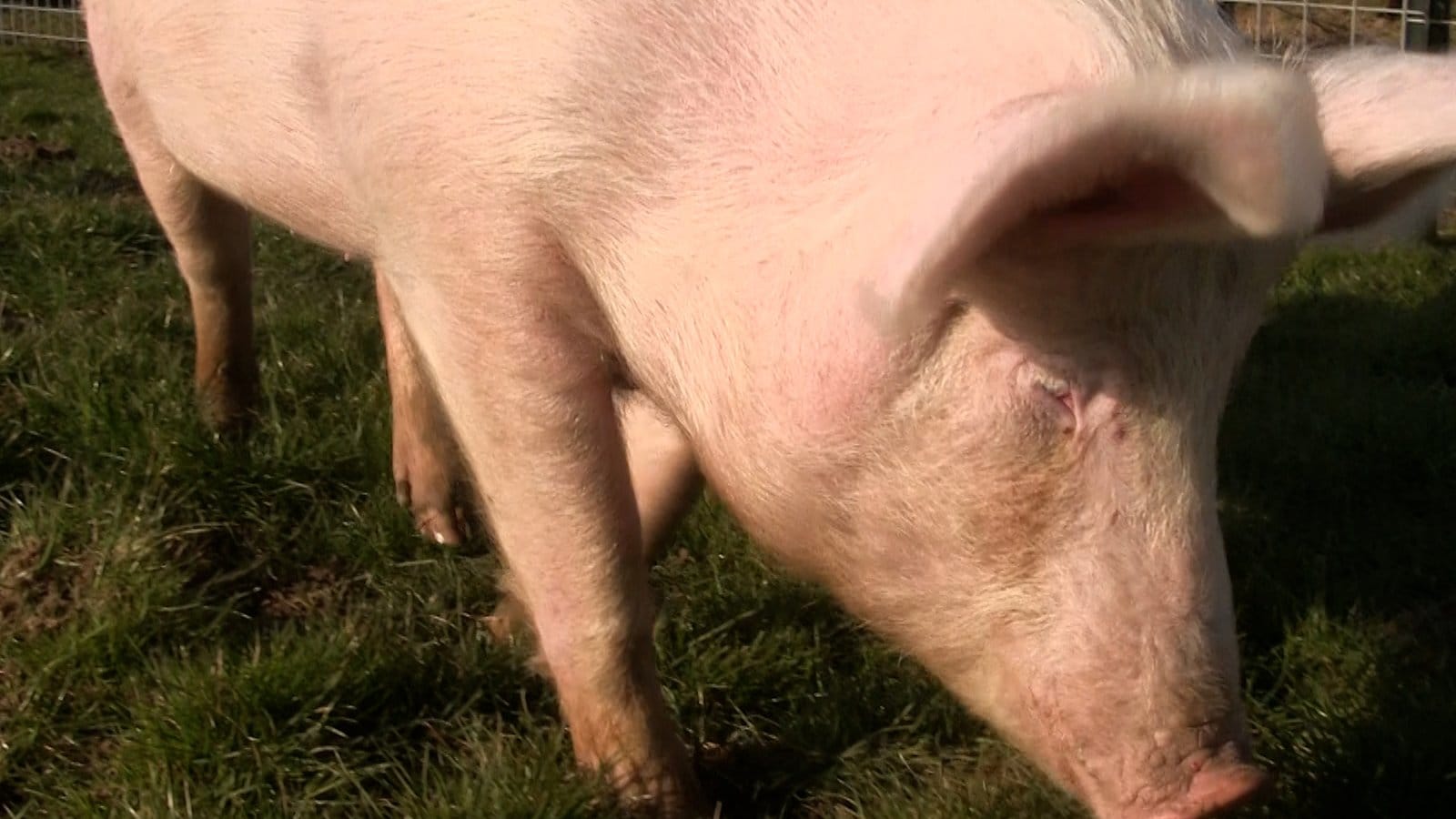
Pigs in the large stable of Ten Have-Mellema
A team from Ongehoord conducted an extensive investigation into the living conditions of pigs at Annechien ten Have-Mellema's farm. Over one year, from August 2020 to September 2021, investigators visited the barns multiple times. During each visit, they filmed stressed, injured, and dead animals.
Mega stable
The ten Have-Mellema pig farm houses 600 sows, 4,900 finishing pigs, and a rearing barn for 2,680 weaned piglets, which are between 4 to 10 weeks old. Based on the criteria of the Beter Leven welfare certification, ten Have's farm qualifies as a mega farm:
A mega-farm is defined as a single UBN (or EU registration number) with 330 or more NGE. To calculate the number of NGE on the farm, multiply the number of pigs based on the Beter Leven farm capacity by the following NGE values for each animal category: 1 sow = 0.2606 NGE and 1 finishing pig = 0.0437 NGE. [4]Ten Have's farm has 370.76 NGE, calculated as (600 × 0.2606 NGE + 4,900 × 0.0437 NGE). In principle, mega farms are not allowed to receive the Beter Leven welfare certification.
The total number of 8,180 animals is distributed across various sections. The breeding barn has 52 cages for artificially inseminating mother pigs. The maternity ward features 80 free-range farrowing crates (2 Beter Leven stars) and 60 traditional farrowing cages. [5] [6] [7] The Hamletz promotional website claims that the sows are not confined when they give birth. Consumers are unaware that the same company also utilizes farrowing crates where mother pigs are trapped between bars.
There are 2,680 spaces for piglets that have just been separated from their mothers. The "farms" for fattening Hamletz finishers consist of 80 group pens, each housing 62 animals. In the Beter Leven commercial, we learn that Ten Have-Mellema picks apples or pears from her garden every day to feed the pigs. [8] Given the 4,900 pigs in the "farms" barns, this claim seems unlikely.
The training ground for future breeding sometimes
Because the living conditions of sows in the industry conflict with their natural needs, young female pigs must learn to adapt to the production process. Ten Have has transformed an old insemination room into a training area. Before the animals are inseminated for the first time, they stay in this training area. They must learn to eat at an automatic feeding station and become accustomed to being confined in a cage. Their social behavior must also be adjusted to fit the farm's operations. Later in life, they will spend significant time in the sow group pen, where there is a constant flow of animals. A changing group composition is unnatural for pigs and leads to stress and fighting. Therefore, efforts are being made to help the animals adapt to changing groups in the training area. Additionally, they must also get used to actions performed by people, such as moving between different departments, being weighed, and being inseminated. [9] In Ten Have's training area, the research team filmed pigs confined between bars, while other animals roamed freely. The animals in the free-range area slept on a concrete floor with slats; there was no bedding provided. Three pigs with open skin wounds were kept in separate cages, also without bedding. The light in the training stable was on at night, which violates the regulations of the Beter Leven quality mark. [10]
The stud farm: artificial insemination
In stud houses, mother pigs undergo artificial insemination. A long pipette filled with semen is inserted into the animal. Within the stud house, pigs are kept in an insemination crate, a steel cage that restricts their ability to turn or move. Social interaction and grooming are not feasible in the breeding pen. Because of the limited space, the pigs frequently rub against the bars, which can result in injuries. [11]
Mother pigs are brought to the stud house two to three times a year. As soon as the farmer separates a mother from her previous litter of piglets, she is taken to the stud house for another insemination. It takes four to seven days for her to come into heat and be inseminated. After insemination, the animal stays in the stud house for an additional four days. Then, she is moved to a sow house, where group housing is legally required. One week before the due date, sows may be relocated to individual pens or cages. [12] [13]
In the ten Have breeding pen, the research team recorded two long rows of insemination cages where mother pigs are confined. They remain in place for days, facing a wall; the cages are too small for them to turn around. The animals stand and lie in their own waste on a concrete surface without bedding. The only enrichment in the cages is a PVC roll wrapped around a bar. According to researchers at Wageningen University, this type of 'enrichment' is inadequate to provide sows with sufficient distraction. [14] In the images, we observe bar biting and foaming at the mouth, which are signs of stress and hunger. [15] In one cage, a pig lay with a bloody wound on its leg.
During two visits in September 2021, the investigation team observed that the light in the breeding pen was on at night.
The group stable for pregnant mother animals
Pregnant mother pigs are kept in legally required group housing between inseminations and births. Their pregnancy lasts about 3.7 months.
The investigation team's images highlight a small area on the right side of the group barn where a group of pigs sleeps on a layer of straw. In the larger section of the barn, where most of the animals are located, only a thin layer of soiled straw covers the floor. Many mother pigs have no space left in the bedding area and end up sleeping on the slatted floor, where they defecate and urinate. The sow barn connects to an outdoor run with a concrete surface.
Smooth floors and partial or complete concrete slats are recognized as risk factors for the development of claw problems in pigs. Using straw can mitigate these risks, as long as it is maintained clean and dry. Damp or dirty straw can soften the hooves, thereby increasing the likelihood of hoof damage. [16]
The ten Have sow barn is equipped with automatic feeding stations. In the pig industry, mother pigs are given limited feed because overfeeding can result in fewer piglets. [17] Feeding stations help pig farmers provide their animals with the right amount of food. A computer calculates the daily feed allocation for each pig. When a hungry pig approaches the feeding station, an electronic identification system recognizes it, and a specific amount of feed is automatically dispensed into the trough. If an animal has no “feed balance” remaining according to the computer, the trough stays empty. [18]
The investigation team filmed a sow foaming at the mouth and chewing involuntarily. This behavior indicates hunger and stress.
During each visit by the investigation team from 2020 to 2021, the lights in the sow pen were on at night.
The maternity ward: trapped mothers and dead piglets
In the farrowing unit at Ten Have, sows and piglets were filmed in two types of farrowing pens: free-range farrowing pens and conventional farrowing cages. In the conventional cages, sows are sometimes confined between bars for a month. Under the Hamletz concept (with 2 Beter Leven stars), mothers are only allowed to be kept in free-range farrowing crates. Piglets from conventional farrowing crates are rated as 1 Beter Leven star. [19]
The dimensions of a free-range farrowing pen are 2.10 m × 3 m, which doesn't give a sow enough space to "walk around freely." A jute sack serves as nesting material in the pen. Sometimes, the farrowing sow cannot go outside and stays in the pen for the entire farrowing and suckling period.
A significant welfare issue in free-range farrowing crates is that more piglets are accidentally crushed by their mothers. In conventional farrowing crates, this risk is reduced because the mother is securely wedged in. [20] This is why further research is being conducted at Ten Have, where 'free-range farrowing sows' are again temporarily restrained with movable bars for several days. [21] The Beter Leven criteria permit sows to be confined in free-range farrowing pens for a maximum of 5 days. [22]
The issue of crushing stems from the unusually large litter sizes in industrial farming, a consequence of genetic selection in livestock breeding. An industrial sow typically has between 12 and 16 piglets per litter. [23] Unfortunately, this results in low birth weights, and many piglets are born weak. Newborn piglets tend to huddle close to their mother's udder for warmth and nourishment. When the sow moves, the weakest piglets often cannot escape quickly enough and end up being crushed to death (24).
To reduce the risk of crushing, free-range farrowing crates include a "nanny." This nanny is a type of nest box that has a heat lamp. The concept is that piglets will naturally seek the warmth of the nanny after nursing from their mother, keeping them safe from being crushed.
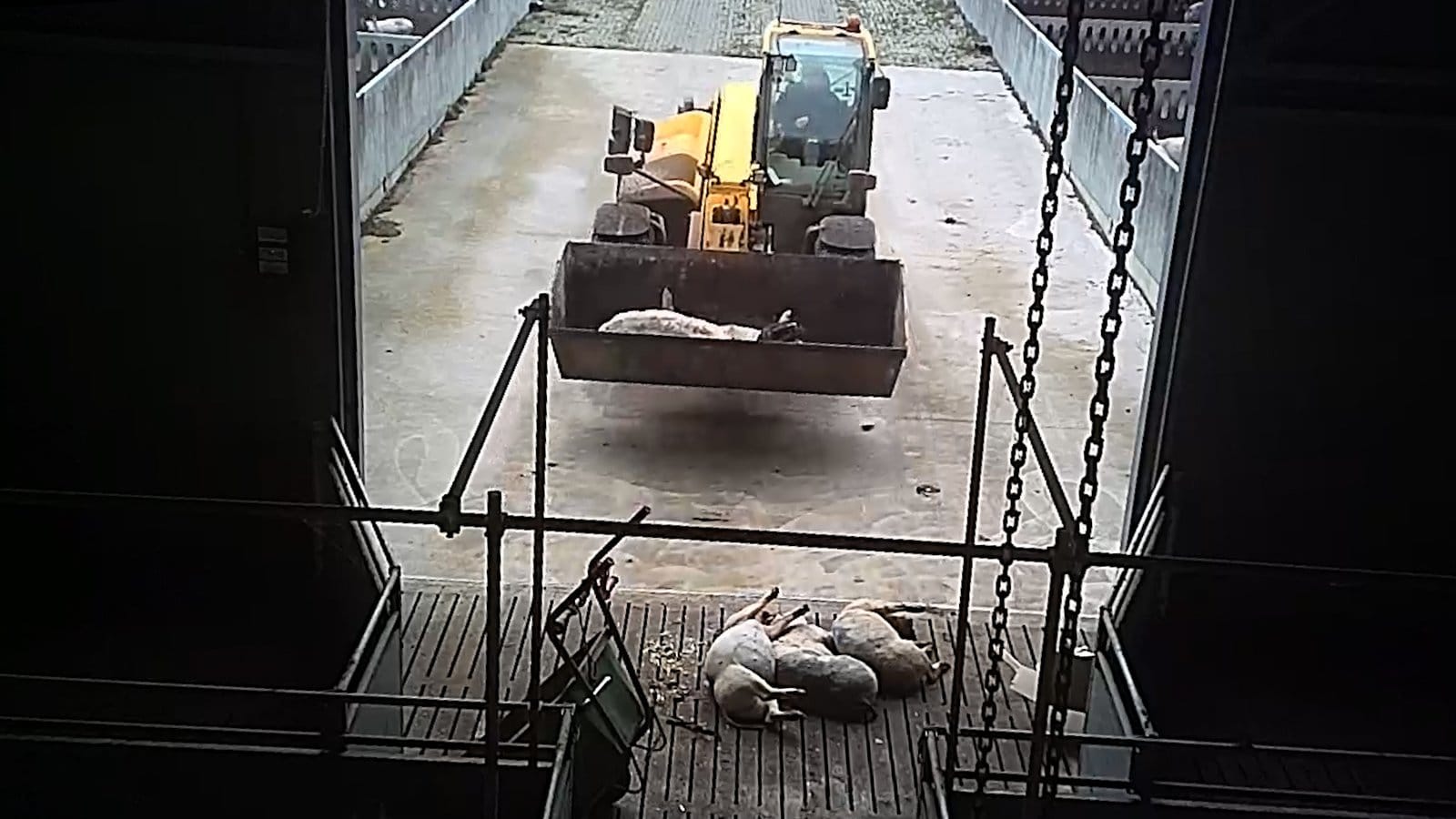
The investigation team filmed many dead piglets at Ten Have, both in the free-range farrowing crates and in the conventional farrowing cages. Some piglets were also found dead in the "nanny" section of a free-range farrowing crate. In both types of crates, pigs were lying in their own feces. One sow had an open wound. Several dead piglets were stacked in the hallway of the farrowing unit.
In "The Journey to Profit from Pig Welfare" (published in the trade journal Pig Progress, August 2020), ten Have explained that she separates the Hamletz piglets from their mothers when they are four weeks old to achieve an annual production of 29 weaned piglets per sow. According to the Beter Leven 2-star criteria, piglets may only be separated from their mothers at the age of 5 weeks. [25]
In a separate section of the barn, the investigation team filmed young piglets in pens on concrete floors with slats and no bedding. The piglets show several health problems, including diarrhea, tumors, and lameness.
The playful stables: meat pigs with leg problems and gnawed tails
The pig pens, where pigs are fattened for slaughter, look different from the Hamletz commercials. The front of the pens has a bare slatted floor for pigs to urinate and defecate. The rear section, similar to the sow pen, contains a soiled layer of straw. Pigs can access an outdoor run with a concrete fence and a concrete surface that has slats for feces.
In the pig pens, Ongehoord filmed pigs with serious tail-biting wounds, a pig with a large tumor on its leg, pigs that appeared to be dying, and several dead pigs of different sizes. One of the carcasses was notably swollen, suggesting that the animal had been dead for several days.
Tail-biting is a frequent behavioral issue in pigs. This biting behavior is primarily driven by boredom, lack of stimulation, and frustration. Sources of frustration in pigs include inadequate barn conditions, overly large group sizes, and issues with feed composition or feeding methods. According to Wageningen University, biting occurs on up to 50% of all pig farms. [26]
Lameness is a frequent issue in pig farming. The main causes of lameness include joint inflammation and meningitis, which are often triggered by streptococcal infections. These pathogens lead to inflammation in the joints, sometimes affecting multiple joints simultaneously. Additionally, lameness can result from osteochondrosis, a joint disease that arises from selectively breeding pigs for faster growth rates. The cartilage struggles to keep pace with the pig's rapid growth, leading to joint defects. These painful movement disorders result in abnormal walking patterns or may even prevent the animal from standing upright. [27] [28]
Violations of the Beter Leven quality mark
A few days after Ongehoord recorded the abuses in the playful barns, Ten Have received an unexpected inspection visit from the Beter Leven Foundation. Ten Have published a blog on her Hamletz website regarding the Beter Leven audit, where she highlighted that “animal health is also a crucial aspect of the quality mark.” [29]
The Dutch Society for the Protection of Animals (Dierenbescherming) maintains strict confidentiality regarding the inspection results of Beter Leven companies. No public information has been disclosed about any sanctions or measures taken. As a result, consumers cannot be assured that the products they purchase truly comply with all Beter Leven requirements. Ongehoord's investigation into Ten Have's company uncovers several violations of the Beter Leven quality mark regulations, earning it two stars. [30]
1. Mega stable
According to the Dutch Society for the Protection of Animals (Dierenbescherming), individual animal care receives less attention in mega-farms, putting more animals at risk in situations such as fires, ventilation failures, or disease outbreaks. Research also indicated that supporters of the Animal Protection Association have a strong aversion to mega-stables. [31] As a result, the Dutch Society for the Protection of Animals (Dierenbescherming) has prohibited mega-farms from receiving its quality mark. An exception is allowed for mega-farms that were certified prior to 2012: they may keep their current number of animals. This number may not be increased further during subsequent renovations and new construction. [32]
The transformation of ten Have's pig farm into a mega-barn occurred after 2012. In 2014, a new sow barn was added, raising the number of pigs on the farm from 300 to 600. In 2018, fattening barns for meat pigs were constructed, boosting the number of meat pigs from 1,720 to 4,900. [33]
2. No day and night rhythm
The criteria for two Beter Leven welfare certification stars require that all pigs have a clear day and night rhythm. This means they must receive at least 8 hours of uninterrupted darkness and at least 8 hours of uninterrupted light, which should come from daylight in the barn. The 8-hour light period cannot occur between sunset and sunrise.
The footage from Ongehoord shows that lights are on at night in multiple areas of the farm.
3. No litter
According to the criteria, all pens must be "at least half-covered with straw or a similar material, so that the floor is completely covered." In theory, if this requirement is not met, it can lead to suspension. However, at ten Have's farm, Ongehoord filmed pigs without straw or other bedding, including in the training area for farrowing sows. The pens for finishing pigs also showed a lack of bedding or insufficient bedding.
4. No straw or soft lying area for farrowing sows
The two-star criteria require that free-range farrowing pens have permanent straw. However, this was not observed. Sows in the farrowing pen also need a closed and soft lying area. In ten Have's free-range farrowing pens, some sows were lying on a hard concrete floor with slats.
5. Piglets weaned too early
In the trade journal "Pig Progress," ten Have mentioned that Hamletz piglets are separated from their mothers at 4 weeks old. However, the two-star Beter Leven welfare certification guidelines state that piglets should not be weaned until they are at least 5 weeks old.
Sources
- 4
Alterra, Mega-Stables in Focus, 2017 - edepot.wur.nl/41420
- 5
Animal-friendly dart stables ready for use. Farm, July 2018. boerderij.nl/diervriendel...tallen-klaar-voor-gebruik
- 6
The journey to make money from pig welfare. Pig Progress, August 2020. pigprogress.net/World-of-...from-pig-welfare-615075E/
- 7
Hamletz: Animal Welfare. hamletz.nl/dierenwelzijn/
- 8
Beter Leven, two-star pig farm. A promotional video from the Dutch Society for the Protection of Animals (Dierenbescherming). you.tube.com/watch?v=AXvAKcvKzmQ
- 9
Handbook for rearing sows. Wageningen UR Livestock Research, 2014. edepot.wur.nl/328107
- 10
Beter Leven quality mark, criteria for pigs. beterleven.dierenbescherm...en/veehouderijen/varkens/
- 11
Discomfort in cattle, pigs, poultry, mink, and horses. Wageningen UR Livestock Research, 2011. edepot.wur.nl/190225
- 12
Fertility in sows. Van Gansbeke, 2011: p. 11 varkensloket.be/Portals/6...htbaarheid_bij_zeugen.pdf
- 13
Rules for pig farmers. NVWA . nvwa.nl/onderwerpen/varke...le-op-een-varkenshouderij
- 14
Discomfort in cattle, pigs, poultry, mink, and horses. Wageningen UR Livestock Research, 2011: p. 15 edepot.wur.nl/190225
- 15
Party for the Animals (PvdD) initiative proposal, 2019. partijvoordedieren.nl/upl...tel-b1-huidigestavaza.pdf
- 16
Preventing claw problems in sows housed in groups. L. Pluym, 2013.
- 17
Discomfort in cattle, pigs, poultry, mink, and horses. Wageningen UR Livestock Research, 2011: p. 18. edepot.wur.nl/190225
- 18
Feeding stations at EuroTier 2010. youtube.com/watch?v=F7Ic1Lhru94
- 19
The journey to make money from pig welfare. Pig Progress, August 2020. pigprogress.net/World-of-...from-pig-welfare-615075E/
- 20
25 percent piglet mortality in free-range farrowing crates without sow restraints. Pig Business, April 2019. pigbusiness.nl/artikel/19...zonder-vastzetten-zeugen/
- 21
Experiments with farrowing crates for sows. Farm, May 2021. boerderij.nl/experimenten-met-kraamhokken-zeugen
- 22
Beter Leven quality mark, criteria for pigs. beterleven.dierenbescherm...2.1-ZW-dd.-01.01.2018.pdf
- 23
Not all piglets grow to maturity. How much mortality is acceptable? Pig Farm, January 2019. varkensbedrijf.nl/fokkeri...eel-uitval-is-acceptabel/
- 25
The journey to make money from pig welfare. Pig Progress, August 2020. pigprogress.net/World-of-...from-pig-welfare-615075E/
- 26
Preventing tail biting in pigs. Wageningen University Research. wur.nl/nl/show/Staartbijt...voorkomen-bij-varkens.htm
- 27
Lame pigs: infection or something else? Pig, 2016. edepot.wur.nl/402860
- 28
Osteochondrosis deserves attention. Pig Business, 2016. edepot.wur.nl/370234
- 29
The Controller – A Chat with Farmer Annechien, September 2021. hamletz.nl/de-controleur/...hVs6hmZLTKsIarbPBKU5qG0go
- 30
Beter Leven quality mark, criteria for pigs.
- 31
Beter Leven Quality Mark. Comments on draft criteria for dairy cattle (3 stars): p. 2.
- 32
Beter Leven quality mark, criteria for pigs. beterleven.dierenbescherm...en/veehouderijen/varkens/
- 33
Spatial justification Ten Have-Mellema Beerta. t_NL.IMRO.1895.01OV0002-0301.pdf (ruimtelijkeplannen.nl)