Chickens are being slaughtered without stunning, drowning in soapy water, or crushed by machines. Some live chickens even have their heads torn off. These shocking abuses were documented in inspection reports from the Van der Meer slaughterhouse in Dronryp. The investigation group Ongehoord requested this data because the company holds the Beter Leven quality mark from the Dutch Society for the Protection of Animals (Dierenbescherming). Despite this certification, inspectors from the NVWA repeatedly found cramped and dead chickens in overcrowded transport crates. In their annual reports for 2023 and 2024, the NVWA noted about 120 animal welfare violations involving one or more chickens.
Van der Meer specializes in the slaughter of spent laying hens. After eighteen months in the egg industry, laying hens produce fewer eggs. At this point, they are no longer profitable for farmers and are sent to slaughter. The Frisian chicken slaughterhouse is the only Dutch laying hen slaughterhouse that has the Beter Leven quality mark (1, 2, and 3 stars). Laying hens from well-known brands such as Rondeel and Kipster are processed there. Van der Meer also holds the SKAL and EKO quality marks. The company slaughters 125,000 chickens each week, totaling 6 million animals annually. [1] Serious animal welfare issues have been reported at the slaughterhouse for several years.
2018: WUR research on water bath stunning at Van der Meer
In 2018, WUR examined the effectiveness of water bath stunning at Van der Meer. The results indicated that 0.6% of the chickens tested emerged from the water bath conscious. This translates to 36,000 chickens being slaughtered fully conscious each year. The WUR study involved random samples, where 350 chickens were examined over a period of 3 days under optimal conditions. [2] In practice, Van der Meer slaughters 75,000 chickens over 3 working days, and technical faults can occur that prevent the water bath from functioning properly. [3]
2019: Undercover investigation reveals serious abuses
In 2019, Ongehoord captured undercover footage of Van der Meer. [4] The images revealed chickens stacked in crates for hours in the feed hall, sprayed with water while cleaning transport trolleys, abused while suspended from the slaughter line, had their heads dragged over crates, and chickens that were slaughtered while conscious after failed water bath stunning. Our footage also exposed significant shortcomings in NVWA (Netherlands Food and Consumer Product Safety Authority) oversight. Instead of addressing the abuses, one inspector chose to assist with the work. The ongoing disparity between enforcement by "strict" and "lenient" inspectors in slaughterhouses was highlighted in the 2Solve government report. 'Factual Investigation into the Supervisory Chain and its Shortcomings' (2019). [5]
2021: Demand a Postponement for Beter Leven
In August 2021, Ongehoord reported on an exemption granted to Van der Meer by the Dutch Society for the Protection of Animals (Dierenbescherming). This exemption allowed for the stunning of chickens using an electric water bath. [6] The Dutch Society for the Protection of Animals (Dierenbescherming) had already announced a ban on water bath stunning in 2016. Suspending chickens alive before they are placed in the stunning bath causes significant stress and pain. The ban applies to all animals in the slaughterhouse, regardless of whether they are covered by the quality mark. [7]
Although slaughterhouses were given until 2020 to switch to gas stunning, Ongehoord discovered that Van der Meer was granted an even longer extension. In response to our criticism, the Animal Protection Association stated in 2021 that it was a case of force majeure, as the municipality delayed issuing a permit for the gas installation. [8] That turned out to be false; the permit had already been granted in 2020. [9] The promise by the Dutch Society for the Protection of Animals (Dierenbescherming) that Van der Meer would use gas stunning by January 1, 2022, has now also been proven untrue. The NVWA inspection documents reveal that the company continued using water bath stunning until March 2024. “To save on gas costs,” Van der Meer told the NVWA. [10] Nevertheless, the Dutch Society for the Protection of Animals (Dierenbescherming) found no reason to exclude the company from its quality mark. During the annual Beter Leven inspection in June 2023, Van der Meer's certificate was renewed. It is not surprising that slaughterhouses mislead consumers about 'animal-friendly' meat. However, the active complicity of the Dutch Society for the Protection of Animals (Dierenbescherming) in this matter is unacceptable.
2025: New inspection documents reveal more animal suffering
Ongehoord requested inspection documents from the NVWA covering January 2023 to November 2024. These documents reveal an increase in animal suffering at Van der Meer. Notably, there are ongoing issues with stunning chickens, both in the electric water bath and with stunning gas. Problems also arise during transport and supply. An overview of the most common abuses has been compiled.
Failed stunning during gassing
Since March 2024, chickens at Van der Meer slaughterhouse have been stunned using CO2 gas. Gasification is often marketed as a more humane alternative to a water bath. The animals are transported in crates on a conveyor belt through a gas chamber and are only hung on the slaughter line after being stunned. However, scientific research has demonstrated that inhaling CO2 gas leads to irritation and shortness of breath, even when low concentrations are initially used. [11] Furthermore, NVWA ( Netherlands Food and Consumer Product Safety Authority) documents indicate that the gassing of chickens at Van der Meer is consistently flawed.
During lunch breaks, employees frequently leave crates with live chickens on the conveyor belt of the gas plant. The conveyor belt remains operational, causing the chickens to spend half an hour on a vibrating surface. [12] Even more concerning, many chickens exit the gas plant without being stunned and are slaughtered while still conscious.
In the NVWA annual reports covering the period from March 6, 2024 (the date of the gas switchover) to November 6, 2024, we identified at least 12 comments regarding chickens that were not stunned by the gas. At times, it referred to 1 chicken, at other times to 3 or 4, and occasionally the NVWA mentioned 'several chickens' or 'many chickens'. [13]
Heads torn off alive
Workers must euthanize chickens that exhibit signs of consciousness after gassing by breaking their necks. This method is legal, provided it is performed according to guidelines: removing the chicken from the slaughter line, holding its legs with one hand, and breaking the neck with the other. [14]
NVWA inspectors discovered that workers are killing unstunned chickens by pulling on their necks while the birds are still hanging on the slaughter line. Their heads are frequently pulled away from their bodies. [15] During an inspection in August 2024, an inspector observed that 'in just two minutes, the necks of five hanging chickens were broken, and the heads of two chickens were torn off.' [16]
Since the law permits each worker to process a maximum of 70 chickens per day, Van der Meer returns to his previous stunning method when there are significant issues with the gas installation: the electric water bath. [17]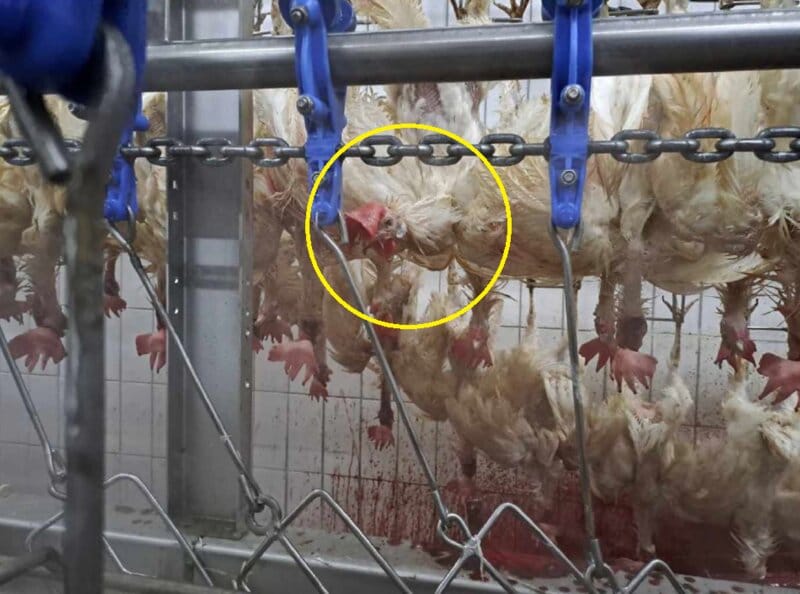
Stress, Pain, and Death by Drowning in the Electric Water Bath
Before March 2024, Van der Meer used water bath stunning as the standard method. After that, the facility still used the bath multiple times to stun chickens during malfunctions in the gas installation.
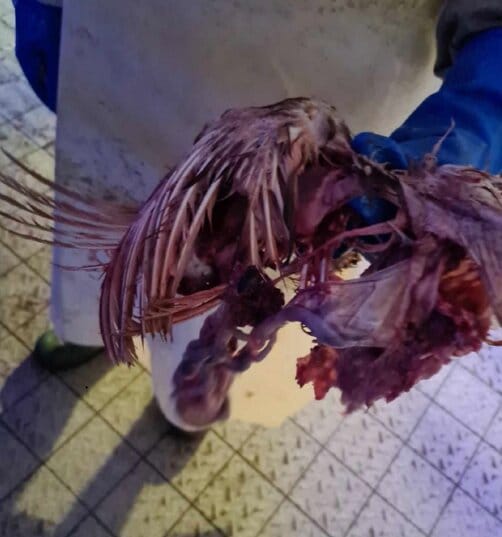
The NVWA discovered that chickens were often hung alive before entering the water bath, dragging their heads along the crates. [18] After the chickens are manually hung onto the slaughter line, a machine pushes their legs deeper into the hooks. An inspector noted that the chickens reacted with loud vocalizations; they tensed their legs and flapped their wings. [19] Such stress and pain responses seem to happen regularly. [20] One chicken was also found that had ended up under this “leg presser.” The animal was literally torn apart by the machine. [21] One morning, the electric water bath had not yet been turned on while the slaughter line was already operating and workers were hanging chickens. Many chickens ended up in the bath (at that moment without power), meaning they were not stunned but drowned alive or were cut while still conscious. [22]
Failed Water Bath Stunning
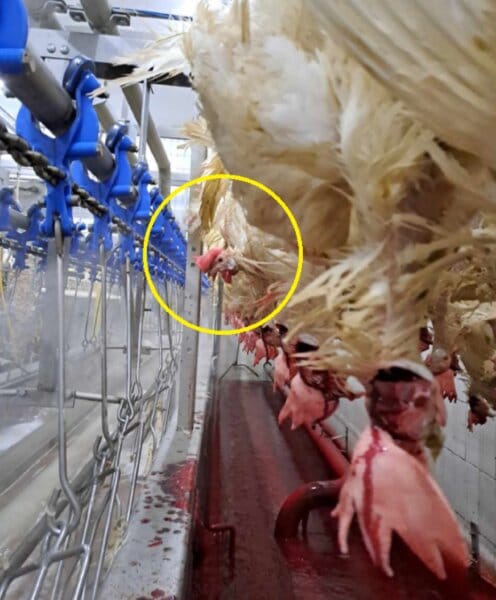
In the annual reports of the NVWA, we noted up to 25 instances of chickens remaining conscious after electrocution in the water bath. [23] Unstunned chickens exhibited reactions when their arteries were cut or flapped their wings while suspended above the blood trough. The NVWA also observed chickens lifting their heads to evade the cutting blades. Chickens that are not cut end up conscious in a hot scalding bath. During an inspection in March 2023, an inspector witnessed as many as 12 chickens responding to the cutting. A little further along, 8 chickens were hanging with their wings tightly pressed against their bodies, which also suggests consciousness. [24] In stunned and deceased chickens, the body hangs limp and the wings droop. [25]
Workers did not take any action to help when conscious animals were hanging on the slaughter line. On around ten occasions, inspectors had to remove chickens from the line themselves or stop the line using the emergency button. The animals were on the verge of drowning alive in the scalding bath. [26]
Stunning Problems Are Structural
It is impossible to determine how many chickens each year at Van der Meer are poorly stunned and cut while still conscious, or drown in the scalding bath. NVWA inspectors only perform spot checks on stunning, as they are also required to inspect many other aspects of the slaughter process. During a spot check, an inspector observes the chickens passing along the slaughter line for just a few minutes. The line speed at Van der Meer is 4,500 animals per hour, or 75 per minute. [27] This means the inspector has less than one second to evaluate a chicken’s consciousness. In a report on welfare inspections at Van der Meer, the NVWA states that the animals move by too quickly to be properly assessed. The NVWA references EURCAW (the European Reference Centre for Animal Welfare) in this context. According to EURCAW, animals should be observed for 4 to 5 seconds, which is not feasible at Van der Meer. [28]
Because the NVWA repeatedly observed live chickens during very limited spot checks in 2023 and 2024, it is likely indicative of a structural problem. The NVWA appears to agree with this assessment. During a company meeting in January 2024, the authority expressed concern: "If, during the brief period that the NVWA conducts inspections (which have a small chance of detection), live chickens are already being observed, then it must also be happening at other times." [29]
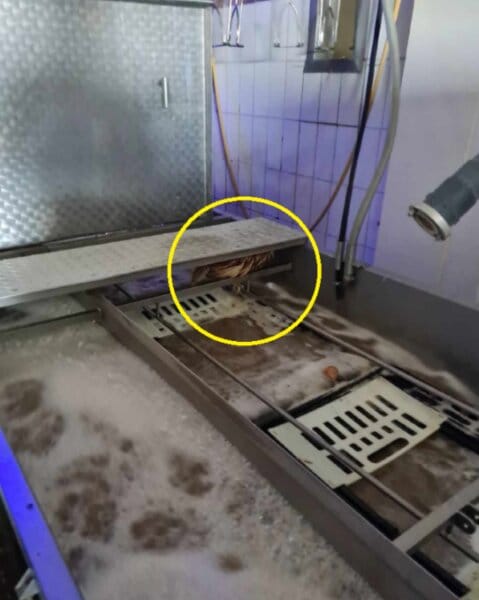
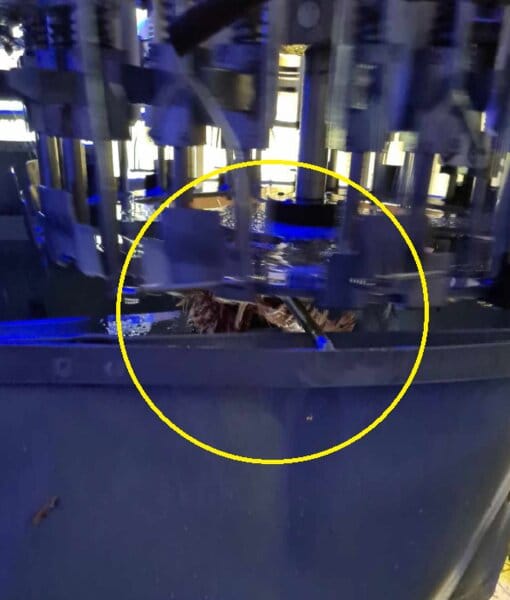
Drowning in the Pre-Soak Tank
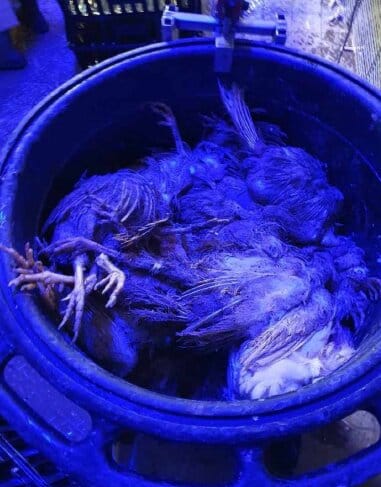
The NVWA has repeatedly observed soaking wet chickens near the pre-soak tank. This tank contains warm water mixed with cleaning agents, where emptied crates are submerged to loosen dirt. Due to worker inattention, some chickens are occasionally left behind in the crates. The crates roll along a conveyor belt into the pre-soak tank, causing the chickens to be submerged in the foamy water along with them. Inspectors discovered wet chickens up to seven times that had managed to escape from the crate and the water. [30] Unfortunately, many chickens are less fortunate and drown unnoticed in the pre-soak tank. This issue was already known at Van der Meer in 2019 when Ongehoord conducted undercover research there. Our undercover worker was warned by regular employees that the NVWA must not see it.
Structural Animal Suffering During Transport and Intake
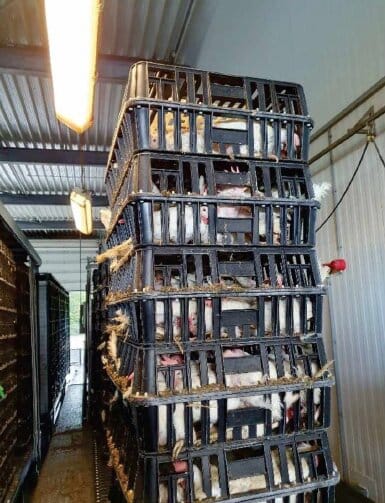
Van der Meer runs its own transport company to collect chickens from poultry farms. The catching and transport of chickens occur the night before slaughter. Full trucks arrive at the company’s intake hall throughout the night. There, the crates with chickens are stacked for hours until it’s time for slaughter. According to a study by WUR, the chickens spend an average of 10 hours in transport crates—2 hours of travel time and 8 hours of waiting time in the intake hall at Van der Meer. [31] This is double the maximum waiting time (upon intake) set by the Beter Leven label. [32]
As a transporter, Van der Meer must ensure that the chickens are loaded properly; as a slaughterhouse, it must protect their welfare upon arrival and while they wait. Van der Meer does neither. We identified 56 comments in the NVWA annual reports regarding welfare violations during the transport and intake of chickens. [33]
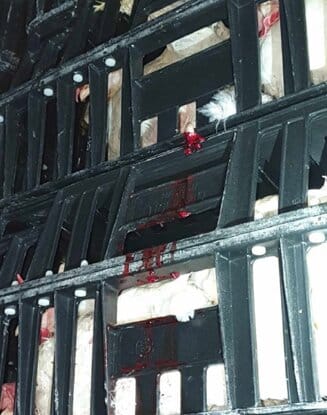
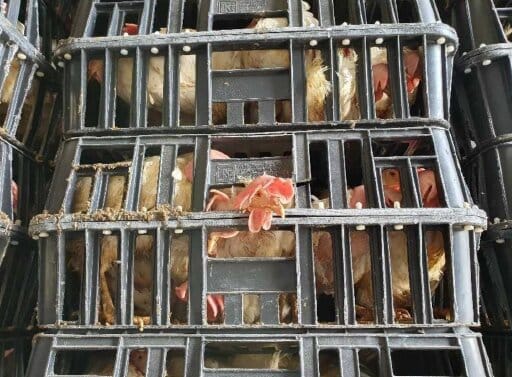
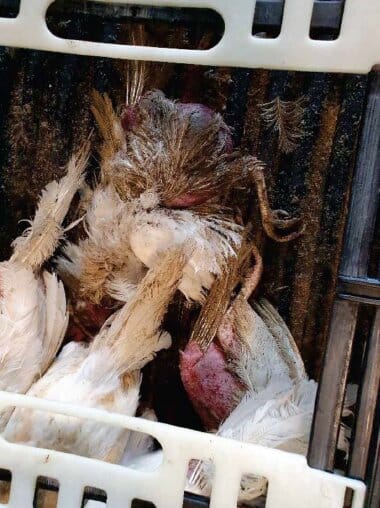
The NVWA regularly observed overloaded crates in the intake hall, where chickens were literally piled on top of one another, gasping for air. Animals suffering from heat stress or cold stress were noted. Some chickens were left in crates for over 12 hours without access to water or feed. Inspectors discovered nine instances where chickens had their toes trapped between crates for hours, sometimes resulting in bleeding. [34] Dead chickens were often found in the crates. Inspectors frequently encountered loose chickens that had escaped from broken or poorly secured crates. The animals then had to be recaptured, which caused additional stress. Loose chickens were at risk of injuring themselves or dying accidentally. For instance, two chickens were crushed between containers, with one nearly dying. [35]
Stacks of crates are unloaded from the trucks and positioned in a destacker—a machine that lifts crates one by one from the stack to arrange them side by side on a conveyor belt. However, issues arise here as well. Inspectors witnessed a stack of crates filled with chickens topple over in the destacker. [36] During a power outage, the destacker halted with a stack of crates inside. The crates were tilted at an angle, leaving the chickens in this unstable position for an hour and a half. [37]
On the conveyor belt from the intake hall to the slaughterhouse, crates filled with chickens clattered harshly against one another, causing stress reactions. [38] Empty trucks are washed with a high-pressure washer next to stacks of full crates, drenching the chickens as well. [39] This issue was also evident in the 2019 undercover investigation.
Humane Slaughter Does Not Exist
Ongehoord’s investigation reveals that “humane slaughter” is a contradiction. The abuses uncovered in 2019 are still unresolved in 2025. Overloaded crates, failed stunnings, and drowned chickens continue to happen daily at Van der Meer. In a facility where 4,500 animals are killed every hour, severe animal suffering is unavoidable. Even small error rates lead to widespread suffering. The issue isn’t that slaughterhouses refuse to follow the rules; it’s that technical problems and human errors happen in every workplace. To eliminate animal suffering, we must begin by closing slaughterhouses.
1 location
Sources
- 1
- 2
- 3
Open Government - NVWA Annual Reports - pp. 515 to 787, NVWA annual reports
- 4
- 5
- 6
Ongehoord - Beter Leven Research - Chicken slaughterer W. van der Meer: years of delay in complying with criteria
- 7
- 8
- 9
- 10
Open Government - NVWA Annual Reports - p. 676 (gas switch date) and p. 162 (gas costs)
- 11
- 12
- 13
Open Government - NVWA Annual Reports - pp. 676 to 787, annual overviews
- 14
- 15
- 16
- 17
- 18
- 19
- 20
- 21
- 22
- 23
Open Government - NVWA Annual Reports - pp. 515 to 787, annual overviews
- 24
- 25
- 26
Open Government - NVWA Annual Reports - pp. 515 to 787, annual overviews
- 27
- 28
Open Government - NVWA Annual Reports - p. 33 and p. 79
- 29
- 30
Open Government - NVWA Annual Reports - pp. 515 to 787, annual overviews
- 31
- 32
Animal Protection - Beter Leven criteria for poultry slaughterhouses - Poultry slaughterhouse, waiting period, criterion S15.5
- 33
Open Government - NVWA Annual Reports - p. 515 to p. 787, annual overviews
- 34
- 35
- 36
- 37
- 38
- 39