Chapter 2 / 2
The chicken investigation
Ongehoord has spent a year investigating the living conditions of animals in Caring Farmers' poultry farms. They have already released images of sick and injured pigs. Now, Ongehoord reveals images of crippled and dead chickens in these poultry farms.
The lives of production chickens, both in the egg and meat industries, are vastly different from those of natural chickens. Laying hens and broilers are artificially hatched in hatcheries and grow up without their mothers. This situation is true across the entire chicken industry, including regular, Beter Leven, and organic farms. In natural settings, chicks spend their first days alongside their mother, where they receive warmth and protection. During the following weeks, the mother teaches the chicks vital behaviors such as foraging, dust bathing, and selecting a safe roosting spot on a tree branch. It is only after eight weeks that the chicks start to forage for food on their own, yet they still stay close to their mother. At 18 weeks of age, they join the rest of the chicken group. [14]
Dead laying hens in Martijn Vonk's run
In Loil, Gelderland, Caring Farmer Martijn Vonk raises 43,000 laying hens in two aviary houses. Vonk transformed a stable into a Beter Leven stable (1 star) to benefit from the higher prices that the quality mark brings for the eggs. [15]
Under natural conditions, chickens have a specific breeding season. In the spring, a hen typically lays around ten eggs, which she incubates. If the first clutch does not hatch, she may lay a second clutch. A hen can lay up to 20 eggs in a year. Like all other birds, chickens do not lay eggs during the autumn and winter periods. [16]
In the egg industry, hens are required to produce eggs throughout the year. To simulate the natural breeding season of spring, lighting schedules are implemented in laying hen houses. An industrial hen can produce over 300 eggs each year. This intense egg production results in calcium deficiencies in laying hens, as all the calcium in their bodies is utilized to create eggshells. However, calcium is also essential for bone development. Consequently, laying hens in the egg industry often experience weak and brittle bones. Research by Heerkens indicated that 97% of hens in aviary houses have experienced chest fractures by the time they reach 14 months of age. [17]
In Vonk's aviary, the hens' habitat features layers of metal slats and a concrete floor covered with litter. According to the Beter Leven criteria, the barn occupancy rate is 9 hens per square meter, which meets the legally required minimum standard. [18]
Under natural conditions, chickens prefer habitats rich in trees and vegetation where they can find shelter and rest. Researchers have discovered that the territories of groups of free-range, feral chickens can be as large as half a hectare. Natural chicken groups typically consist of 4 to 30 individuals, including roosters, hens, and chicks. To establish and maintain a hierarchy within the group, it is crucial for the chickens to recognize one another. Chickens can individually identify up to about 100 of their own kind. Introducing new animals into a group disrupts the pecking order, necessitating a redefinition through conflicts. [19]
At Vonk's farm, Ongehoord filmed numerous weak, sick, and dead animals. Many hens had bald patches from feather pecking, a behavioral disorder common across the entire laying hen industry (including regular, concept, and organic hens). Feather pecking inflicts pain, injury, and can lead to the death of the animals. [20]
A covered run has been added to the Beter Leven barn. This run features a concrete floor, a roof, and mesh walls, but it lacks plants or trees. The wall separating the barn from the run has openings that allow hens to move between the two areas. These openings have hatches that open in the morning and close in the evening. At Vonk, the investigation team discovered dead hens that had been trapped while the hatches were closing. The hens had gotten their heads caught under a hatch, which caused their deaths. Since the investigation team found multiple dead birds under different hatches, it’s likely that these "accidents" happen daily.
Lame broiler chickens at Johan Leenders
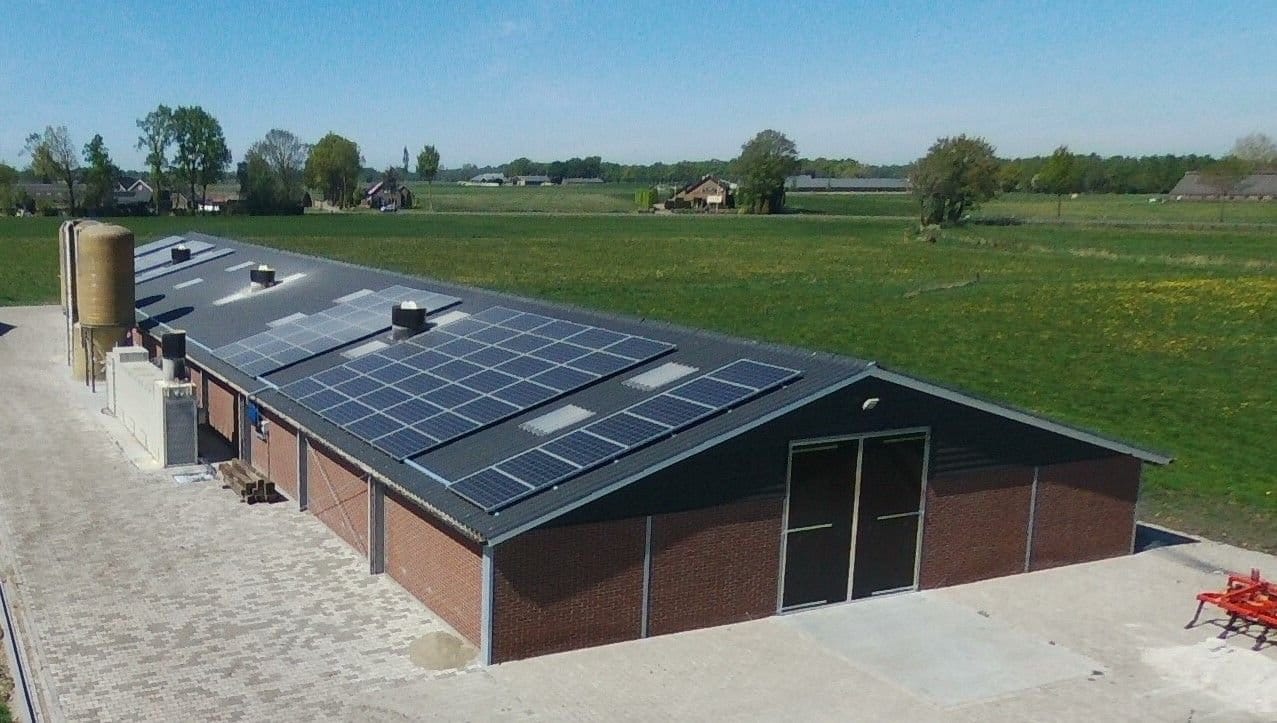
Caring farmer Johan Leenders operates two broiler barns in Swifterbant (Flevoland) that have earned one Beter Leven star from the Dutch Society for the Protection of Animals (Dierenbescherming). The chicks are unable to roam outdoors and spend their lives on a concrete floor covered with a layer of litter. During the day, natural light enters the barn through skylights, and the birds have access to a covered run. This run also features a concrete floor with litter. The outer wall of the run is constructed from mesh. The Beter Leven quality mark specifies that a barn may accommodate 12 chicks per square meter. Leenders can house 17,500 chicks in each barn. Beter Leven Keeping Chicks. [21]
Leenders works with "slow-growing" broiler breeds, which is necessary to obtain the Beter Leven quality mark. Slow-growing chicks reach slaughter weight in eight weeks, while regular chicks do so in six weeks. According to the Animal Health Service, several factors associated with the 1-star Beter Leven quality mark heighten the risk of introducing pathogens, such as salmonella and avian influenza. Marek's disease, a serious viral illness characterized by tumors affecting the nervous system and organs, is more common in Beter Leven chicks than in fast-growing chicks. Due to the draft in the barn that enters through the run, star chicks are also more susceptible to respiratory diseases. [22]
Depending on sales, the second barn is also used to fatten Orange hens. The "Orange hen" is a chicken concept created by Leenders in partnership with Esbro slaughterhouse and animal feed giant ForFarmers. Orange hen meat is sold under the Beter Leven label, which is a 1-star quality mark.
A chicken breed with colored plumage is used for the production of Orange hen meat, unlike "regular" Beter Leven chicks, which primarily have white feathers. The stocking density in the Orange hen barn is 9.2 chicks per square meter, which amounts to 12,000 chicks in the barn. This situation remains unnatural, as natural chicken groups typically consist of 4 to 30 individuals in habitats of up to half a hectare, or 5,000 square meters for 4 to 30 animals. [22] [23] [24] The "improvements" in living space and growth rate do not prevent the chickens at Leenders from experiencing welfare and health issues. In the barn with Beter Leven (Beter Leven) chicks (identified by their white plumage), a chick was filmed with a significant head wound. The plumage of several chicks was soiled with feces from other chicks. In the barn with Orange chickens (colored plumage), several chicks were filmed limping.
According to the criteria of the Beter Leven label, broiler chickens must have a dark period of at least eight consecutive hours. The investigation found that the lights in the barn with Orange chickens were on during the night.
In broiler farming, the birds' sleep-wake rhythm is often controlled by light schedules to promote growth. A recommended schedule for optimal “technical results” includes 4 hours of light, followed by 4 hours of darkness, and then 4 cycles of 3 hours of light and 1 hour of darkness. [26] Research by Schwean-Lardner et al. indicated that broiler chickens need at least 7 to 8 hours of darkness for their welfare. The investigation revealed that chicks exposed to longer light periods were less active. They showed reduced movement and walking, ate less, and were less attentive to grooming their feathers. Chickens that received 23 hours of light completely stopped dust bathing. According to the researchers, these behaviors are crucial for the health and well-being of the animals. [27]
Broiler farming does not allow chickens to fulfill their natural instinct to sleep high up. While laying hen houses still include perches, broiler chickens do not have this option. Selective breeding for larger breast meat has led to broiler breeds that cannot balance on a perch. Chickens naturally prefer to sleep in tree branches, as this makes them feel safe from predators.
Sources
- 14
Natural behavior of laying hens and broiler chickens. Council for Animal Affairs, 2006. rda.nl/publicaties/ziensw...legkippen-en-vleeskuikens
- 15
Conversion to one star due to additional cost. Pluimveeweb, October 2017. pluimveeweb.nl/artikel/16...n-ster-vanwege-meerprijs/
- 16
Natural behavior of laying hens and broiler chickens. Council for Animal Affairs, 2006. rda.nl/publicaties/ziensw...legkippen-en-vleeskuikens
- 17
Sternum injuries occur in 82% of laying hens. Farm, April 2016. boerderij.nl/borstbeenletsel-bij-82-legkippen
- 18
Beter Leven criteria, laying hens. beterleven.dierenbescherm....1-ZW-d.d.-01.09.2016.pdf
- 19
Natural behavior of laying hens and broiler chickens. Council for Animal Affairs, 2006. rda.nl/publicaties/ziensw...legkippen-en-vleeskuikens
- 20
Preventing feather pecking. Wageningen University. wur.nl/nl/Dossiers/dossie...komen-van-verenpikken.htm
- 21
Broiler farming systems. nanopdf.com/download/houd...systemen-vleeskuikens_pdf
- 22
Animal health damage often invisible in ster chicks. Poultry Web, September 2021. pluimveeweb.nl/artikel/41...ichtbaar-bij-sterkuikens/
- 23
Orange hen ready for breakthrough. Poultryweb, December 2019. pluimveeweb.nl/artikel/22...oorbraak-na-vele-hobbels/
- 24
Orange hen: an example of Dutch innovation. Nieuwe Oogst, January 2019. nieuweoogst.nl/nieuws/201...van-nederlandse-innovatie
- 26
Better results for broilers with short dark periods. Poultry Web, April 2014. pluimveeweb.nl/artikel/14...met-korte-donkerperiodes/
- 27
Schwean-Lardner K, Impact of daylength on behavioral output in commercial broilers. Anim Behavior Sci. 2012 sciencedirect.com/science...abs/pii/S0168159112000287
What can you do?
Share this investigation with people around you.