Consumers know Livar above all from its PR location: the Lilbosch abbey in Echt. That is a small-scale breeding farm with some thirty sows and three hundred fattening pigs, in a photogenic setting.[1][2] At this demonstration location the Dutch Society for the Protection of Animals (Dierenbescherming) makes videos to promote three-star Beter Leven pork.[3][4] The actual production of the 'Limburgs Kloostervarken' (Limburg monastery pig) takes place at other locations.
Ongehoord visited Livar's largest production location: the Sint-Antoniushoeve at Hekbergerweg 3 and 7 in Echt. The Sint-Antoniushoeve is owned by Livar director Frank de Rond and comprises a sow farm, where mother pigs give birth to piglets (Hekbergerweg 3), and fattening barns where the piglets are fattened for slaughter (Hekbergerweg 7).[5] On the premises of both number 3 and number 7, next to recent outdoor-run barns – in the typical Livar style – there are still old barn buildings that in no respect meet the requirements of three Beter Leven stars. All barn buildings of the Sint-Antoniushoeve, old and new, at number 3 as well as 7, are registered with the government as one farm location, with one UBN (unique holding number). Under that number the Sint-Antoniushoeve is also listed in the Beter Leven register, with three stars.[6]
Although the Dierenbescherming claims in an advertorial that “tail biting really does not occur at Livar”[7] Ongehoord filmed an outbreak of tail biting in the three-star fattening barn of the Sint-Antoniushoeve, Hekbergerweg 7. Tail biting points to stress and frustration in pigs.
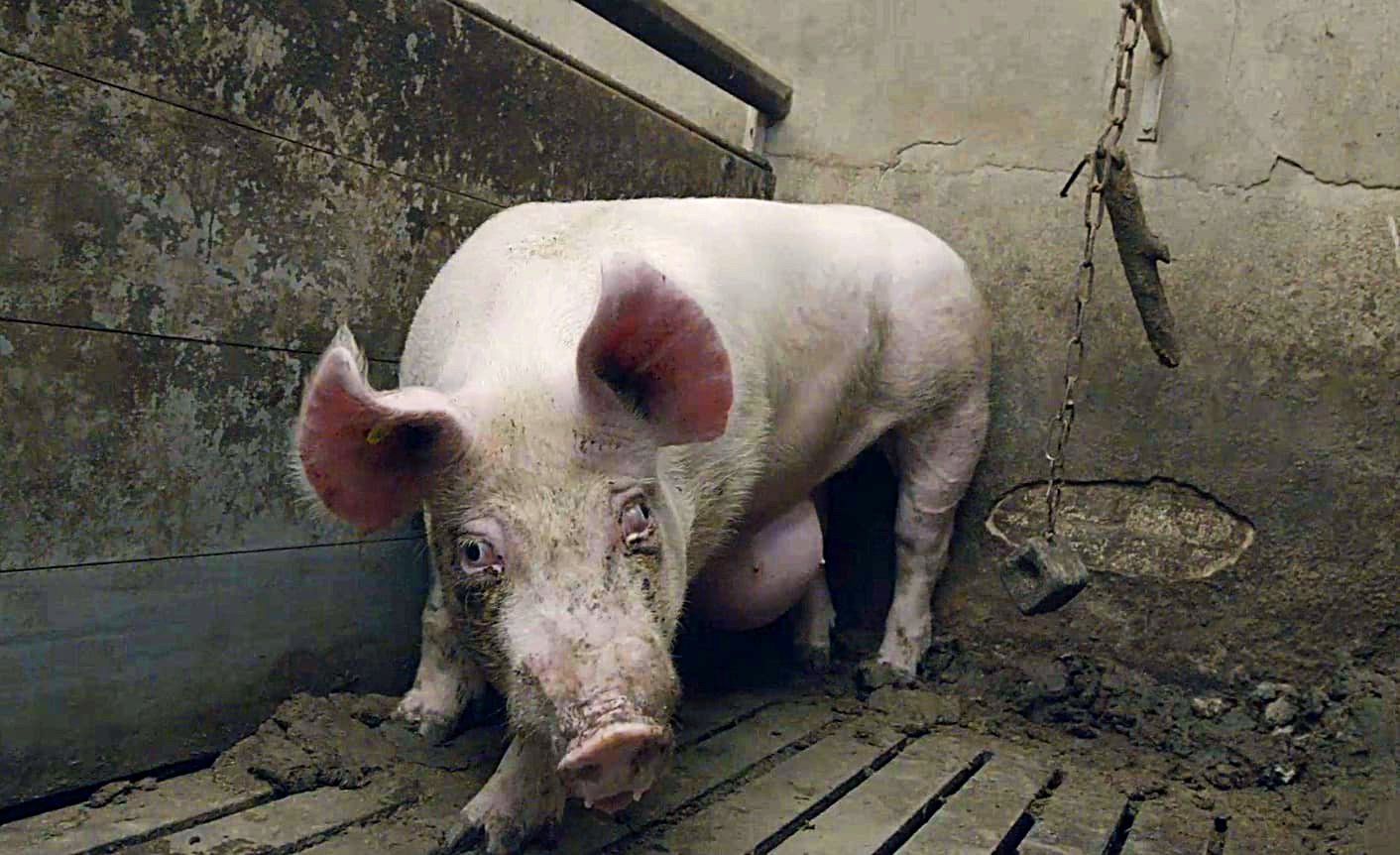
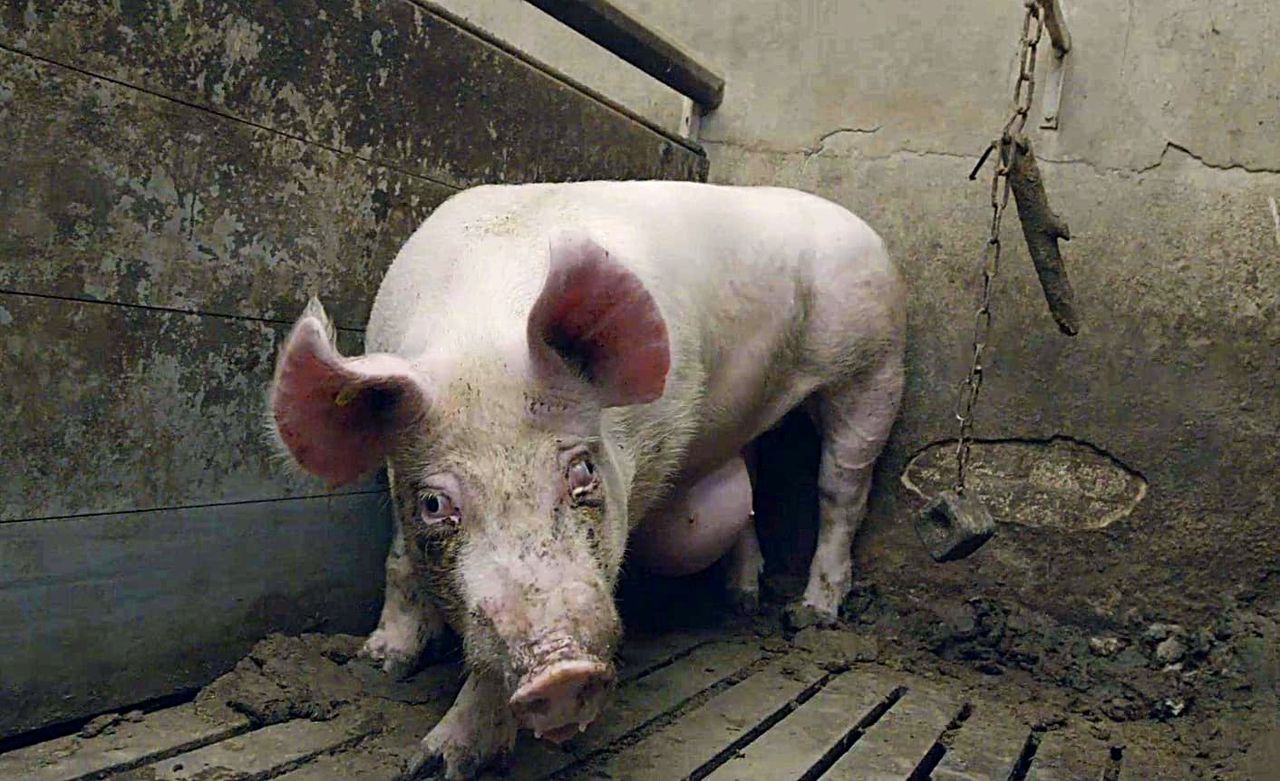
In the old barn buildings next to the three-star barns, fattening pigs also turned out to be present. They were kept in poorly maintained pens, in an unhealthy environment full of dust and cobwebs. The animals had no outdoor run and no straw. The fattening pigs in the three-star outdoor-run barn and those in the old, closed barn alike wore ear tags with the same UBN number, the number under which the Sint-Antoniushoeve is listed in the Beter Leven register as a three-star farm.
At the sow barns a little further along, at Hekbergerweg 3, we saw the same. In the old barn next to the newer outdoor-run barns, sows were kept in the most animal-unfriendly conditions: pinned in farrowing crates, which are prohibited under three stars of the Beter Leven label. Filmed sow cards showed that sows are confined in these crates for as long as 7 to 8 weeks (suckling period + a week before giving birth. For comparison: in an average, conventional breeding farm sows usually spend about four weeks in the crate – because the piglets are weaned sooner). On the ear tags of the crated sows we again saw the same UBN number.
According to the label's requirements, a three-star UBN location may only hold pigs that meet the criteria for three stars.[8] The situation at the Hekbergerweg is clearly in breach of those rules. Moreover, in 2023, when the new sow barns were finished, Livar director Frank de Rond told a very different story in the trade journal Nieuwe Oogst.[9] He explained that the location was in conversion. At Hekbergerweg 3 there were at that time 320 sows kept with three Beter Leven stars, and as many again in pens with one star. In 2024 the fattening barns at no. 7 were to be built. After that, the Sint-Antoniushoeve would only keep animals that meet the requirements for three stars. In March 2025 the fattening barns were finished. Yet during Ongehoord's investigation, in the summer of 2026, there was still no sign of the old section being shut down.
Ongehoord presented the footage to the editors of BOOS (BNNVARA). They went to confront Frank de Rond and the Dierenbescherming. In emails to BOOS, De Rond stated that the Sint-Antoniushoeve has been certified with three stars of the Beter Leven label since early 2022. That is remarkable, because the first newly built barns that met the requirements of three Beter Leven stars (the sow barns, Hekbergerweg 3) were not finished until June 2023.[10] This means that for more than a year De Rond was allowed to supply meat under three stars, coming from animals still kept in farrowing crates and fully enclosed barns. Unsuspecting consumers pay a high premium for the “three-star meat”.
According to De Rond, he receives exemptions from the Dierenbescherming because the farm is ‘in conversion’. That allows him to keep different categories of pigs on the same farm. Until the end of 2024, in addition to pigs under three stars of the label from the newly built barns, he was also allowed to supply pigs under one star from the old barn buildings. Since January 2025, with the introduction of new Beter Leven criteria, he lost the one-star certificate. Instead he received a new exemption to keep breeding animals in the old barns for the ‘conventional’ market. This exemption runs until at least 31 December 2027.
The conversion story of the Sint-Antoniushoeve has thus been dragging on for almost five years, and the end is not yet in sight. The Dierenbescherming stated that the exemption was granted on the basis of ‘relevant plans’ for further conversion. However, it refused to let BOOS see documents that could substantiate these plans. De Rond also refused to show documents. Enquiries with the municipality show that there are currently no applications pending for the construction or renovation of barns on the Hekbergerweg.
Ongehoord is not surprised. After earlier abuses under the label, the Dierenbescherming had Lysias draw up an advisory report. It already raised the problem of long-running exemptions: “it must be prevented that participants receive an exemption lasting years without any urgency to comply quickly”.[11]
BOOS asked the Dierenbescherming how it prevents pigs from the old barns being sold as three-star pigs. The Dierenbescherming replied that correct sales of the different categories are guaranteed. The exemption stipulates that “the conventional and three-star pigs remain recognisably separated. Ear tags in different colours and separate registrations are used for this. Through regular and additional unannounced inspections, the certification body checks how this separation with differently coloured ear tags is carried out on the farm, and whether it matches their registration and the way the animals are kept.”
Ongehoord's footage, however, shows pigs with red and with yellow ear tags in both the new and the old barns. In reality the different colours of ear tags are simply mixed together, in every section.
The Dierenbescherming further states that “the conventional and three-star pigs are delivered (to the slaughterhouse) in separate transports. The accompanying transport documents state whether they are conventional pigs or three-star pigs. The receiving party checks the identification of the delivered animals and the accompanying documents for the stated label status. The certification body checks the application of the procedures for separation and traceability at slaughterhouses and processors.”
During its investigation Ongehoord photographed transport documents. It is true that a load of three-star pigs was transported separately to the Compaxo slaughterhouse. On another transport document, however, it can be seen that De Rond ‘downgraded’ an entire load of three-star pigs to a lower category, namely one Beter Leven star.
Livar's UBN at the Hekbergerweg is not certified to supply pigs with one star. In the case of ‘downgrading’ – converting three-star pigs to the lower one-star category – it is possible after all, as the transport document shows. The document has space for remarks, but nothing has been filled in about the reason for the downgrade. We see that the pigs were not under treatment, apart from a deworming agent. Nor is anything mentioned about, for example, tail damage or other defects that could be grounds for a downgrade.
It is bizarre, to say the least, that De Rond sells expensive three-star pigs without any apparent reason at the lower one-star price. Concept pigs are sometimes downgraded when there is too little demand in the more expensive segment. But that would run counter to De Rond's intentions to expand the Livar chain even further.
It raises questions about the true origin of the ‘downgraded’ pigs. Do they really come from the three-star barn, or could they be conventional animals from the old barns, sold as one star under the guise of “downgraded three-star pigs”? That would still earn De Rond a higher sales price for the animals than the conventional market.
Ongehoord sees no guarantees in the Dierenbescherming's statements. The transport documents, which must state what category of animals is involved, are filled in by pig farmer De Rond himself. At the slaughterhouse, the label status of delivered animals is checked against the Beter Leven register. The slaughterhouse can look in the register to see whether the supplier's UBN is listed and for how many stars the farm is certified.
The Sint-Antoniushoeve has only one UBN number (under which all of its animals are delivered), and is listed with three stars in the register. That is enough for the slaughterhouse to slaughter ‘downgraded’ animals from the three-star farm under the lower category, one star.
Although Livar's own cutting plant and wholesale business is also certified to process both three-star and one-star Beter Leven meat[12], we see on the transport document that the downgraded pigs do not go back to Livar: they are sold on to Compaxo. They therefore disappear into the mass production of one-star Beter Leven meat that Compaxo runs every day, and can no longer be traced in the records of Livar's cutting plant and trading business. Ongehoord does not see how the Dierenbescherming could still verify the precise origin of the ‘downgraded’ pigs taken over by Compaxo.
Whether Frank de Rond really commits fraud with downgrades of supposedly three-star pigs cannot be proven. What has been irrefutably shown with the filmed transport documents is that De Rond ‘downgrades’ pigs from the Sint-Antoniushoeve and sells them as Beter Leven pigs with one star. Under one star, pigs may not be castrated. The Dierenbescherming also explicitly mentions that ban on the consumer pages of the Beter Leven label.[13] Three-star pigs, however, may be castrated. That is permitted because of the ‘boar taint’ of the meat and because of aggression problems among boars in three-star housing.
At the Livar location on the Hekbergerweg all pigs are castrated, both in the three-star barns and in the old, conventional sections. This can be seen in our footage and was also confirmed to BOOS by the Dierenbescherming. Downgrading castrated “three-star pigs” to one star, whether or not they come from the right barns, means in any case that the castration ban for one star is not being complied with. The consumer who buys the meat is being lied to.