Beter Leven ads turn out to be a fable

Pigs

Published on

The animal friendliness of Beter Leven pig farms turns out to be an advertising fable. Pig farmer Loes cuddles piglets for a photo in the Telegraaf, but beats them to death when nobody is watching. Pig farmer Pieter is honoured by the Dutch Society for the Protection of Animals (Dierenbescherming) – on hidden camera footage he abuses his animals with an electric prod. At the three-star company Livar the pigs are, according to the Dierenbescherming, "simply content". Investigation group Ongehoord filmed serious tail biting there: a behavioural disorder that points to stress and frustration in the animals.

Beter Leven is the best-known label for animal products in the Netherlands. The logo of the Dierenbescherming appears on 90% of the fresh pork in the supermarket. What the label means for animals in practice is far less well known. Consumer information about the animals almost always comes from parties with an interest in the label: producers (farmers, slaughterers, processors), sellers (supermarkets), and the Dierenbescherming itself, as owner of the label.

At the end of 2025 a series of articles about the label appeared in the Telegraaf. They turned out to be advertisements paid for by the Dierenbescherming, promotional pieces that look like objective reporting. Investigation group Ongehoord found that the advertising imagery did not match the reality we know from earlier investigations and from the literature. That was Ongehoord's reason to go out and look.

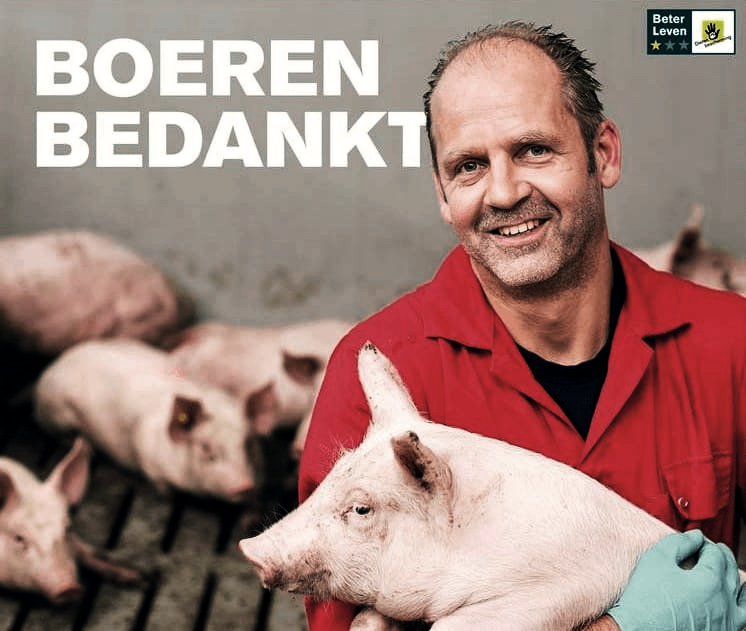
Pig farmer Van de Pas poses for a Beter Leven advertisement in De Telegraaf

To give consumers an objective view of the production of Beter Leven meat, we filmed the living conditions of pigs. We visited five farms that the Dierenbescherming presents as model examples of the label. Because 98% of Beter Leven pig farms fall into the lowest star category, we visited 4 farms with 1 star. In addition we visited a farm with 3 stars, which according to the Dierenbescherming is “the highest attainable rating”.

On its website the Dierenbescherming summarises the core promises of its label: "Animals under the Beter Leven label often have more space, enrichment material and opportunities to express their natural behaviour than animals not kept under the label".

What stands out is that the Dierenbescherming makes much of "natural behaviour" without substantiating it any further. The page lacks almost all the context a consumer would need to compare the living conditions of Beter Leven pigs with natural conditions. That distorts the frame of reference: as long as the comparison is only made with the worst imaginable practice – conventional animal farming – even the most trivial improvements already look positive.

It is very much open to question how far a straw dispenser, a scratching brush and a sliver of daylight in a pen really make a pig's life "better". Ongehoord's investigation shows that the most important aspects of a pig's life under the label are still just as unnatural – and stressful – as in the conventional industry: mothers give birth in farrowing crates, piglets are separated from their mothers, and fattening pigs in a concrete pen can never root in the earth with their snouts.

Where we filmed

5 locations

All locations
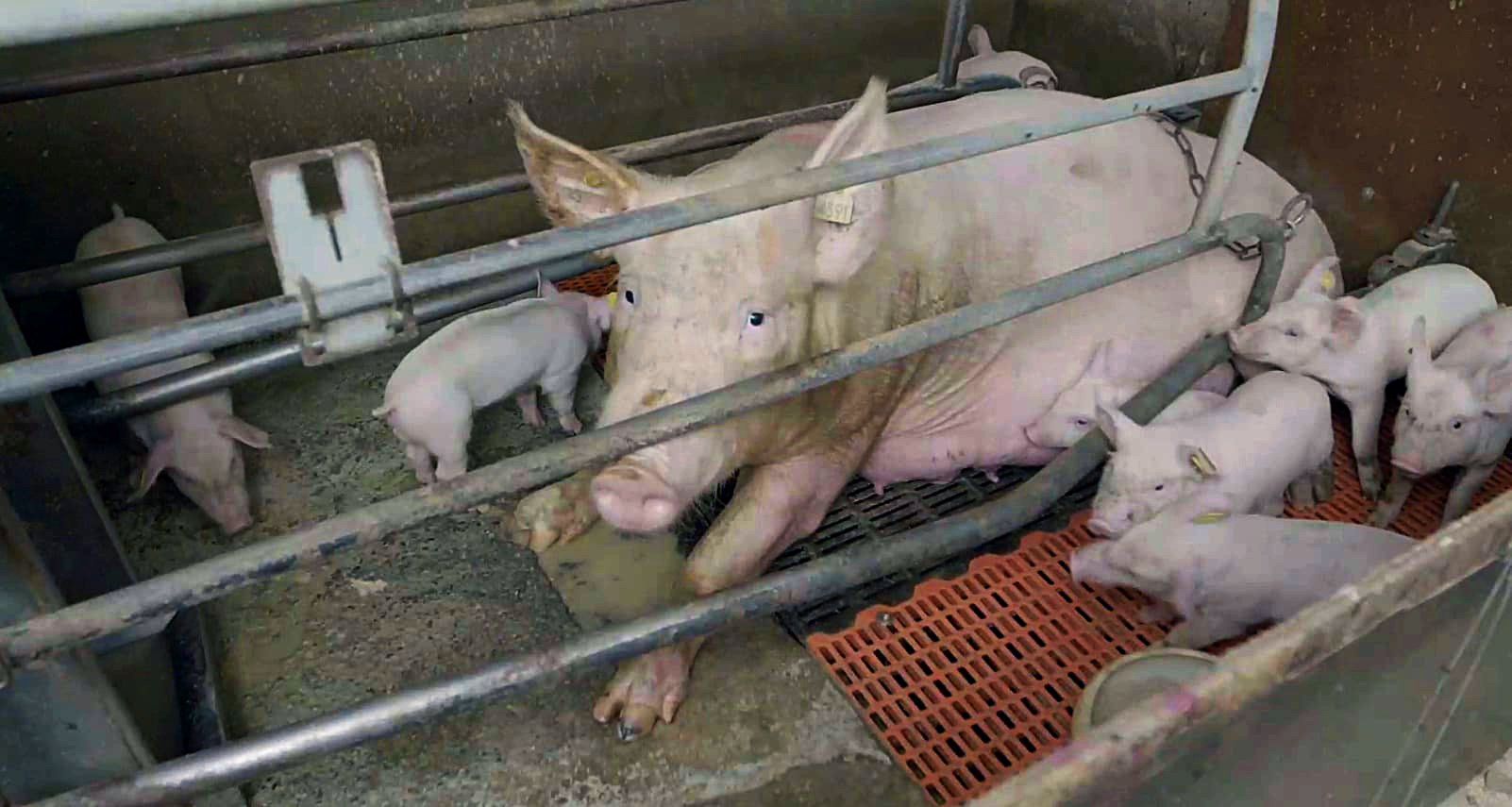
A sow lies in a farrowing crate, surrounded by her piglets.

Footage

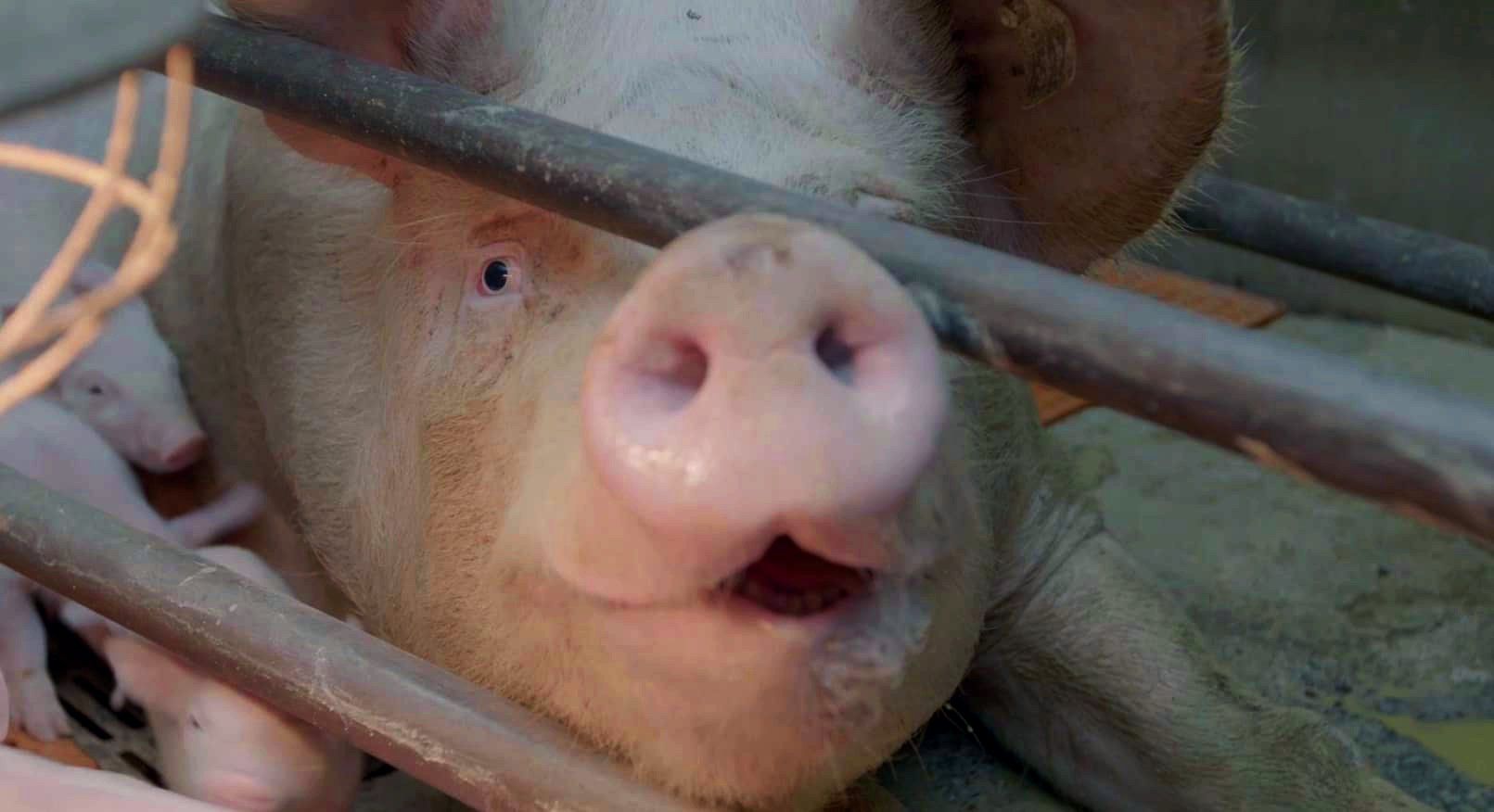
Ongehoord used hidden cameras to film the daily work in the farrowing unit at Loes van de Pas (Fokbedrijf Den Tip, Bergeijk). Mother pigs stand clamped into farrowing crates: a construction of steel bars in which the sow cannot move freely. The animals eat, drink, sleep, give birth and nurse in the crate, and have no opportunity to relieve themselves on a separate dunging area: we see excrement falling onto the heads of piglets.

Around the period of farrowing and nursing, mother pigs are confined in the crate for more than a month without interruption. The footage shows sows bar-biting, behaviour that points to stress and frustration.

The pig farmers handle the animals with little gentleness. A mother pig who cannot move in her crate is prodded in the flank with a stick. Piglets are picked up by their hind legs to be thrown into the treatment crate. Their ears are pierced with an ear-tag pliers, after which they are carelessly thrown back into the farrowing pen. We see that Van de Pas also moves the piglets regularly. She picks up newborn animals by their hind legs, three at a time, and walks through the corridors with them. The piglets hang upside down and swing about wildly.

Weak, undersized and sick piglets are systematically killed by the pig farmers. It was repeatedly filmed how Loes Van de Pas and her employees beat animals to death against a metal gate. The piglets are held by their hind legs and their heads are struck against the gate. This does not always cause death. Piglets that are still alive are taken back out of the waste bin to have their heads struck hard against the gate again.

Pig farmer Van de Pas beats weak piglets to death

At the end of the farrowing period piglets are separated from their mother and moved to the piglet unit. Moving the piglets is anything but calm. With a sorting board and a rattle, and amid loud shouting, the animals are driven to the unit. Trade literature establishes that pigs become stressed by noise and shouting.

When driving pigs, electric prods may not be used and the so-called 'cattle prod' may not even be present on the farm. Yet we see co-owner Joris van Iersel walking around with an electric prod in the pocket of his overalls.

In the farrowing barns of pig farms Kroes (Woubrugge) and Buut’n Gewoon (Rouveen) too, sows stand clamped into farrowing crates, and several animals have pressure sores on their bodies. In the Kroes farrowing barn a screaming piglet is filmed: a mother pig has shifted and a weak piglet could not get away in time. The piglet is crushed under the heavy body of the sow. At all three farms there are dead piglets in several farrowing pens, and piglets that are close to death. In buckets and carcass containers there are more dead animals.

A piglet gets trapped under its mother

A sticking plaster

Just as in conventional animal farming, farrowing crates are still the norm in Beter Leven breeding farms, 1 star. In the farrowing unit, a Beter Leven mother therefore has just as few opportunities to express natural behaviour as her conventional counterparts.

In nature a wild sow builds her own farrowing nest. One to two days before giving birth she leaves her family group to look for a sheltered nesting place. She may cover several kilometres to find a spot that meets her needs. She digs a hollow several decimetres deep and drags nesting material to the nest, often over tens of metres. She lines the bottom of the hollow with plant material such as grass, leaves and moss, and covers the hollow with branches.

Farrowing crates restrict mother pigs almost completely in their freedom of movement and make natural maternal behaviour impossible. A week before the expected farrowing date the mother pig is placed in the crate. To accommodate her strong nest-building drive, a Beter Leven pig is given nesting material in the days before she gives birth. Usually a jute cloth is provided, tied to the bars of the crate. A sticking plaster, because the essential acts of nest-building behaviour (digging and rooting, gathering nesting material, covering the nesting place with it) cannot be carried out in a farrowing pen. Out of stress and frustration, sows develop stereotypical behaviour such as bar-biting.

A jute cloth as “nest-building material”

After the piglets are born, the crate prevents the mother pig from withdrawing when she needs to: she is constantly available to the piglets. In a natural family group, raising and caring for piglets is a shared task: several mothers look after each other's piglets together, and a hungry piglet can drink milk from several mothers.

On top of that, a Beter Leven pig has more than double the number of piglets per litter compared with a natural wild sow. The mothers are also made pregnant several times a year.

High piglet mortality

High piglet mortality in farrowing barns is a well-known problem of pig farming. Around 12% of piglets (almost 1 in 8) die within the first weeks of life. As can be seen in Ongehoord's footage, a Beter Leven star changes nothing about this.

The high piglet mortality is a direct consequence of the inflated litter size of the mother pigs. Through genetic selection the piglet production of sows has been greatly increased. They have an average of 15-16 live-born piglets – and that applies to Beter Leven sows as well. A natural wild sow has an average of 6 piglets per litter.

The flip side of the unnatural litter size in the industry is that many piglets are stillborn, or are too weak and too light at birth. They die in the farrowing pen or are killed by the pig farmer. Under the Beter Leven label the killing of piglets is permitted, as long as it happens according to “legislation and humane principles”. According to these principles animals up to 5 kilos may be killed with a precise 'percussive' blow to the head.

A pile of dead piglets in the carcass bin

Crushing of piglets by the mother also has its cause in the unnatural litter size. The weakest and smallest piglets are not vital enough to move out of the way of their mother's movements in time. This is the reason mother pigs are confined in farrowing crates: the crate offers protection for the piglets. In free-farrowing pens the risk of crushing is even greater.

Separating mothers and piglets

The stay in the farrowing unit ends with the ‘weaning’ of the piglets. This means they are switched from mother's milk to solid feed. Piglets are weaned at around 3-4 weeks of age, because the pig farmer wants to inseminate the mother animal again as soon as possible. Separating piglets and mothers is unnatural in every respect and counts as one of the most drastic and stressful events in the life of pigs.

Young piglets are separated from their mother

Beter Leven piglets (1 star) may stay with their mother a few days longer than conventional piglets: 25 days versus 21 days. According to recently introduced Beter Leven criteria the nursing period will be raised further to 28 days from mid-2027. In physiological terms one can speak of some ‘improvement’ – the piglets then have a better developed immune system and digestive system, which is mainly advantageous for the pig farmer: they eat better and grow faster, so they also reach slaughter weight sooner. It therefore looks very much as though an adjustment for more efficient pig farming is being sold here by the Dierenbescherming as a welfare improvement.

A later weaning date does not, however, make the separation of mothers and piglets any more natural or any less stressful. In nature piglets do not stop drinking mother's milk abruptly. Natural weaning is a lengthy process, stretching over 3 to 4 months, during which the piglets gradually drink less from the mother. From 3 weeks they go exploring the forest under their mother's guidance, they learn to root and to find food, and switch very gradually to solid food.

Separating mothers and piglets also runs counter to the animals' natural social organisation. Wild boar live in family groups, sows stay for life with the group they were born into, boars leave the group at around one to one and a half years old. The integration of newborn piglets into the group is gradual. At first they do not leave their mother's side; over time they more often dare to engage in social interactions with other group members. They develop play behaviour with peers, but contact with adult group members is just as important. By imitating their mother and other adult animals, the piglets learn all the important skills they need in life.

The contrast with ‘Beter Leven’ could not be greater. Weaning piglets in the breeding farms means that on one and the same day the animals undergo a whole series of drastic, unnatural changes: they are separated from their mother, moved to a strange environment, confronted with unfamiliar pen mates and switched from mother's milk to solid feed. The separation itself and all the unnatural events that come with it cause severe stress in the piglets. A shift in weaning age changes nothing about this. In piglets weaned at 21 days as well as at 28 days, researchers have observed vocalisations, aggression and stereotypical behaviours, such as sucking and chewing on the body parts of pen mates. ‘Belly-nosing’ also occurs in both age groups: the piglets push insistently with their snouts against the belly, flank or other body parts of a pen mate – behaviour they would normally only direct at their mother's udder when they want to drink.

Longer in the crate

While raising the weaning age does not help prevent stress in the piglets, the consequences for mother pigs are dramatic: later weaning means even longer confinement in the worst imaginable housing system of the pig industry: the farrowing crate.

Sows farrow 2 to 3 times a year. Per litter, Beter Leven sows spend some 32 days in the farrowing crate: a week before farrowing, plus 25 days afterwards to nurse the piglets. According to the newest criteria they will stand in the crate 3 days longer from May 2027: 5 weeks in total. That is a week longer than sows on conventional farms.

Sow with pressure sores in a farrowing crate

Nevertheless the Dierenbescherming tells consumers that “sows are better off under the new criteria”. By this the Dierenbescherming means the abolition of farrowing crates, but that will happen in 2035 at the earliest. The Dierenbescherming is already warning of possible postponement of the target date, because of permit problems. Moreover, even after 2035 mother pigs may still be clamped into farrowing crates for a week around farrowing.

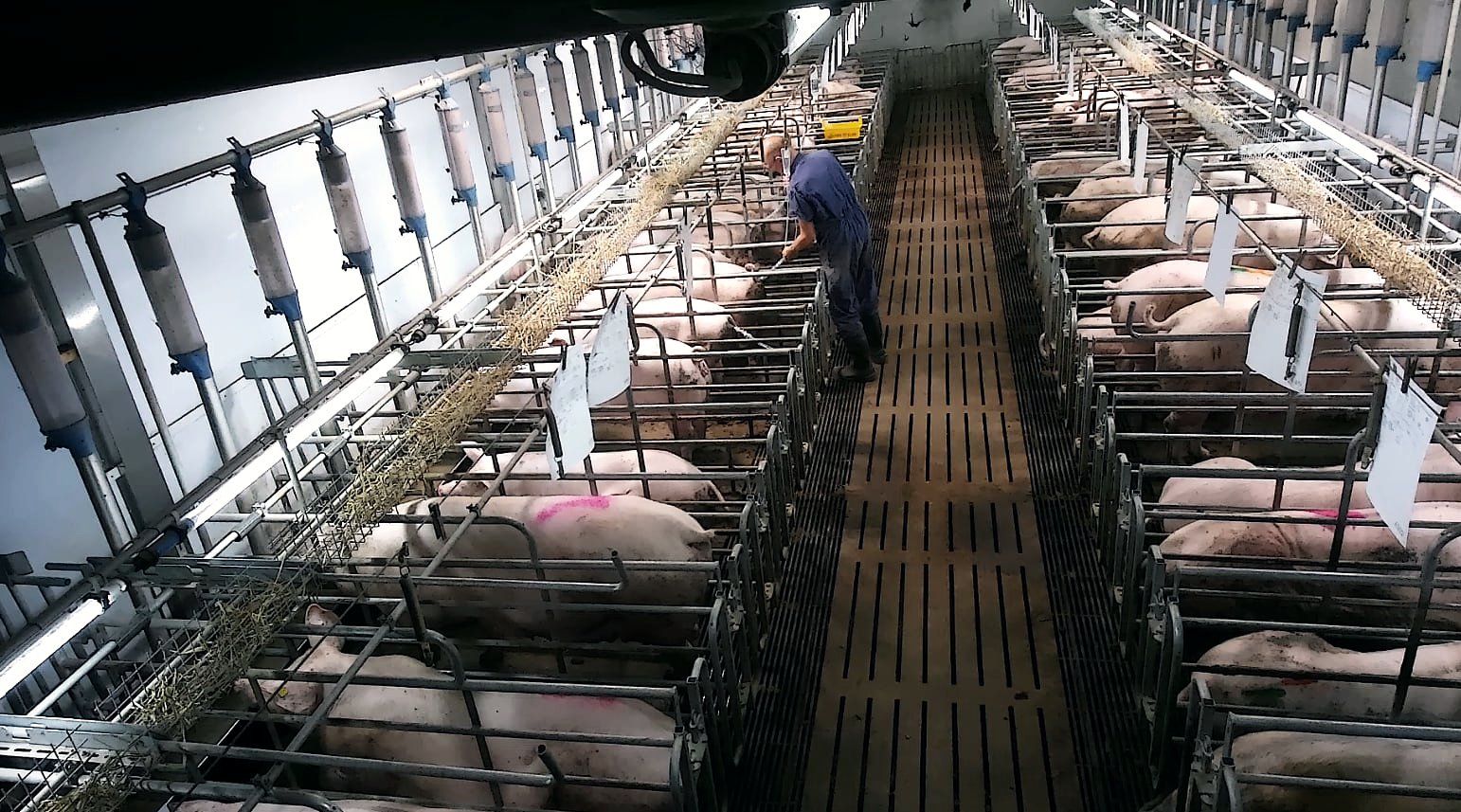
A barn full of insemination crates holding sows, with a farmer in the aisle.

Footage

Once the piglets have been taken away, their mothers are moved to the insemination unit. There too they are put into a crate again, the insemination crate.

Moving the animals between units involves stress and abuse. At Van de Pas it was filmed how a mother pig is forced to walk by being grabbed by the tail. This is painful, because a pig's tail contains many sensitive nerves. Pig farmer Tom Kroes uses a stick when moving mother pigs. A sow who goes the wrong way is repeatedly struck hard.

Pig farmer Tom Kroes hits sows with a stick

We see how Kroes and other employees repeatedly touch the genitals of sows to check whether they are fertile yet. The insemination itself is done by inserting an insemination pipette into the vagina. A bag of semen is hung from the pipette to fertilise the sow. In pig farming it is customary to inseminate sows again a day after insemination.

Nico Kroes checks the vulvas of sows

Inseminated animals are moved to the gestation barn, a large group pen for pregnant sows. The research team filmed the gestation barns at pig farms Van de Pas and Buut’n Gewoon. The barns are dusty and covered in cobwebs. We see sows standing, sitting and lying in a layer of urine and manure. Many animals are themselves covered in the filth too.

Artificial is not natural

There is no difference between inseminating sows on conventional and on Beter Leven farms. It goes without saying that artificial insemination in no way answers the need for natural mating behaviour. To trigger and speed up the production of fertility hormones in the sows, pig farmers walk a male pig, a boar, past the crates. As soon as the mother animals enter their fertile period, they make clear through their behaviour that they want to mate. In pig farming, however, it will never come to that – the boar is shut back up in the boar pen, and the pig farmer injects the sows with semen.

In the wild, wild boar have a mating season. They mate from autumn and farrow in spring. The wild sow has months to recover before she becomes pregnant again. In animal farming a mother pig is inseminated again a few days after the piglets are weaned. The pregnancies following closely on one another and the nursing of unnaturally large numbers of piglets — more than double a natural litter — eat into her energy reserves.

Before she is even 4 years old the mother pig is exhausted: her resistance declines, she develops fertility and/or other health problems and is sent to slaughter. By nature she could live to be 20 years old.

The Dierenbescherming glosses over crate suffering

On the consumer section of the Beter Leven website, the Dierenbescherming enthusiastically announces that sows “may only still be confined individually for 4 days around covering (= insemination) and for the time in the farrowing barn with the piglets”. A lie, because the stay of sows in the insemination crate is not a fixed, bounded period. Both the law and the Beter Leven criteria prescribe that a sow may be confined “from the moment of weaning up to and including 4 days AFTER the day of insemination”. On the consumer page the Dierenbescherming appears to 'forget' that a sow is not inseminated immediately after weaning. She first has to come into heat, and that heat on average only occurs 5 days after weaning. This can even run up to 10 days. The 4 days mentioned on the consumer page come on top of the days preceding insemination.

Beter Leven mothers in insemination crates

The gestation barn

From the insemination unit the sows go to the gestation barn. There too the living conditions are unnatural. In the wild, sows live together in fixed family groups. Such a group consists of two to five closely related mother pigs with their offspring. The animals make journeys of several kilometres daily within their range, moving between their resting place, food-rich spots where they root together for fresh morsels, mud pools to bathe in and places where they relieve themselves. Female wild boar stay for life with the group they were born into.

In the gestation barn, sows are kept in groups put together by the pig farmer. After 3 months the group is broken up because the animals are then moved to the farrowing unit.

Instead of setting out together and rooting for fresh food, sows in the gestation barn have to wait their turn at feeding stations or troughs to obtain a portion of industrial pig feed. Because there is too little space for a natural dunging area, the floors quickly become fouled with excrement. Damp, dirty floors lead to more claw and leg problems in sows — and claw problems are an important reason for sending sows to slaughter.

The animals live in their own excrement

No extra space for Beter Leven sows

All animals are equal, but some are more equal than others. George Orwell's famous quotation is strikingly applicable to the Beter Leven label. On its homepage the label promises "demonstrably more space" for all animals, and the Dierenbescherming itself acknowledges that lack of space is one of the greatest problems for pigs in conventional pig farming. Yet mother pigs in Beter Leven gestation barns (1 star) get just as much — or rather: just as little — space as their conventional counterparts.

The living space amounts to 2.25 m² per sow, and in conventional as well as Beter Leven barns that may be reduced by a further 10% when animals are kept in groups of more than forty. By way of comparison: in the wild a family group of five to thirty wild boar has an average range of 800 hectares — that is 8 million square metres.

No better life for Beter Leven sows
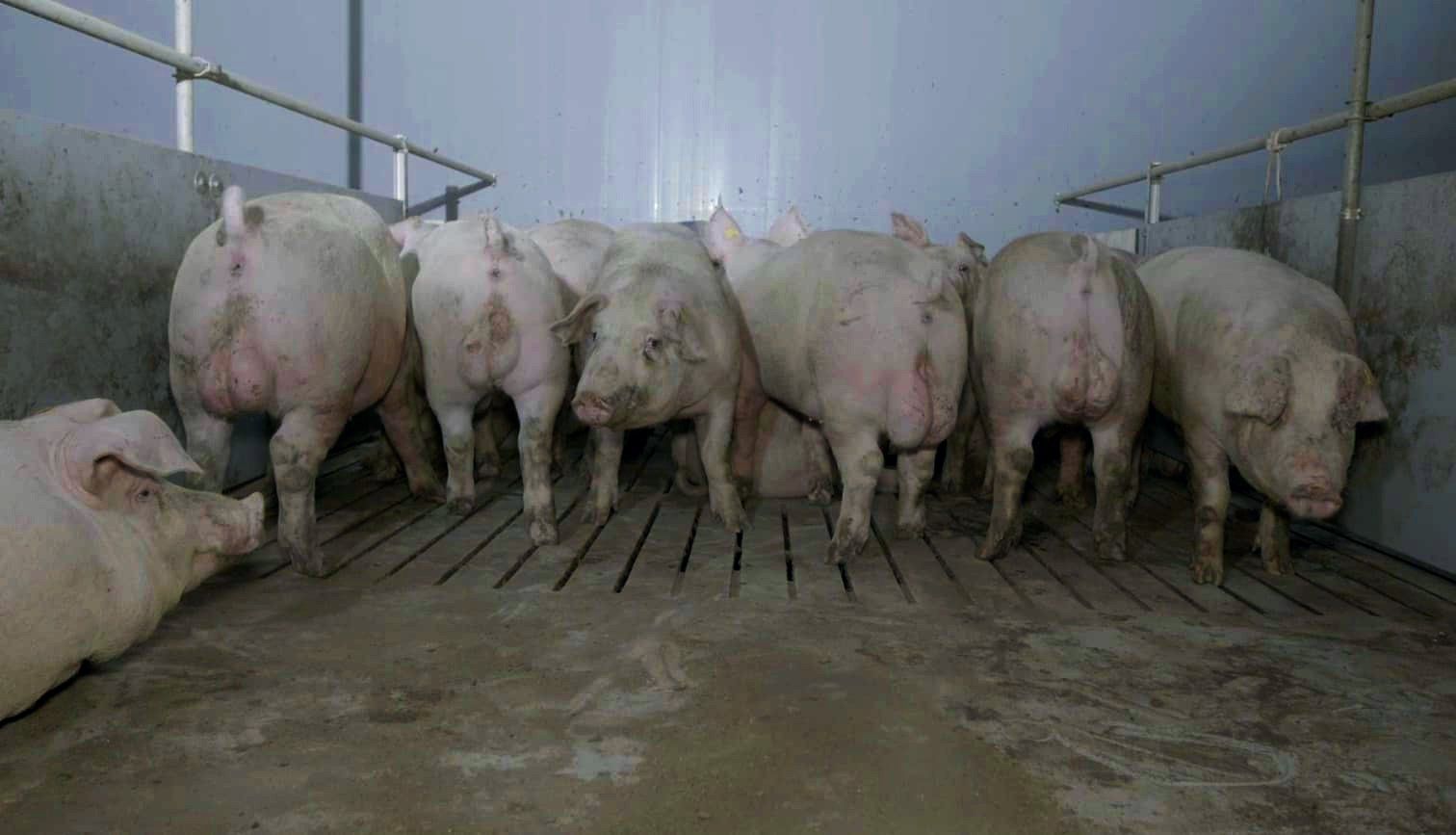
A group of fattening pigs in a pen with a slatted floor.

Footage

In the fattening unit young pigs are fattened for slaughter. Ongehoord filmed 1-star fattening pens at Buut’n Gewoon (Rouveen) and Van Veldhuizen (Ede). In Echt, Limburg, we visited a 3-star fattening barn belonging to Livar.

Under Beter Leven, 1 star, the pigs cannot go outside: they stand, sit, eat and sleep on the concrete and slatted floors of the pen. Ongehoord filmed the fattening pens at Buut’n Gewoon, 1 star Beter Leven. Although pen enrichment is present – intended to give the animals distraction – Ongehoord filmed pigs there biting each other's tails: stereotypical behaviour that points to boredom, stress and frustration. Several pigs have chewed tails.

Our research team also visited a 3-star fattening barn belonging to Livar. Although the pigs there are weaned later (6 weeks), get more space and more pen enrichment, lie on a layer of straw and can go outside, Ongehoord filmed a severe outbreak of tail biting. Instead of curly tails we see hanging tails, which indicates that the animals are feeling unwell.

Their tails are severely chewed. In the short span of time the animals were filmed, we repeatedly see pigs chasing each other for fresh biting attacks. Even in the roomier three-star pen the pigs cannot escape each other's biting attacks.

Every pig farm has a sick bay to isolate pigs with welfare and health problems. Ongehoord placed cameras in the fattening farm of the best-known pig farmer of the Beter Leven label: 'boer Dik' from the promotional video for pigs with 1 star.

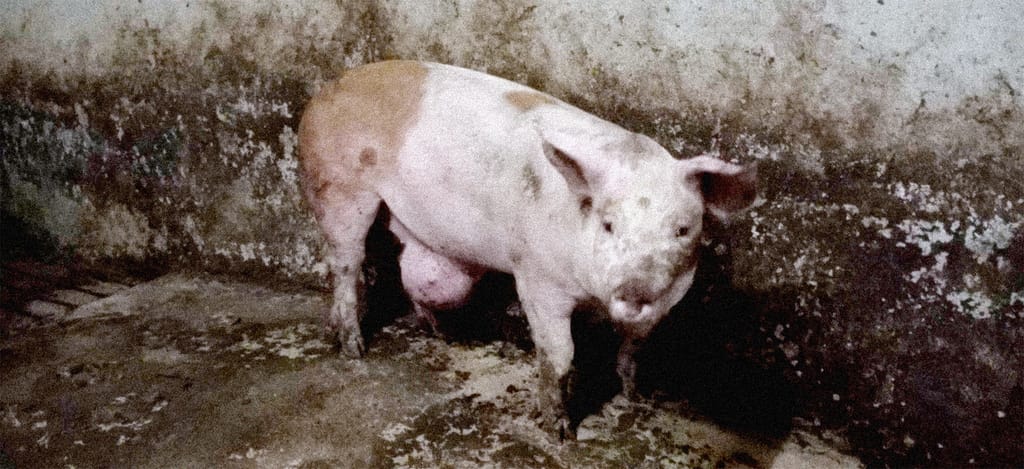
In the sick bay of Dik van Veldhuizen (Ede) we see fattening pigs with conditions typical of pig farming, such as large umbilical hernias and lameness. The pens are heavily soiled, there are many mice running around, there is no bedding on the floor and there is no pen enrichment that meets the requirements. Although the label prescribes that pigs in an individual sick pen must have eye contact with conspecifics, that is not always the case.

Pig with an umbilical hernia in the sick pen

In one of the pens sits a lame pig with an inflamed buttock. Van Veldhuizen forces the animal to stand upright by pulling its tail. The pig is treated with injections. When that does not help, the captive bolt gun is brought in — a device that shoots a metal bolt into the animal's brain. The pig is shot through the head, but no throat cut is performed to let the animal bleed out. European legislation prescribes that shooting an animal must be immediately followed by a killing method, such as bleeding. A captive bolt gun does not guarantee death: the pig can regain consciousness.

After the shot pig has lain convulsing for minutes, Van Veldhuizen wheels it outside on a carcass cart. To move live animals in the sick bay he uses an electric prod.

Serious welfare problems were also filmed in the unit for healthy fattening pigs at Van Veldhuizen. A pig with a bleeding prolapse (a condition in which a piece of intestine comes out of the anus) is chased by pen mates who bite at the wound. This is a form of cannibalism: abnormal behaviour that, like tail biting, stems from boredom, stress and frustration. Even when the injured pig lies down to rest, a pen mate cannot resist nibbling at the prolapse. The pen enrichment material, a block on a chain, is left untouched.

Cannibalism in the fattening pig barn

Unnatural living conditions lead to stereotypical behaviour

Tail biting counts as one of the most serious and widespread problems in the pig industry. It occurs in all housing systems: WUR research at the slaughter line found no appreciable differences in tail damage between conventional, Beter Leven and organic pigs.

Tail biting in a barn with three Beter Leven stars (Livar)

The fundamental cause of tail biting – and of other forms of stereotypical behaviour – lies in the inability of pigs to express natural behaviour. According to the EFSA report "Welfare of pigs on farm", the lack of opportunities for exploratory and foraging behaviour in a barn is one of the most important welfare problems in pig farming.

On the consumer page of the Beter Leven label it is claimed that tail biting can be prevented with extra space per animal, more feeding places and enrichment material. Ongehoord's footage in barns with 1 as well as 3 stars does not bear this out.

Even in the ‘roomier’ Beter Leven pen (1 square metre per animal under 1 star), pigs do not have the space and freedom to make journeys of kilometres as they would in the wild. And even the best enrichment material quickly loses its appeal: pigs get used to it, it only stimulates their curiosity briefly. A natural environment changes continuously: new smells, changing plants, other animals, the seasons.

Edible rooting material, such as alfalfa on the barn floor, also does not offer the diversity of a natural soil: in the forest wild boar root for roots, larvae, insects, worms — every mouthful different, every spot a surprise. Under 3 stars of the label, fattening pigs do get an outdoor run (1 square metre per animal), but the surface of this run consists in most cases, just like the barn floor, of concrete and slats.

A bit more space in a pen, enrichment material, an extra feeding place or even an outdoor run offer pigs no full alternative to natural exploratory, foraging and rooting behaviour. Ongehoord's investigation shows that stress and frustration – with stereotypical behaviour as a consequence – are inherent to the unnatural life of pigs in pig farming, regardless of the number of stars.

Curly tail routes tailored to the industry

For pig farmers, tail biting is above all an economic problem. Pigs with severe tail damage have to be killed on the farm. Animals with less severe wounds may go to slaughter, provided they are transported separately on the lorry — but even then the farmer runs the risk of being paid less because of the tail damage, or of the NVWA rejecting the animal entirely after all.

To limit economic losses from tail biting, the tails of piglets are docked. The risk of outbreaks of tail biting is then smaller. But the cutting off of tails meets with growing distaste from society. To improve the industry's image and keep meat sales up, government, sector and the Dierenbescherming have decided to stop tail docking. For the Beter Leven label, 1 January 2030 has been set as the end date for the cutting off of tails.

The Dierenbescherming has devised a very remarkable method for phasing out tail docking under its label: the 'curly tail routes'.

The curly tail routes are not intended to reduce animal suffering gradually, but to give pig farmers time to adapt their operations and barns. One of the routes means that the tails are left a bit longer each year: in 2027 two thirds of the tail may still be cut off, in 2028 half, in 2029 a third, arriving at a complete docking ban in 2030. Research has established that docking piglets' tails is painful and stressful, regardless of the length that is cut off.

GefeliciStaart

According to research by Wageningen University, tail biting can never be fully prevented in pig farming: even with more welfare measures and pen enrichment, an estimated 5 to 15% of pigs will still suffer tail damage. Annual production of Beter Leven pigs fluctuates between 3.5 and 4 million animals, which means that with the docking ban well over half a million pigs a year will be at risk of tail-bite wounds.

Yet the Dierenbescherming prefers a good-news show for the consumer. In a promotional video on the website, pig farmers Pieter Post and Klaas Mijnheer receive a "GefeliciStaart cake" because they "show that they are able to keep pigs with curly tails". Ongehoord's footage shows the opposite: in the pens of their farm Buut'n Gewoon (1 star), pigs with chewed tails were filmed.

Post and Mijnheer receive a “GefeliciStaart cake” from the Dutch Society for the Protection of Animals (Dierenbescherming)
Tail biting in the fattening pig barn of Post and Mijnheer
With an article and video about Livar, the three-star company where serious tail biting was likewise observed, the Dierenbescherming goes one better: Merel Postma, chain quality manager at Livar, is given the floor to tell consumers that her three-star pigs “walk around relaxed, with wagging curly tails [...] Something like tail biting really does not occur here, the pigs here are simply content”.

Caught in the act?

During the visit to the Livar location with 3 Beter Leven stars in Echt – known as the Sint-Antoniushoeve – Ongehoord's research team made another unexpected and striking observation. In old barn buildings next to the outdoor-run barns, our researchers found mother pigs in farrowing crates, and fattening pigs in housing without outdoor access. The footage shows poorly maintained pens, under a cloud of dust and cobwebs. Instead of on straw, the pigs sit on bare concrete and slatted floors. In the corridors of the old barn buildings, forms and overalls bearing the Livar logo were filmed. All the pigs, in the old barns as well as in the three-star barns, wore ear tags with the same UBN number (holding number). It is under this UBN number that Livar is listed in the Beter Leven register as a three-star location.

According to the criteria of the label, all pigs present at a holding (UBN) with three Beter Leven stars must meet the criteria of three Beter Leven stars. This is clearly not the case at the Sint-Antoniushoeve.

Pigs in dusty pens without outdoor access at three-star farm Livar
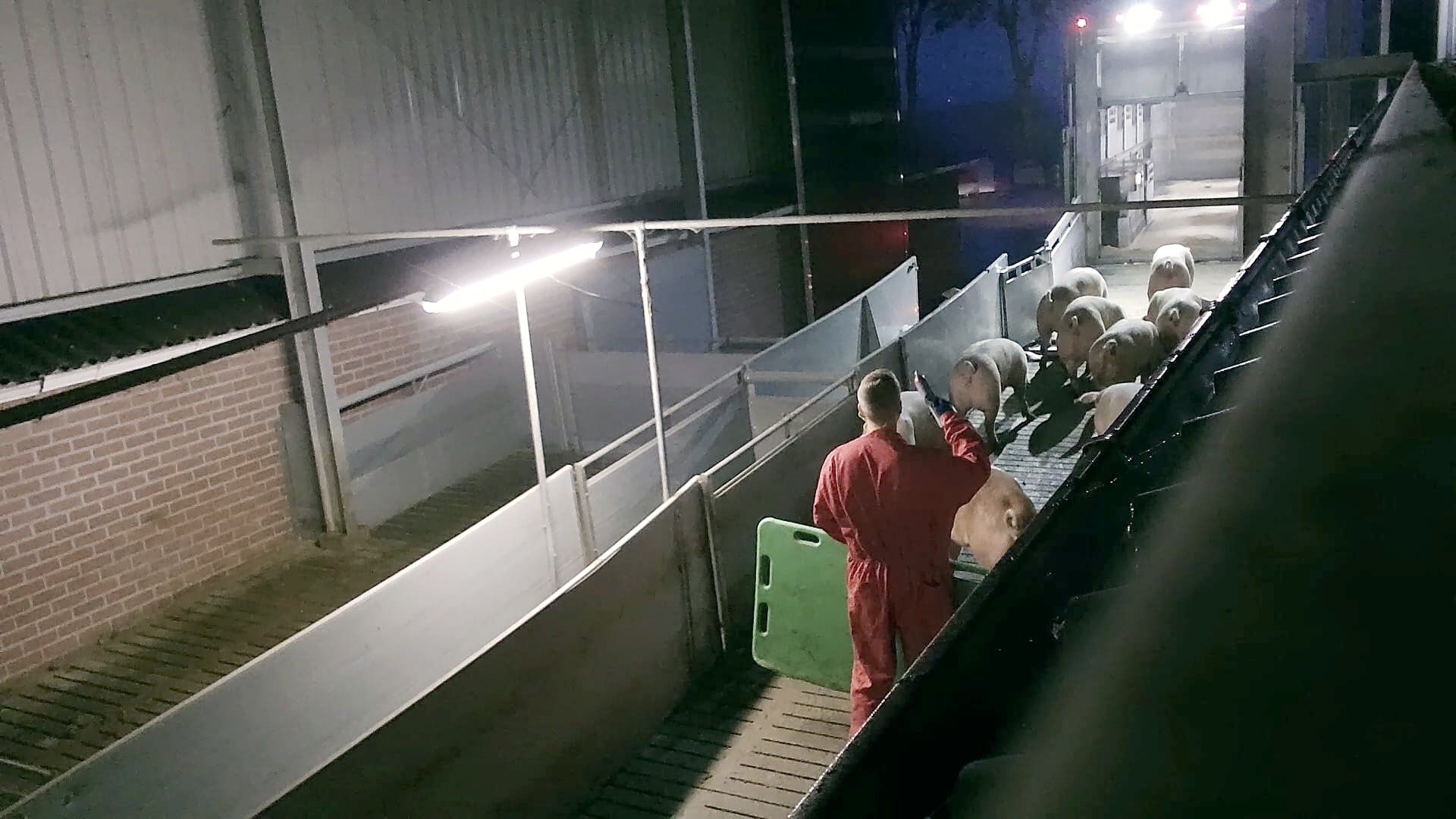
A man in red overalls drives pigs along a long loading passage toward a truck.

Footage

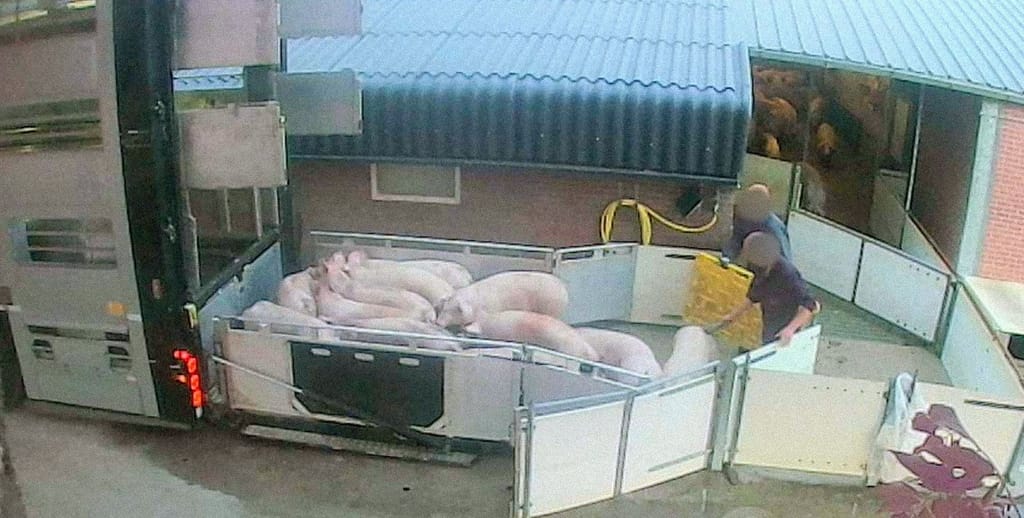
At around 6 months of age fattening pigs are taken to slaughter. Ongehoord used hidden cameras to film the loading of the pigs at Buut’n Gewoon. Pig farmer Pieter Post takes groups of pigs out of the barns and lines them up in the farm's loading area. He kicks pigs and hits them with a rattle, pulls their tails and administers electric shocks. A haulier from pig trader Schuttert then loads the animals, again making frequent use of an electric prod. When the lorry is full, a second haulier comes to collect the remaining pigs — he too makes excessive use of the taser. Some pigs are given several electric shocks in quick succession; we hear the animals screaming loudly.

Beter Leven farmer Pieter Post drives pigs with a rattle and an electric prod
Animal transporter uses an electric prod while driving pigs

The lorry has several decks, and the pigs are loaded in layers above one another. On one compartment the lid will not close. A pig has climbed onto the back of another pig, because there is no room in the lorry. The haulier stands on top of the lid and jumps up and down to push it shut. When that does not work, the lid is lifted to kick pigs out of the way.

At another moment we see a mother pig being removed from the farm. She is loaded into a small trailer. This too does not succeed without violence. We see the sow being seriously abused with a sorting board for more than 10 minutes.

Pigs left to their fate during transport

The Dierenbescherming claims that ‘Beter Leven’ is a chain label: all links in the production chain, “from farmer to supermarket and every link in between”, must be inspected and certified. This is untrue. Although the Dierenbescherming acknowledges on the Beter Leven website that “transport is one of the most stressful events for a pig”, the label imposes no certification obligation or criteria whatsoever on hauliers. There is therefore no form of oversight of hauliers on the part of the label.

The criteria for Beter Leven slaughterhouses do include a ban on electric prods, and under the requirements for pig farmers such ‘cattle prods’ may not be present on the pig farm. The prod ban for Beter Leven slaughterers and farmers has existed for years, and since the beginning of 2026 prods have also been banned by law within the Netherlands.

Although the legal ban is regarded by the Dierenbescherming as a good thing it campaigned for over many years, the footage at Buut’n Gewoon, Dik van Veldhuizen and Loes van de Pas shows that the ban does not help to curb prod use under the Beter Leven label.

Ongehoord had already filmed the use of electric prods and other forms of violence during the loading of animals before, specifically at pig farm Albers (1 Beter Leven star), Ten Have-Mellema (2 Beter Leven stars) and Houbensteyn (1 Beter Leven star). At Beter Leven slaughterhouse Westfort the unloading of pigs was filmed, which involved kicking, pulling tails and ears, and hitting hard with rattles.

That the transport of pigs, despite criteria and legislation, still involves a great deal of stress and violence comes as no surprise to Ongehoord. During loading the animals are confronted with stressful situations: unfamiliar conspecifics from different pens, unfamiliar people, a strange environment and noise, slippery surfaces on loading bridges and lorries. By nature pigs take their time to explore new environments cautiously. They are not given that time during loading: the haulier has to deliver the animals to the slaughterhouse on schedule. To speed up loading, the pigs are driven with violence.

Advertisement from the “Boeren Bedankt” campaign: a smiling pig farmer in red overalls holding a piglet, with the Beter Leven logo.
Beter Leven

Loes van de Pas runs a breeding farm with 300 sows (with suckling piglets), 1000 weaned piglets and 2500 fattening pigs. The farm breeds mother animals intended for sale to other pig farms; in addition, fattening pigs are also fattened for slaughter. The meat is destined for supermarkets such as Jumbo and Lidl, and chains such as IKEA and Unox.

At the end of 2025 Van de Pas took part in a promotional campaign for the Beter Leven label. Her portrait in the Telegraaf was part of a series of promotional articles paid for by the Dierenbescherming, with the aim of encouraging readers to buy Beter Leven products. The article can also be found on the Beter Leven website. A photo of Loes with a piglet in her arms is meant to convince consumers of the label's animal-friendliness. In Ongehoord's footage we see Loes van de Pas beating piglets to death against a gate.
Beter Leven

Buut’n Gewoon is the pig farm of Pieter Post and Klaas Mijnheer. Their breeding farm has 360 sows and 3400 fattening pigs. They produce for Jumbo, within Van Loon Group's “Varken op z’n Best” concept.

In March 2026 Post and Mijnheer received the “GefeliciStaart cake” from the Dierenbescherming, because they stopped docking pigs' tails some time ago. On social media the pig farmers proudly post the GefeliciStaart video, with the caption that the Dierenbescherming is “very enthusiastic about how we work and how we treat our animals”.

At their farm Ongehoord filmed pigs with tail-bite wounds and serious abuse before transport. Pieter Post administers electric shocks to the pigs and pulls their tails. It is ironic that the label's ‘welfare improvement’ – keeping pigs with long tails – offers pig farmers new ways of abusing the animals. We also see two hauliers from Schuttert with electric prods. Schuttert is a pig trader that, by its own account, transports many Beter Leven pigs (1 star).

Beter Leven

Tom Kroes runs a breeding farm with 750 sows and their piglets. The footage of sows in insemination crates was made at Kroes's farm. We see the pig farmer striking sows with a stick. He too was put in the spotlight by the Dierenbescherming. In March 2024 Kroes was visited by Ellen Bien, director of the Dierenbescherming, and Bert van den Berg, one of the founders and driving forces behind the Beter Leven label. They rewarded Kroes with a GefeliciStaart cake because he is committed to preserving long tails on his abused sows.

Beter Leven

Dik van Veldhuizen keeps 2400 fattening pigs with one Beter Leven star in Ede. In 2017 “Boer Dik” was the face of “Boeren Bedankt”, an advertising campaign by the Dierenbescherming for the Beter Leven label. The well-known promotional video giving consumers a (selective) look inside a Beter Leven barn was made at his farm. Although Van Veldhuizen says in the video that his Beter Leven pigs are “feeling great”, Ongehoord filmed a sick bay there full of pigs with serious conditions. The footage also shows the use of an electric prod and cannibalism among pigs.

Beter Leven

Livar was in 2016 the first pig farm (outside the organic sector) to receive three Beter Leven stars, which according to the Dierenbescherming is the highest attainable rating for animal welfare. The Livar chain now consists of 7 pig farms, all of which produce under the Beter Leven label, three stars.

Among consumers Livar is known above all for the advertising images of little pigs on straw and sows in a mud pool at the Lilbosch monastery farm. The abbey serves as a demonstration location; visitors can see some thirty sows and 300 fattening pigs there in a photogenic setting. The Dierenbescherming makes videos there to promote three-star meat to consumers.

Our research team visited Livar's largest location: the Sint-Antoniushoeve on the Hekbergerweg in Echt, a kilometre from the abbey.

Originally a large conventional pig farm was situated here; in 2019 the conversion began into a production location for Livar's three-star meat. In 2023, according to Livar director Frank de Rond, there were 320 three-star sows present and another three hundred or so sows with 1 Beter Leven star. At that time the outdoor-run barns for three-star fattening pigs had not yet been built. The plan was to expand the number of three-star sows to 450 animals after the new barns were completed, and to stop production under 1 star. Although the fattening barns with outdoor runs have by now been in use for a year and a half, and Livar only holds an approval for three-star meat, our research team established that pigs are also still being kept in the old, conventional barn buildings.

What is certain is that the main production of Livar meat takes place at this location and not at the small-scale monastery farm shown to the public. The Sint-Antoniushoeve is Livar’s most important breeding location (a breeding farm where piglet production also takes place); in addition Livar has some five locations where pigs are mainly fattened for slaughter.

A roll of stickers with the Beter Leven logo and three stars on a machine.

Although the requirements of the Beter Leven label are undemanding and ask no systemic change of the farmer, new participants are given ample time to adapt their farm to the criteria. Transition periods also apply when a new criterion is introduced within the label. In addition there are generic exemptions — which a whole category of farmers can make use of — and individual exemptions per farm. All these deferral arrangements have one thing in common: the consumer pays the premium of the label for products that do not yet meet its promises.

Exemptions for pig farmers

On 1 January 2025 a series of new criteria came into force for pig farmers with 1 Beter Leven star, including the daylight requirement and adjustments to floors and feeding installations. These requirements had been known since 2010, so the sector had 15 years to implement them. Yet shortly before the deadline the Dierenbescherming announced exemption options, meaning that pig farmers could request deferral for specific adjustments. When trade journal Boerderij requested information from the Dierenbescherming in February 2025, it turned out that 66 of the 526 pig farms with 1 star had an exemption: 1 in 8 farms therefore did not yet meet all criteria.

The Dierenbescherming claims that its label "makes the animal welfare behind Beter Leven products transparent" and that "consumers know what they are choosing". But hardly any information is available about the transition and exemption arrangements within the label. Which criteria have entry and transition periods, and which do not? How long do those periods run? How many farmers are currently making use of them? And how many farms have been granted an exemption, and for what exactly?

That deferral arrangements are the rule rather than the exception within the label is clear from information Ongehoord made public in 2024: at that time exemptions were granted on a large scale to broiler farmers. Four in five participants turned out not to have the outdoor space promised by the label. Omroep Gelderland asked a spokesperson for the Consumentenbond for a response. They did not mince words: "You may expect that meat with a label meets all the conditions. If that is not the case, then you are being lied to".

A pig pushes its snout between the steel bars of a farrowing crate, with piglets beneath.

The Beter Leven label was launched in 2007 by the Dierenbescherming as a route to "less and better": less meat consumption, and better living conditions for the animals. The animal industry soon saw a different potential in the label: a promising marketing tool to radiate trust towards the consumer and keep meat sales up. The ministry of agriculture also saw the label as a good way to boost consumer confidence. The success of ‘Beter Leven’ is largely due to the subsidies the ministry pumped into the label: between 2010 and 2017 the Dierenbescherming received more than a million euros for the further development and promotion of its label. Retailers such as Albert Heijn also received subsidies to promote the label to consumers.

Slaughterhouse Vion and the Dierenbescherming jointly promote Beter Leven meat at the Grüne Woche trade fair

Investigation group Ongehoord has been following the label since 2011. We made footage of rabbits, broiler chickens, laying hens and pigs on farms and in slaughterhouses with 1, 2 and 3 Beter Leven stars. Time and again we demonstrated that animals were suffering severely, and that requirements of the label were not being met. An advisory report the Dierenbescherming itself commissioned in response to Ongehoord's footage shows, however, that the organisation still regards abuses as "incidents". The Dierenbescherming's main concern is the reputational damage to the label rather than the animal suffering that has been demonstrated.

Investigation group Ongehoord therefore regards the Beter Leven label as a sham: by soothing the consumer's conscience with misleading animal welfare claims, meat consumption is kept up. Beter Leven, 1 star, has by now grown into the norm in the supermarkets — but the promised change in consumer behaviour, "less and better", has not materialised.

Recent behavioural research by Wageningen University has now confirmed that animal welfare labels such as Beter Leven have a counterproductive effect. The label makes consumers feel good, because the wording is positive (better, rather than less bad) Consumers no longer have to think critically about their meat purchase and see no reason to change their eating habits.

Both Ongehoord's investigation and that of Wageningen University therefore point in the same direction: the label cannot deliver on its promises. Instead of soothing consumers' consciences, it is time the Dierenbescherming turned to protecting animals. The Dutch meat industry has been under fire for years over animal suffering. There is no prospect of improvement at all; the scandals are in fact piling up. Animal protectionists should therefore not be serving the interests of the meat industry by polishing its image. Real animal protectionists try to abolish the animal industry.

What can you do?

Share this investigation

Share this investigation with people around you.

115 sources

  1. beterleven.dierenbescherming.nl

  2. beterleven.dierenbescherming.nl

  3. beterleven.dierenbescherming.nl

  4. wetten.overheid.nl

  5. beterleven.dierenbescherming.nl

  6. beterleven.dierenbescherming.nl

  7. efsa.onlinelibrary.wiley.com

  8. beterleven.dierenbescherming.nl

  9. beterleven.dierenbescherming.nl

  10. facebook.comOriginal no longer reachable (checked 2026-10-17)

  11. edepot.wur.nl/722207 meldt een omzet van 5,7 miljard euro.

  12. beterleven.dierenbescherming.nl/over-het-keurmerk/veelgestelde-vragen. Beter Leven noemt voor één ster een meerprijs van ongeveer 5–15 procent en koppelt die aan investeringen en hogere kosten bij veehouders.

  13. Wageningen Economic Research / POV – BLK Fair Prijs. Uitleg over de verschillende kostprijzen: www.nieuweoogst.nl/nieuws/2024/02/05/onafhankelijkheid-blk-fair-prijs-positief.

    Archived

  14. research.wur.nl/en/publications/agro-nutri-monitor-2025-achtergrondrapport-monitor-prijsvorming-v. Bron voor de vergelijking €7,95 versus €8,41 per kilo, de inkoopprijzen en de berekende nettomarges. De cijfers betreffen gemiddelden over 2021–2023 en zijn dus geen actuele winkelprijzen van 2026.

    Archived

  15. Stichting Beter Leven keurmerk, Fees BLL 2025, herzien op 24 januari 2025, p. 1–3. Voor grote retailketens bedraagt de jaarlijkse logobijdrage €18.264; de jaarlijkse vaste bijdrage voor een groot bedrijf (>15 fte) bedraagt €4.092 per bedrijfslocatie. Bedragen exclusief btw. De logobijdrage komt ten gunste van de Dierenbescherming; de vaste bijdrage wordt betaald aan SBLk. beterleven.dierenbescherming.nl/zakelijk/wp-content/uploads/sites/2/2025/04/participation-fees-SBLk-2025-V1.1.pdf.

    Archived

  16. Follow the Money, 2021 – Beter Leven-kip bezorgt vooral supermarkten een beter leven.

  17. Stichting Beter Leven-keurmerk – criteria varkens. Bron voor de verschillen tussen gangbaar en één ster, waaronder leefruimte en aanvullende welzijnseisen: beterleven.dierenbescherming.nl/over-de-dieren/alle-dieren/varkens.

  18. Zie www.rvo.nl/onderwerpen/welzijnseisen-dieren/huisvesting-verzorging/varkens. De ruimte van 0,8 m² is tot 110 kilo levend gewicht bij regulier, bij BLk en regulier mag je daarnaast 10% minder doen bij groepen > 40, dus minimaal is dan 0,72 of 0,9 m².

    Archived

  19. Zie edepot.wur.nl/695941, pagina 84.

  20. De reeks over de eerste jaren is onder meer terug te vinden in onderzoek van Ongehoord, gebaseerd op de jaarverslagen van de Dierenbescherming (www.ongehoord.nl/nl/onderzoek/beter-leven). BLK-omzet: historische Monitors Duurzaam Voedsel (Wageningen Economic Research), www.agrimatie.nl/ThemaResultaat.aspx?indicatorID=2662&subpubID=2232&themaID=2810. De reeks kent methodewijzigingen: 2013–2017 betreft een beperktere supermarktdekking. Het bedrag voor 2018 is in de Monitor 2019 herberekend van €1,649 naar €2,419 miljard, onder meer door ophoging naar alle supermarkten. De jaarbedragen vormen daarom geen volledig vergelijkbare groeireeks. De stijgingspercentages zijn de verandering ten opzichte van het voorgaande jaar. Door methodewijzigingen en herberekeningen betekenen verschillen tussen jaarbedragen niet altijd werkelijke marktgroei; met name 2017–2018 is niet rechtstreeks vergelijkbaar.

    Archived

  21. De opbrengsten over 2023–2026 zijn ramingen door extrapolatie. De baten 2023 zijn 1,7 miljoen tot 1 september. Extrapolatie geeft 1,7/8x12=2,57 miljoen. Dit is waarschijnlijk te laag i.v.m. de piek in vleesconsumptie in december. Vanaf 2023 volgen we de percentuele omzetstijging, die in het verleden zowel hoger als lager kunnen liggen dan de percentuele opbrengsten voor de Dierenbescherming.

    Sinds de verzelfstandiging van SBLk per 1 september 2023 worden de totale SBLk-opbrengsten niet meer opgenomen in de openbare geconsolideerde jaarrekening van de Dierenbescherming. De kolomtitel omvat hier de historische keurmerkopbrengsten inclusief SBLk en de doorgetrokken ramingen; deze zijn niet gelijk aan de eigen inkomsten van de Dierenbescherming na de verzelfstandiging, die zij wel publiceert. De verhouding is een rekenaanname: deelnemersbijdragen zijn niet rechtstreeks aan consumentenbestedingen gekoppeld.

  22. De Staat van Landbouw, Voedsel, Visserij en Natuur, Duurzaam voedsel naar keurmerk, gegevens Monitor Duurzaam Voedsel 2024. www.staatvanlandbouwnatuurenvoedsel.nl/kerncijfers/duurzaam-voedsel-naar-keurmerk.

    Archived

  23. De Staat van Landbouw, Voedsel, Visserij en Natuur, Duurzaam voedsel naar keurmerk, gegevens Monitor Duurzaam Voedsel 2024. www.staatvanlandbouwnatuurenvoedsel.nl/kerncijfers/duurzaam-voedsel-naar-keurmerk.

    Archived

  24. edepot.wur.nl/722207 meldt een omzet van 5,7 miljard euro.

  25. Ook de BLK-omzet voor 2026 is een extrapolatie: de groei van €5,3 miljard in 2024 naar €5,7 miljard in 2025 (+7,55%) is doorgetrokken naar 2026, circa €6,13 miljard. Bij toepassing van 0,0616% resulteert circa €3,78 miljoen aan geraamde keurmerkopbrengsten. Dit zijn geen gerealiseerde jaarcijfers.

  26. Stichting Beter Leven keurmerk, Tarieven BLk 2026, 23 december 2025, versie 1.1, p. 1–3. De variabele bijdrage wordt aan SBLk betaald door slachterijen, eierpakstations en zuivelondernemingen. De tarieven zijn gebaseerd op 0,05337% van de economische waarde volgens KWIN. beterleven.dierenbescherming.nl/zakelijk/wp-content/uploads/sites/2/2026/01/Tarieven-SBLk-2026-1.pdf.

  27. De vier influencers die de Dierenbescherming in 2024 voor de Beter Leven-campagne inzette waren Francesca Kookt, Jurino, Noortje Geerts en De Club van Relaxte Moeders. Samen bereikten zij volgens het jaarverslag van de DB 529.334 personen.

  28. In de Telegraaf ging het om 8 verhalen. De tariefkaart staat hier: www.mediahuis.nl/files/_nederland/files/tariefkaart-online-direct-2026-v1.09.pdf. Voor de schatting van de verspreiding van de flyers is deze tariefkaart gebruikt: www.uwfolderverspreiding.nl/folderverspreiding-nederland.

  29. Zie onderzoek Ongehoord uit 2021: www.ongehoord.nl/nl/onderzoek/beter-leven.

More investigations

Other investigations into the same animals and the same industry.