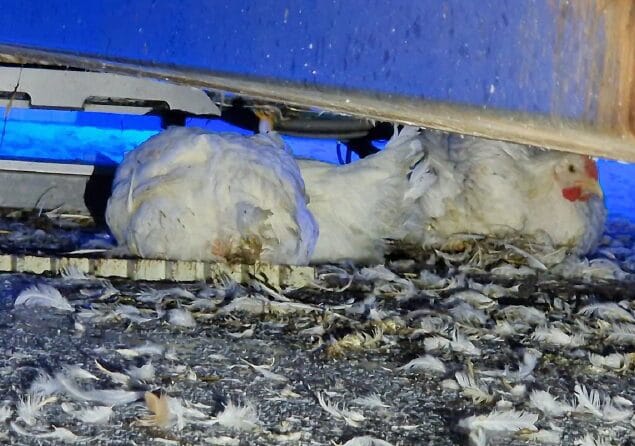
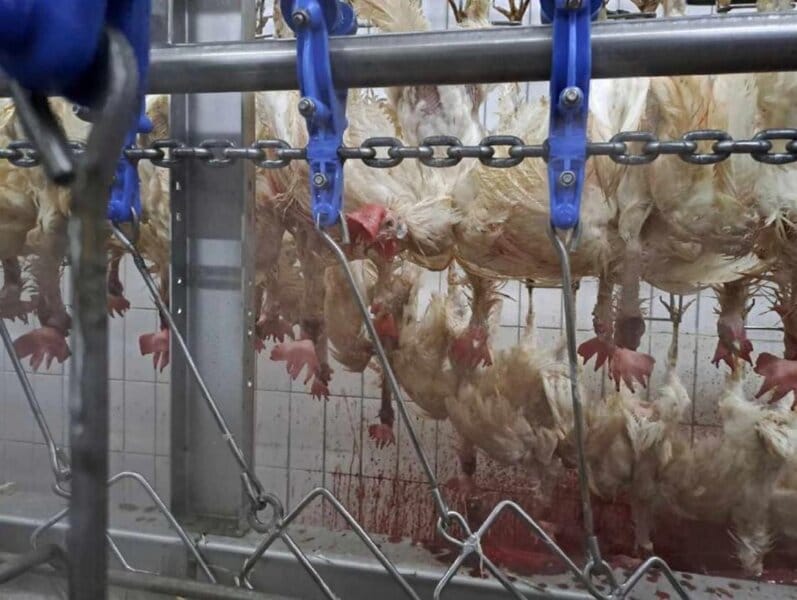
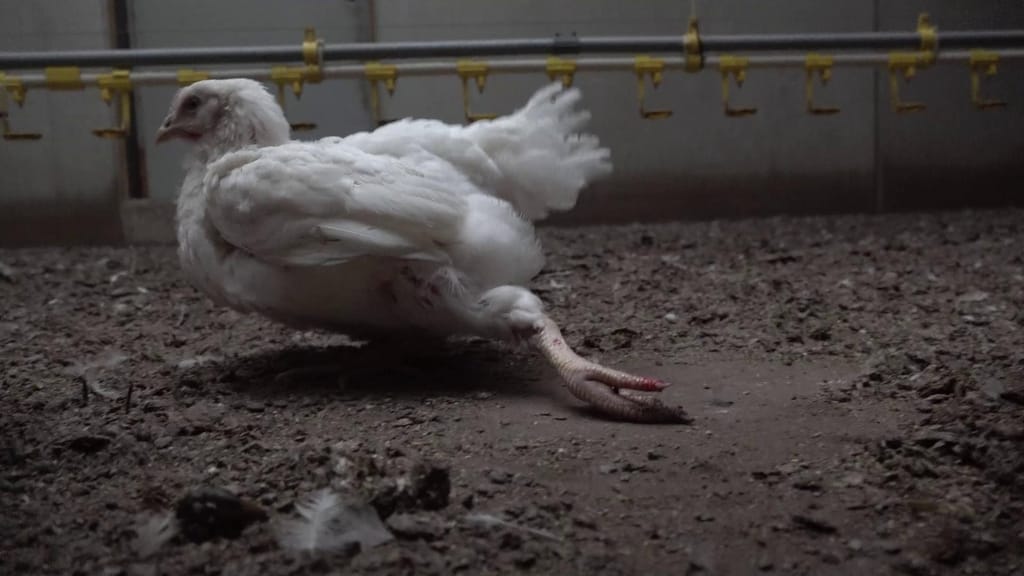
On September 26, 2013, Ongehoord published its investigation into broiler chickens. The investigation team visited two organic broiler farms: one in Lelystad and another in Dreumel. They also installed a hidden camera in Lelystad. The team looked into the living conditions in barns that the Dutch Society for the Protection of Animals (Dierenbescherming) praises with one "Beter Leven" star. In Hulten, Brabant, they visited the barn of Elly de Kort, a spokesperson for broiler farmers. Meanwhile, in Loppersum, East Groningen, they documented similar welfare issues. The undercover investigation also included Thymen van Voorthuizen's farm in Terschuur. Despite receiving two stars from the Dutch Society for the Protection of Animals (Dierenbescherming), the investigation team observed more shocking incidents there than in many conventional farms.
On the following pages, you will find the results of the investigation along with information about chickens. You'll also discover news articles and source material related to chickens and the poultry industry.
Where we filmed
Wild Chickens
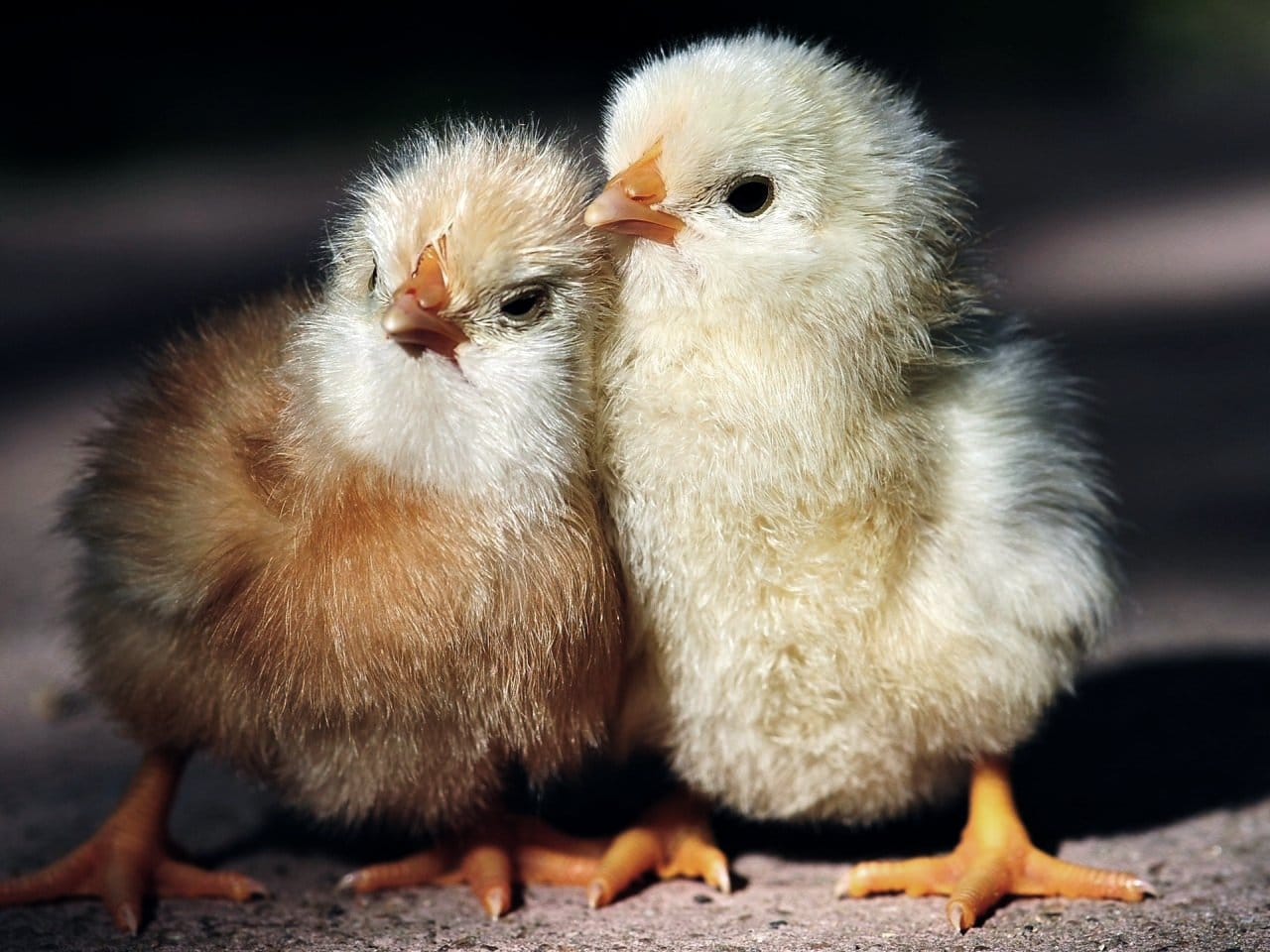
The modern domesticated chicken has been shaped by thousands of years of breeding. Its wild relative, the Junglefowl (Gallus gallus), originates from Asia. Although there are notable physiological differences, broiler chickens display behaviors that resemble those of the Junglefowl.
Gaming behavior
Chickens naturally live in groups. When a mother hen is ready to lay her eggs, she leaves the group. She stays on her nest for about three weeks, only leaving briefly each day to eat and drink. While the embryos are developing, they can produce calls that encourage their mother to return to the nest. If an embryo gets too cold, it communicates with its mother. When the hen moves the egg closer to her body, the embryo can call out to signal that it is now warm. Because a chick hears its mother’s call while still in the egg, it recognizes her voice as soon as it hatches.
Once hatched, the chick starts to explore its surroundings and pecks at round objects. The hen teaches her young what to eat by calling and pecking at the ground. If the chicks peck at things that aren't edible, their mother corrects them by demonstrating the right behavior more intensively.
For the first four days, the chicks stay close to their mother for warmth and protection. When it rains, they shelter under her wings. The hen teaches them to take dust baths and roost. She also shows them how to react to danger, using over 20 different sounds to indicate threats from the air or the ground. The chicks learn from each other through play, which helps them understand how to respond to aggression.
As the chicks grow, they start to venture further from their mother. By six weeks old, they can walk up to 20 meters away. At this age, they also begin to establish a hierarchy, showing dominance through behaviors like hopping, threatening, jumping, kicking, and aggressive pecking. After eight to ten weeks, the chicks forage for food on their own but still stay close to their mother and siblings. By 18 weeks, they join the rest of the flock.
Friendship ties
Chickens have a complex social structure. A flock typically includes 4 to 30 individuals, featuring a dominant rooster along with subordinate hens and roosters. The flock roosts together in the same tree. The dominant rooster protects his territory but allows subordinate roosters to stay nearby. Once these roosters reach young adulthood, he chases them to the edges of his territory.
Hens have their own pecking order, which tends to be more stable than that of roosters. Chickens recognize each other's heads to determine their hierarchical positions. They can individually identify up to 200 other chickens. Roosters also communicate their rank by crowing. Additionally, chickens watch the behavior of flock members to assess the position of unfamiliar chickens.
Beyond dominance relationships, hens, in particular, form friendships. These friendships help reduce stress and strengthen social bonds within the flock.
Under natural conditions, chickens follow a predictable behavior pattern. In the morning, they search for food. Around noon, they enjoy a dust bath. In the afternoon, they groom their feathers. After foraging again, the chickens roost together in the evening. Overall, chickens spend most of the day looking for food and exploring their environment.
Intelligent
Investigations show that chickens are much smarter than most people think. For instance, newborn chicks can count up to 10. They can tell the difference between 10 holes and the one that has food. Chickens also have a sense of time. Researchers taught them to peck at a touchscreen for 6 to 7.5 minutes to earn more food than if they pecked right away.
One particularly impressive skill is their understanding of object permanence. This means they realize that an object still exists even when it’s out of sight. Human babies only develop this understanding after 6 to 7 months. In experiments, young chicks remembered an object they saw through a small window and could find it by navigating around obstacles.
The life of a chicken in the industry
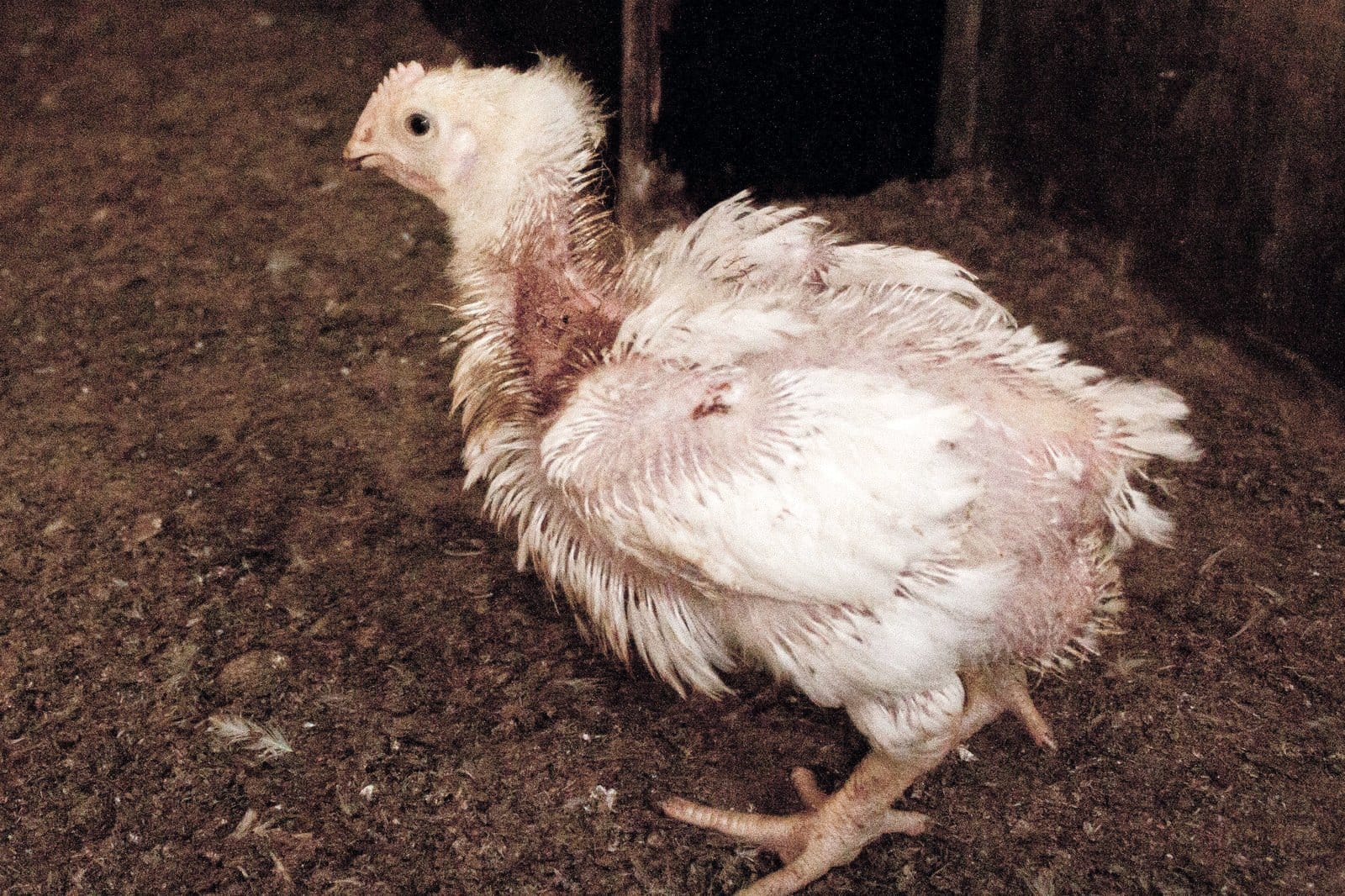
The meat you find in supermarkets labeled as chicken is actually broiler chicken. After just six weeks, or a maximum of 12 weeks for organic chickens, these chicks are sent to the slaughterhouse. During this brief period, the birds grow to a weight of 2 to 3 kilograms. This rapid growth is a result of extensive breeding for speed. The broiler sector aims to produce as much chicken meat as possible while using minimal feed and time, which helps maximize profits. To reach these goals, the broiler sector includes a network of highly specialized companies.
Breeding company
The breeding company crosses different chicken breeds to create specific genetic traits. Only three companies worldwide focus on broiler chicken genetics. The chickens on these breeding farms are known as great-grandparent chickens because they are the ancestors of the broiler chickens. The breeding company aims to produce male chickens that grow quickly and develop a lot of muscle, which means more meat. The hens also need to be "meaty," but their primary role is to lay many eggs so they can hatch a large number of broiler chickens.
For breeding, the males are kept alone in cages, while the females are housed in small groups or sometimes alone in cages. This setup prevents the chickens from displaying natural behaviors. The males, in particular, experience numerous physical problems due to their rapid growth. The chicks that hatch in the hatchery are referred to as grandparent chickens.
Rearers
At the rearer, grandparent chickens lay eggs that produce parent chickens. Parent chickens are the direct ancestors of broiler chickens. The rearer gets grandparent chickens from the breeding farm and crossbreeds them to supply parent chickens to the parent stockholder. Both the rearer and the parent stockholder aim to hatch millions of broiler chickens. The breeding farm provides small numbers of chickens with the right genetic traits, while rearers ensure these chickens produce a larger number of parent chickens. As a result, some companies combine rearing and propagation.
Parent stock owners or breeding companies
Breeder chicken farmers cross fast-growing males with prolific egg-laying hens to produce eggs that hatch into broiler chickens. However, breeder chickens often become too fat and heavy to reproduce. To manage this, breeder chicken farmers restrict their feed, especially during the breeding season. As a result, broiler chickens experience hunger and thirst.
In organic farming, a crossbreed of slower-growing hens, known as dwarf breeders, is used alongside regular males. The feed for these males is also restricted. Because of these unnatural conditions, males do not show typical courtship behavior. Consequently, the hens lose interest in the males. This situation leads to rough mating behavior from the males, partly due to their weight. The hens endure chronic stress, anxiety, and injuries.
To prevent injuries, the industry burns off the spurs and hind toes of older males while they are still chicks. This treatment causes significant stress and pain.
Hatchery
At the hatchery, broiler chicks hatch from their eggs. The eggs are incubated in a brooder for 21.5 days. After this period, the brooders are emptied all at once. During incubation, there is no food or water available in the brooder. As a result, chicks that hatch early spend days in the dark without food or water. If a chick hasn't hatched after 21 days, the industry discards it, shell and all. In patio barns, the hatchery is combined with the broiler farm, so chicks hatch in the same barn where they are also fattened.
Broiler farmers
At broiler farms, farmers aim to bring chicks to slaughter weight as quickly as possible. In just 40 days, these birds grow to weigh 2.2 kilos. In the organic industry, broiler chickens take 80 days to reach a weight of 2.6 kilograms. Unfortunately, about one in 25 animals dies before reaching this age.
Inside large barns, 20 birds are kept per square meter, with thousands of chicks living in each space. The birds often end up eating their own feces, and the barns are dusty with a strong smell of ammonia. Dead animals frequently remain in the barn, decomposing among the living. Without windows, the chickens have no way of knowing if it's day or night. Traditionally, the light in the barn was kept on constantly. Nowadays, farmers simulate multiple "nights" within a 24-hour period, which helps improve meat yield. However, because broiler chickens are bred to grow quickly on minimal feed, serious welfare issues arise. You can learn more about these diseases and welfare problems in the article "A Sick Industry."
Once the chicks reach their slaughter weight, the barn is emptied. This process occurs in the dark to keep the chickens calmer. Catchers usually grab several birds by their legs in each hand and lift them upside down. The chicks are packed tightly in crates and loaded onto trucks. During this handling, about 8% of the chicks suffer broken or bruised wings, breasts, or legs. It's no surprise that many chicks arrive at the slaughterhouse paralyzed with fear.
The slaughterhouse
When chicks arrive at the slaughterhouse, they are stunned. The most controversial method of stunning is the water bath method. In this approach, a mild voltage is applied to a bath of water, and the chickens are dipped headfirst into it. Although this method was banned as of January 1, 2012, some slaughterhouses continued to use it into early 2013. Most slaughterhouses now stun chickens by applying an electric shock directly to their heads or by using CO₂. After stunning, workers hang the chicks upside down by their legs from a kind of cable car. Then, they mechanically cut open the young animals' throats, causing them to bleed to death.
An unhealthy industry
Broilers face many diseases and behavioral issues. These problems stem from their rapid growth and the unnatural conditions in the barn. The high stocking density causes significant stress for the chickens, making them more vulnerable to pathogens.
Footpad lesions
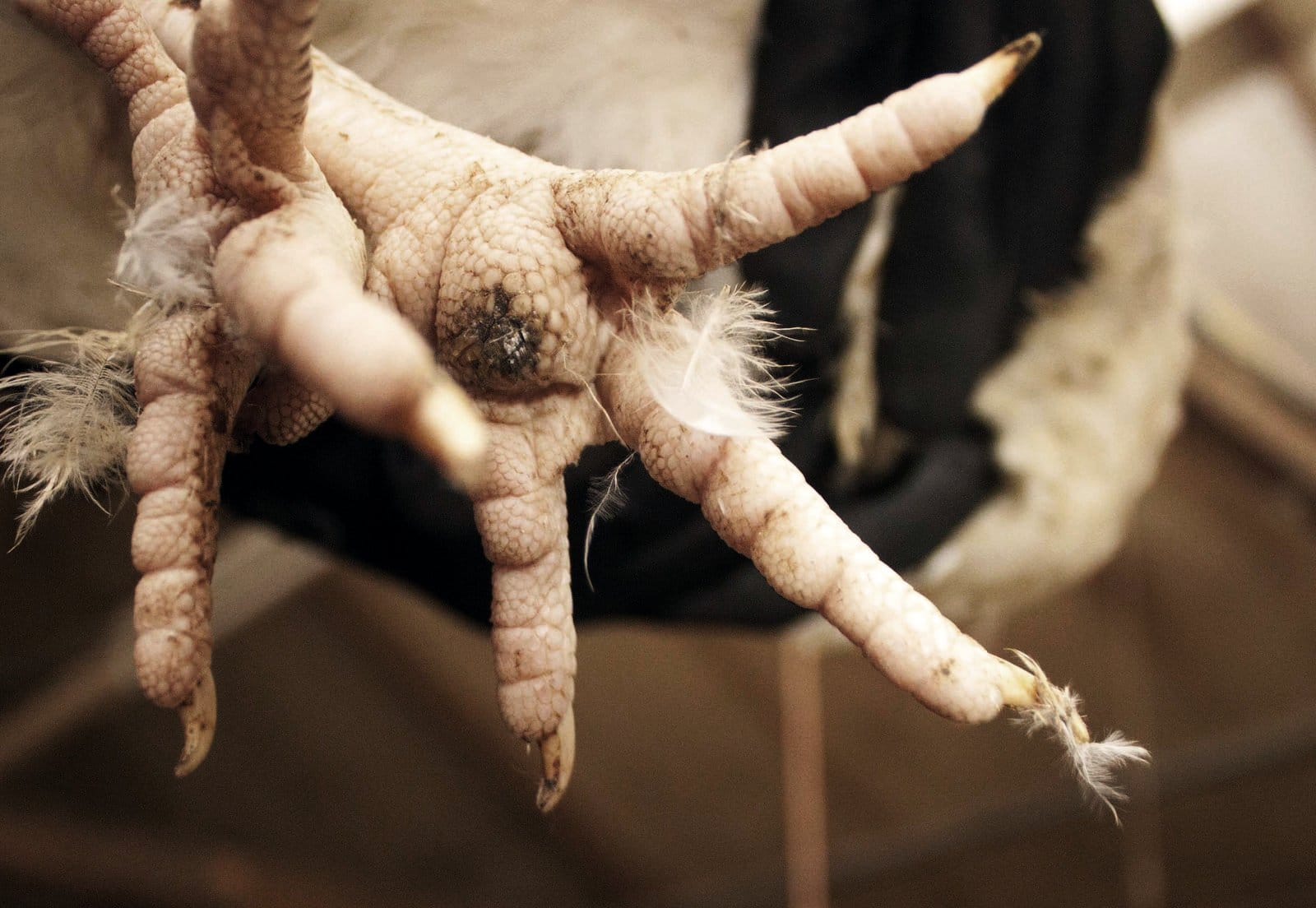
The most common issue for broilers is footpad lesions, which affect the skin on the soles of their feet. It starts with skin discoloration and tissue growth. This can lead to swelling, damage to deeper skin layers, and inflammation. Up to two out of three chickens experience mild to severe footpad lesions. These infections are painful, causing broilers to move around less in the barn and eat less due to the discomfort. Chickens often live in their own feces, and the ammonia in the waste can harm the skin of their claws. If the lesions burst, they can become infected. The litter is mainly responsible for this condition; when it is damp, the risk of footpad lesions increases. The number of birds per square meter also matters; fewer chickens in a barn allow the litter to dry out. Interestingly, the rate of footpad lesions is much higher in organic barns compared to conventional barns.
Burning heels (heel dermatitis) and chest blisters
As chicks grow, they find it harder to move. They often lie on their hocks and chest in the wet litter, which leads to irritation on their hocks, resulting in footpad blisters. These blisters are common, affecting more than 10% of chicks. Chicks experience rapid growth in their pectoral muscles, causing them to tilt forward. This tilt leads to irritation on their chest, known as breast blisters. Both footpad blisters and breast blisters are symptoms of the same disease as footpad lesions, and they frequently occur together.
Irritated eyes and airways
The chicks are packed closely together in a barn. Their manure isn't removed, so they end up walking on each other's droppings. This leads to high ammonia levels in the barn, causing the chicks to suffer from irritated eyes and respiratory issues. Ongehoord's investigation often captures footage of chicks struggling to breathe.
Twisted neck, stargazers and lameness
Some chicks with brain inflammation may raise their heads, a condition known as stargazer, or lower their heads to the side, referred to as rotary neck. A bacterial infection can also lead to lameness in chicks. In response, the industry typically administers large doses of antibiotics to prevent and treat these diseases.
Paralysis and reduced mobility
As many as 90% of broiler chickens show abnormal movements by the time they reach slaughter age. Several factors contribute to this issue. In addition to dermatitis and bacterial infections, bone abnormalities can also restrict the movement of broilers. The skeleton of a broiler can't keep up with its rapid muscle growth, leading to bone fractures and deformities. Another painful condition is spondylolisthesis, where a vertebra becomes dislocated. When a broiler becomes less mobile, the risk of blisters on the soles of its feet, hocks, and breasts increases. This reduced mobility prevents broilers from engaging in their natural behaviors. For instance, dust bathing is crucial for the well-being of chickens. In conventional farming, dust bathing is nearly impossible because the manure layer where the chickens rest isn't suitable for it. Even on farms with better litter, older chickens often still avoid dust bathing due to their limited mobility.
Standards and quality certifications
Beter Leven 1 star
Ongehoord published images of two farms that received a star rating from the Dutch Society for the Protection of Animals (Dierenbescherming) for their broiler chickens. However, the rating for both farms in Hulten, Brabant, and Loppersum, Groningen, turned out to be unfounded. The Society claims that the chicks grow slower, but the Ongehoord investigation team discovered the same welfare issues as with regular chicks. They found animals suffering from paralysis, deformed legs, respiratory problems, and other conditions linked to growth rate. The slower growth is relative; the chicks reach about 2.3 kilograms within eight weeks.
At both farms, decomposed carcasses were found in the barn. The outdoor run, as labeled by the Dutch Society for the Protection of Animals (Dierenbescherming), is actually covered, walled, and has a paved ground without vegetation. This makes the term "outdoor run" misleading, as it refers to an additional section of the barn. The star-rated barn in Hulten belongs to Elly de Kort, who is the primary spokesperson for the broiler chicken farmers.
Beter Leven 2 stars
Thymen van Voorthuizen from Terschuur has received 2 stars for his broiler chickens from the Dutch Society for the Protection of Animals (Dierenbescherming). In the overcrowded barn, the investigation team encountered some of the most shocking scenes. They found a still-living chick with its back completely pecked open. Blood leaked from the gaping wound, and the chick could no longer move. Other chickens walked over it and continued to peck. Many chickens had wounds on their soles and hocks, suffering from footpad lesions and hock dermatitis. They struggled to walk or couldn't move at all. The investigation team also found one chicken lying in the manure with its wing limply beside it. Upon inspection, its leg appeared white, indicating it was unable to walk.
Light
According to the Dutch Society for the Protection of Animals (Dierenbescherming), a Beter Leven barn must stay dark for at least eight hours to help chickens develop a normal day-night rhythm. However, when the investigation team arrived at 3:00 AM, the lights in the barn were on. The lights turned off at 3:30 PM, indicating that the Beter Leven chickens in Terschuur do not receive an eight-hour night. The barn has windows, which means it gets light even at sunrise. The investigation team visited in September, when the sun set at 8:00 PM and rose at 7:00 AM. Therefore, it is impossible for the barn to have been dark for eight hours.
Organic (Beter Leven 3 stars)
Ongehoord published images from two organic broiler barns. In Dreumel, the Vink family's barn had dead and dying chicks. The situation at De Polderhoenderhof farm in Lelystad was even worse. There were countless dead and dying chickens, along with several chicks that could barely walk, chicks with brain infections, dirty bottoms, inflamed eyes, and other health issues. After discovering these abuses, the Ongehoord investigation team decided to install a hidden camera at De Polderhoenderhof. The footage revealed that the chicks do not get to go outside every day.
Catch
When the chickens reach nearly 3 kilos after 12 weeks, the industry catches them and sends them to the slaughterhouse. Hidden camera footage reveals that the catching process is not gentle. The lights in the barn turn off, and a forklift truck enters. An employee kicks the chickens aside. The forklift truck drops off crates and then exits. The catching occurs in the dark, so it's not visible on camera. When the forklift truck returns, the catcher quickly grabs two chickens by their legs and tosses them into the crate. The next day, this is also how the "forgotten" chicks are caught. You can see this footage for yourself at www.onghoord.info.
What can you do?
Share this investigation
Share this investigation with people around you.