Research into animal-friendly park cages
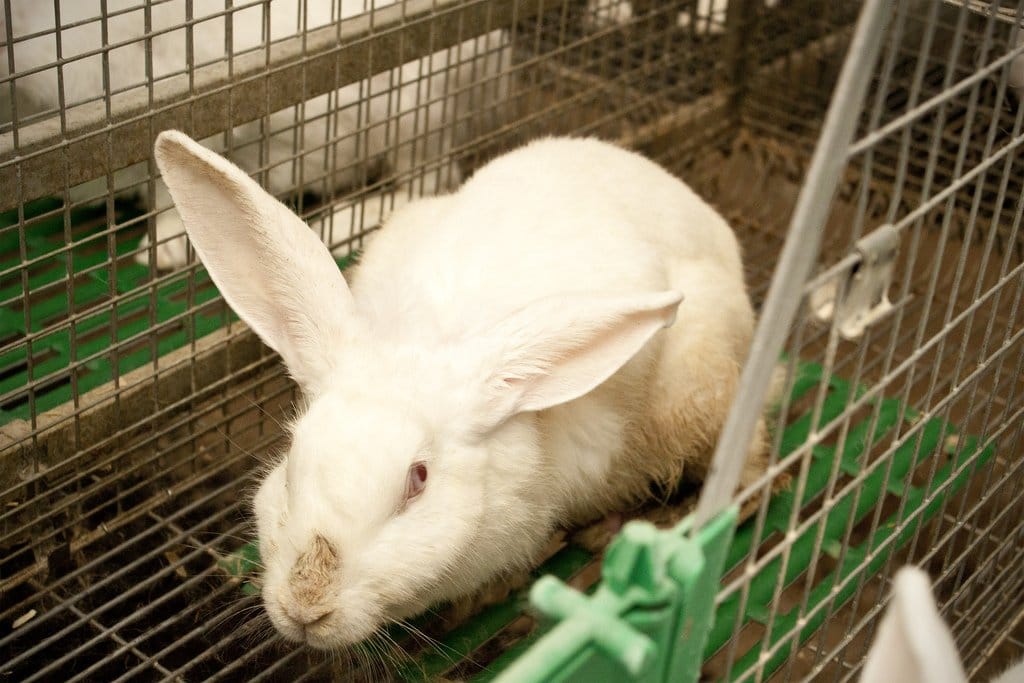
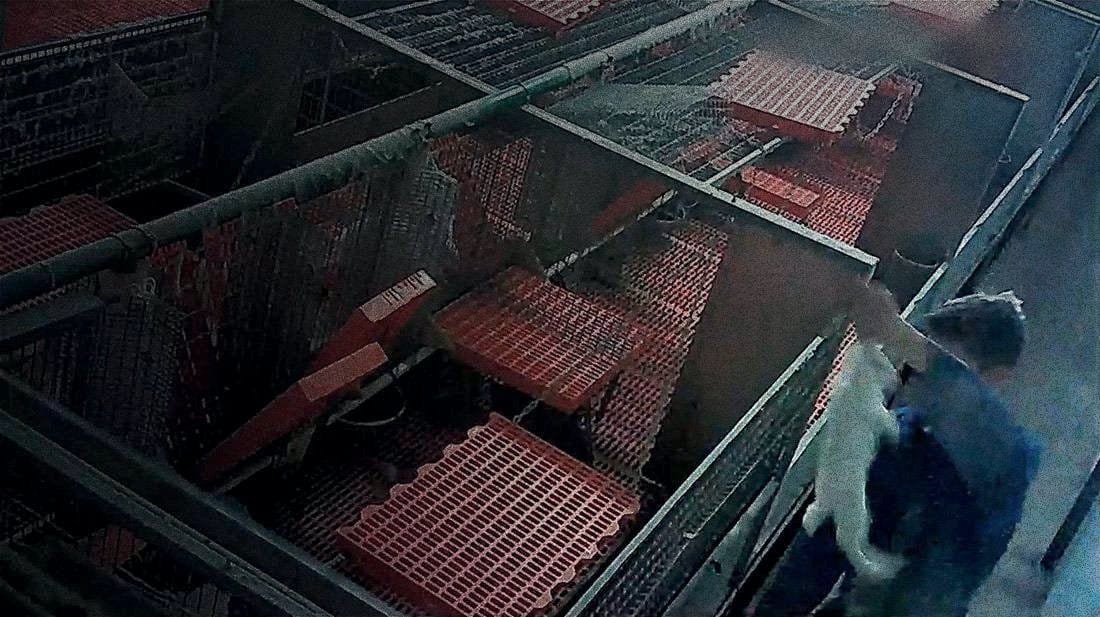
Around Christmas 2023, Ongehoord investigated the leader of the Belgian rabbit industry. At Konzo in Hoogstraten, the investigation team discovered many sick and dead rabbits in what was labeled "animal-friendly park housing." Hidden cameras recorded footage of workers pulling rabbits from the park cages by their fur, ears, and feet. Manager Yves De Bie, who often praises the animal welfare at his farm, was seen throwing rabbits.
Where we filmed
Natural life
Wild rabbits like sandy, hilly areas filled with shrubs and bushes. These environments provide them with the perfect spots to dig burrows and find food. A family of rabbits lives together in a burrow, which is a complex system of underground tunnels and chambers where they nest and sleep. A burrow can reach depths of up to three meters, and the tunnels can stretch over 40 meters in total. Inside their burrows, rabbits feel safe from predators. Their territory around the burrow can range from 0.25 to 6 hectares.
Rabbits spend their days in burrows. At dusk and during the night, they come out to search for food. Their diet includes grasses, herbs, young shrub and tree shoots, and field crops. In winter, they eat bark instead.
A rabbit group typically includes two to ten adults, mostly females, along with their young. These groups have a clear hierarchy. Dominant rabbits get more food, better shelters, and preferred nesting sites. As the rabbits grow, they gradually establish this hierarchy, which helps reduce excessive aggression among them.
Young male rabbits and about half of the female rabbits leave their group before they reach adulthood. They then form new, stable groups. When a new group forms, they establish a hierarchy, which involves some fighting. However, after this initial aggression, there is usually little conflict. If a group becomes too large, aggression may return.
Wild rabbits breed from early February to late July, with the busiest months being April and May. A female rabbit can have four to six litters each year, averaging five young per litter. Pregnant mothers dig nursery tubes that are 1 to 2 meters long, leading to a separate nest chamber. Inside this chamber, they build a nest using grass, moss, and their own hair. To keep the young safe from the cold and predators, the mother plugs the entrance to the nursery tube with soil. She also marks the entrance with urine to discourage other rabbits from entering the nest chamber.
For the first 2 to 3 weeks after giving birth, the mother rabbit visits the nest once a day to nurse her young. If a baby rabbit crawls out of the nest, the mother does not carry it back. This isn't an issue for wild rabbits; if a baby rabbit crawls out, it will naturally roll back into the nest due to the downward slope of the nursery pipe. After each visit, the mother rabbit plugs the entrance with soil.
A rabbit can live as long as 9 years in the wild, but the average lifespan is only 2 years. As prey, rabbits face many natural predators, such as stoats, weasels, polecats, foxes, owls, hawks, and falcons. Other significant threats to wild rabbits include dogs, hunting, traffic, lawn mowers, and diseases.
Rabbits can live up to twelve years in captivity. However, in the meat industry, they are slaughtered at just 10 weeks old.
Research on Konzo, the top rabbit farming industry in Belgium
To get a clear view of the Belgian rabbit industry, Ongehoord investigated the largest and most well-known rabbit farm in the country.
Konzo, Yves De Bie's rabbit farm, raises over 20,000 rabbits across two locations.[5] The company has received more than 14,000 euros in subsidies from both European and Flemish governments over the past two years.[6][7] Their largest and most modern facility is located in Hoogstraten. The rabbits are housed in park cages designed by De Bie, for which he received an innovation award from the Farmers' Union.[8] On the popular VLAM food platform "Lekker van bij ons" (Delicious from here), the Konzo breeding farm is featured as a prime example of Belgian rabbit farming.[9] De Bie asserts that 'animal welfare is always the top priority in his company.'[10] Ongehoord shows that Konzo's advertising starkly contrasts with the reality.
Konzo provides over 105,000 rabbits each year to Lonki, a rabbit slaughterhouse located in Temse.[11] From there, the meat is distributed to Belgian supermarkets, marketed as “Parkkonijn,” a label that the rabbit industry uses to convey trust and animal welfare to consumers.[12]
A research team visited De Bie's farm in Hoogstraten three times in December 2023 to film the rabbits' living conditions. They also installed hidden cameras to investigate how Belgium's most animal-friendly breeder treats animals behind the scenes.
Mother animals
In the section showing female rabbits giving birth and nursing their young, Ongehoord filmed mothers with bald patches on their fur. The young rabbits displayed signs of diarrhea, paralysis, or even death. Instead of being housed in parks, mother rabbits are kept in individual maternity cages.
Although natural sexual behavior is acknowledged by animal welfare experts as a fundamental need for animals, mother rabbits at Konzo are subjected to artificial insemination. This has become a standard practice in the rabbit industry. Due to the animals being housed in large production groups, natural mating has become impractical and economically unfeasible.[13]
A mother rabbit in a breeding facility hardly gets any rest. She is inseminated every six weeks. Ongehoord filmed the inseminator moving from cage to cage. The workers lift mothers out of their cages by their tails. They insert an insemination gun into the rabbits' genitals to inject sperm. Afterward, the workers lift the animals back into their cages by their tails.
About 30 days later, she gives birth to an average of 10 babies. Approximately ten days after giving birth, she is inseminated again. This leads to eight pregnancies and 80 offspring over the course of a year. According to De Bie's business philosophy, 'the stable must always be full to maintain income at the appropriate level.'[14]
The research team took photographs of a calendar that recorded the number of deaths in the farrowing cages. On average, seven rabbits die each week. Professional literature indicates that mother rabbits have a short lifespan in the industry. Typically, a mother is used for breeding for about a year, after which she is sent to the slaughterhouse. Reasons for culling include low fertility (failed inseminations, small litters, or many stillborn young), injuries, abscesses, mastitis, or overall poor health.[15]
Meat rabbits
At five weeks old, young rabbits are separated from their mothers. They are then placed with around thirty other rabbits of the same age in a group cage known as "park housing." In these park cages, the rabbits are fattened up for slaughter over a five-week period.
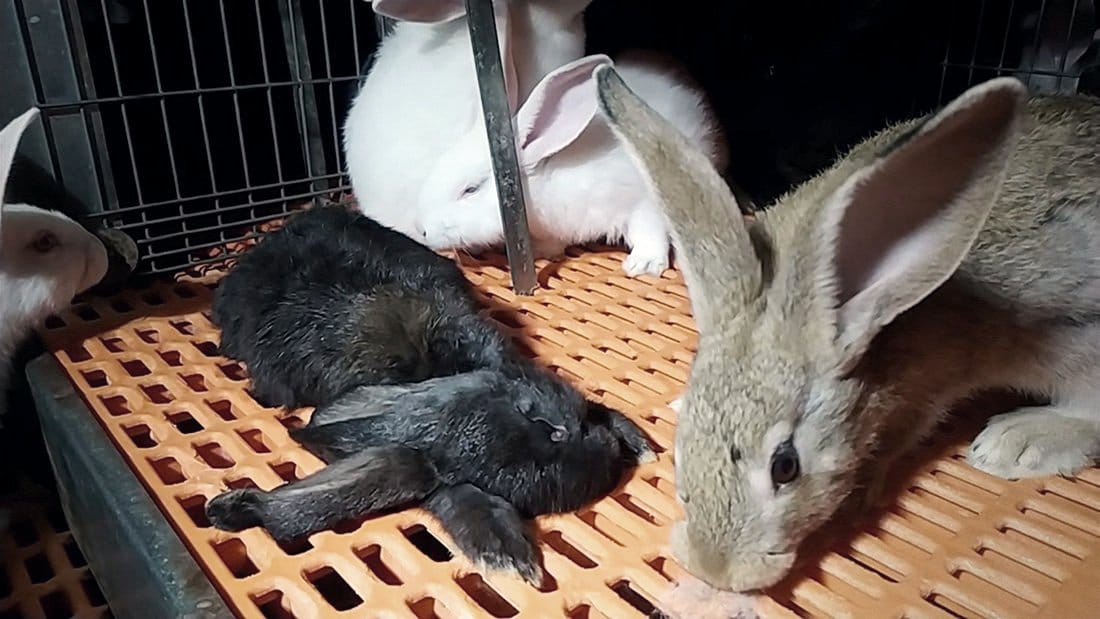
Ongehoord filmed numerous weak, sick, and dead rabbits in Konzo's park cages. The breeder's records indicated that many rabbits die each day. On peak days, mortality in this section reached as high as 40 dead rabbits in one day.
Abuse before transport
After 10 weeks, the meat rabbits reach slaughter weight. Using a hidden camera, Ongehoord filmed how the industry collected the animals from the cages for transport to the slaughterhouse. During this process, both the staff and manager De Bie applied considerable force.
Workers grabbed rabbits from the park cages by their fur, ears, feet, and heads, often taking two at a time. The animals panicked and attempted to escape. Rabbits that showed signs of illness were tossed aside into a separate cage, while others were stacked on top of each other in a cart. This treatment is stressful and painful, posing a risk of injury for both the rabbits being thrown and those in the cart, who are struck by falling rabbits.
Carts full of rabbits are wheeled to the barn exit. At this point, workers lift the animals by their sensitive body parts and throw them into transport crates.
Belgian rabbit industry
Besides Konzo, there are around fourteen other professional rabbit breeders in Belgium, mainly located in Flanders. With Belgian and Flemish laws regarding park housing, the industry asserts that it is a leader in animal welfare. Park cages have been required for meat rabbits (aged 5 weeks to slaughter) since 2016, and starting in 2025, they will also be required for female rabbits. Through subsidy programs, the industry can transfer a substantial portion of the costs associated with transitioning to "animal-friendly park housing" to the taxpayer.[16]
However, professional literature indicates that park cages do not ensure a good life for rabbits. The filmed abuses at Konzo are not isolated incidents.
Diseases and mortality
The more animal-friendly plastic cage floors in parks have, in practice, introduced new hygiene issues. The plastic floors become contaminated more rapidly than the old wire floors because manure does not drain properly through the holes. Additionally, plastic grids are prone to damage from rabbits gnawing on them. Pathogens build up in these damaged areas, making it challenging to thoroughly clean and disinfect the cages. Due to inadequate hygiene in the park cages, serious rabbit diseases such as coccidiosis and potbelly disease spread more rapidly.[17]
Although every breeding farm has a veterinarian and the rabbits are not at risk from predators, hunters, agricultural machinery, food shortages, or adverse weather conditions, mortality rates in the Belgian rabbit sector remain alarmingly high, ranging from 20 to 25% of animals on breeding farms. The transition to park housing has not resulted in any improvement in this area.[18]
Aggression in mothers in groups
Currently, female rabbits are housed individually. Starting in 2025, the law will require keeping female rabbits in group enclosures. However, scientists are already warning about the risks associated with these group enclosures for female rabbits.
Although rabbits require social interaction with their peers, it is known that female rabbits in group enclosures can exhibit significant aggression, particularly during parturition and in the initial weeks following birth. This aggression arises from the limited space in an enclosure, which hinders the animals' ability to avoid one another. Fights can occur, resulting in injuries or even fatalities among the rabbits.[19][20]
The ILVO agricultural institute explored options for semi-group housing, where mother rabbits give birth in individual farrowing cages and only move to group housing a few weeks later. ILVO notes that aggression issues remain unresolved with semi-group housing. In every experimental setup, the researchers still observed numerous injuries, both in mother rabbits and in their young.[21]
Conclusion: stop the rabbit industry
Contrary to the claims made by VLAM, the rabbit industry, and supermarkets, rabbits struggle to show natural behavior in park cages. The plastic floors stop them from digging burrows. Each meat rabbit has just 800 cm² of space in a park cage, which is about the size of one and a half A4 sheets of paper. Inside the cage, there’s only a short piece of PVC pipe for 30 rabbits, a far cry from the long underground tunnels that wild rabbits use for shelter. The artificial repeated insemination of mother rabbits is anything but "natural."
When it comes time for slaughter, capturing, loading, and transporting large groups of rabbits cannot be done humanely. Workers, often under pressure, have no choice but to forcibly pull the animals from their cages. Grabbing the rabbits by their sensitive body parts and throwing them leads to injuries and fractures.
Ongehoord's investigation shows that modern cages and stricter welfare regulations cannot eliminate animal suffering in the rabbit farming industry. Restructuring the rabbit sector is the only way to prevent this suffering.
What can you do?
Share this investigation
Share this investigation with people around you.
Sources
15 sources
Rabbit - Natuurpunt
[Rabbit](Waarnemingen.be waarnemingen.be/species/409) (waarnemingen.be)
Welfare issues in commercial rabbit farming. RDA (1097)
Discomfort in rabbits, turkeys, ducks, sheep and goats. Wageningen UR (2009)
European Agricultural Support (belpa.be)
Rabbit (Delicious from here)
Animal welfare is always our top priority. Farmer & gardener (2020)
Park rabbit with guaranteed origin. Lonki Slaughterhouse
Quick scan information set Covenant on Animal-Friendly Livestock Farming. Faculty of Veterinary Medicine, Utrecht University (2022)
File on animal-friendly housing of rabbits. Farmers' Union, Management & Technology (2014)
Technical manual rabbit breeding. Hycole (2019)