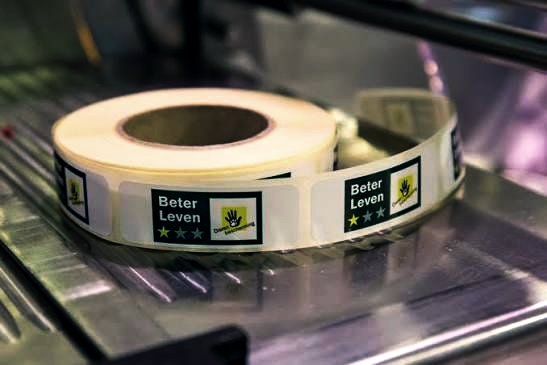
A roll of stickers with the Beter Leven logo and three stars on a machine.

Beter Leven: from animal welfare label to a billion-euro market

Financial appendix

Next year the Beter Leven label celebrates its twentieth birthday. In those 20 years the initiative of the Dutch Society for the Protection of Animals (Dierenbescherming) has grown into the largest sustainability label in the Netherlands. Every year, billions of euros' worth of products carrying the Beter Leven logo are sold. Supermarket sales of Beter Leven products rose from around €517 million in 2014 to almost €6 billion in 2025. That is more than a tenfold increase in eleven years. The Dierenbescherming's income rose steeply along with it and is estimated to come to around 3 million in 2025.

For the rapid growth and success of the label in its first years, the Dierenbescherming had help from the government. In 2009 the Ministry of LNV concluded an agreement with market parties and the Dierenbescherming that formed the basis for rolling out the Beter Leven label. The minister also opened her wallet. The Dierenbescherming received more than a million in subsidies for the development and promotion of the Beter Leven label. Retailers such as AH and Jumbo also received subsidies to promote the label to consumers.

In this way the ministry wanted to neutralise public criticism of livestock farming. The animal industry is almost continuously confronted with scandals around animal welfare and food safety. The label was meant to win back trust and keep meat sales up. That the Beter Leven label does indeed encourage meat consumption was recently demonstrated. Investigation group Ongehoord looked into how the proceeds of Beter Leven are divided. A Beter Leven star looks like a simple deal between consumer and farmer: you pay a little more, the pig gets a better life. The Dierenbescherming writes that one-star products are on average some 5 to 15 percent more expensive, because farmers make investments and have higher production costs. In reality, between consumer and pig sits a chain in which slaughterhouses and supermarkets hold an important position. And they take their cut.

To make the enormous money flows of the Beter Leven label visible, we look at the extra price the consumer pays per kilo of pork. The Producers' Organisation for Pig Farming (POV) had Wageningen Economic Research develop a BLK Fair Price. A number of interesting facts emerge from it. In the years 2021 to 2023, regular pork in the supermarket cost on average €7.95 per kilo, against €8.41 for one-star Beter Leven. A difference of 46 cents, or 5.8 percent.

In this period the supermarket paid on average 41 cents per kilo more for Beter Leven pork, €5.89 instead of the €5.48 for regular meat. Of the 46 cents higher consumer price, 41 cents therefore went into the supermarket's higher purchase price. The supermarket thus has €0.05 extra margin per kilo of Beter Leven meat. According to the researchers, however, those 5 cents are not extra profit for the supermarket. For BL1, WUR attributes higher 'other costs' to the retailers. The public figures do not show why those costs are higher for BL1. The only expenses Ongehoord could find for the supermarkets consisted of at most €18,264 in logo contribution and €4,092 in fixed contribution per year to the Dierenbescherming. Yet the figures show that the costs for retail are considerably higher and that they make more profit per kilo on regular meat. Apparently the improved image makes up for it. Perhaps the supermarkets believed meat sales would fall without the label.

The 41 cents extra the supermarket pays goes for the most part to the slaughterhouses and processors, around 60%. They do not have to do much for it: there are virtually no requirements for Beter Leven slaughterhouses. The costs slaughterhouses incur are partly administrative. They often also act as chain coordinator: they explain the label's requirements to the farmer and carry out the admission inspection at the farm. These companies also pay a fixed contribution of at most €4,092 to the Dierenbescherming. A cost item for the slaughterhouse is that a large part of the pig will not be sold as BLk, because there is no market for it in the Netherlands. They do buy those parts at the BLk price, but sell them on the international market without a label.

How much extra a BL1 farmer gets for his pigs is not fixed. The Beter Leven label itself has no fixed premium per kilo; the payment depends on the agreements with the slaughterhouse or the chain the farmer supplies. In an article from 2025 an adviser calculates that participants in the Beter Leven label receive on average 18 to 19 cents per kilo of carcass weight more than their conventional colleagues.

Other sources also show what the payment for the farmer can be. Slaughterhouse Westfort, for example, reported in February 2026 that participating BL1 pig farmers can receive €16 per pig on top of the base price. A pig has on average 100 kilos of 'carcass weight', so that would amount to 16 cents per kilo more revenue.

How much of those 16 cents goes to a better life for animals, how much does the farmer need for, say, extra administration, and what is the farmer's profit? That is hard to say. The largest cost item for the farmer is probably the space requirement. A fattening pig under Beter Leven 1 star has 0.9 m² of space against 0.72 m² in the regular sector (in groups larger than 40 pigs and up to a weight of 110 kilos). More space means fewer pigs can be kept in the same barn. New requirements can moreover make renovations and investments necessary. Exactly how much more a BL1 pig costs is not easy to establish. Various commercial BL1 chains use their own cost price model. According to the BLK Fair Price, the calculated cost price in 2024 was around €2.10 per kilo. The cost price for a pig without a star was €1.82 in 2024. That the pig farmers were not fully compensated for this 28-cent difference does not necessarily mean they lost out. There are also a great many national and provincial subsidies, tax schemes and interest discounts that encourage making barns more sustainable. The certainty that your pigs will be bought is also a reason to switch to the label.

In the Agro-Nutri Monitor 2025, 38 percent of the pig farmers surveyed name sales certainty as a motive; 69 percent name the higher revenue. Apparently the costs for this group were a good deal lower than the 28 cents per kilo of the BLK Fair Price. This is also confirmed by the percentage of Beter Leven pig farmers making a profit. In the period 2021–2023 that was 57%, against 35% of regular farms that were profitable.

According to calculations, the additional adjustments that had to be met from 2025 (such as the requirements for more windows or light tubes) led to a cost price increase of 6.5 to 10 cents per kilo. Albert Heijn decided to pay affiliated pig farmers at most six cents per kilo extra for the necessary investments, for a maximum of five years. Even so, a hundred pig farmers left the label in 2024, probably partly because of the new requirements.

How much the Dierenbescherming profits from the growth of the label is not entirely clear. In 2023 the Stichting Beter Leven-keurmerk (SBLk) was separated administratively and financially from the Dierenbescherming. Unlike the Dierenbescherming, SBLk has no charity status and the foundation is therefore not bound by the associated obligation to publish a financial account. Accordingly, the foundation does not publish full annual accounts. In 2021 SBLk said about this: "The label market is very complicated and an awful lot of money is involved; 'Angry farmers and other forces' make it 'not desirable in all cases' for the finances to be easily known." Investigation group Ongehoord has nevertheless been able to make a good estimate of the money flows from the meat industry to the Dierenbescherming. In doing so we make no distinction between the income of the Dierenbescherming and that of its foundation Beter Leven keurmerk, because responsibility for the label lies with the Dierenbescherming.

The historical development looks like this:
2012: 0.49 mln, 2013: 0.75 mln, 2014: 0.86 mln, 2015: 1.07 mln, 2016: 1.35 mln, 2017: 1.61 mln, 2018: 1.74 mln, 2019: 1.92 mln, 2020: 2.03 mln, 2021: 2.2 mln, 2022: 2.31 mln, 2023: 2.57 mln (Estimate), 2024: 2.67 mln (Estimate), 2025: 2.87 mln (Estimate), 2026: 3.09 mln (Estimate)

Estimate

Figure 1. Income of the Dierenbescherming from the Beter Leven label, in million euros. The income for 2023–2026 is estimated.
2012: 0.46 bn, 2013: 0.43 bn, 2014: 0.44 bn, 2015: 0.56 bn, 2016: 1.12 bn, 2017: 1.58 bn, 2018: 2.42 bn, 2019: 2.73 bn, 2020: 2.99 bn, 2021: 3.24 bn, 2022: 3.75 bn, 2023: 5.1 bn, 2024: 5.3 bn, 2025: 5.7 bn, 2026: 6.13 bn (Estimate)

Estimate

Figure 2. Supermarket sales of Beter Leven products (BLK sales), in billion euros. The sales for 2026 are estimated.
Table 1. Income of the Dierenbescherming from the Beter Leven label and BLK sales in the supermarket, with the increase on the previous year.
YearIncome DierenbeschermingBLK salesIncrease in incomeIncrease in BLK sales
2012€0.492 mln€0.458 bn——
2013€0.748 mln€0.426 bn+52.0%-7.0%
2014€0.858 mln€0.441 bn+14.7%+3.5%
2015€1.068 mln€0.563 bn+24.5%+27.7%
2016€1.345 mln€1.118 bn+25.9%+98.6%
2017€1.610 mln€1.579 bn+19.7%+41.2%
2018€1.735 mln€2.419 bn+7.8%+53.2%
2019€1.921 mln€2.726 bn+10.7%+12.7%
2020€2.026 mln€2.990 bn+5.5%+9.7%
2021€2.200 mln€3.242 bn+8.6%+8.4%
2022€2.310 mln€3.750 bn+5.0%+15.7%
2023approx. €2.574 mln€5.100 bn+11.4%+36.0%
2024approx. €2.674 mln€5.300 bn+3.9%+3.9%
2025approx. €2.87 mln€5.700 bn+7.5%+7.5%
2026approx. €3.09 mlnapprox. €6.130 bn+7.5%+7.5%

Estimate (in italics)

The income from the label can be split into three parts. First there is the logo contribution: participants who sell products carrying the label to consumers pay a contribution for it to the Dierenbescherming. This is a relatively small amount, probably €140,000 to €170,000 a year. Second, slaughterhouses, processors and supermarkets pay a fixed contribution to SBLk, an amount ranging from €420 for small companies to €4,092 for companies with more than 15 employees. Third, the Dierenbescherming earns money per slaughtered animal. For every slaughtered pig, for example, that is 10 cents.

In SBLk's rate table every slaughtered animal is given an amount with 4 decimal places; eggs are charged per 360, dairy per 100 kilos. The contribution is calculated as a fixed percentage of their economic value.

Table 2. Variable contribution to SBLk per unit, 2026 rates.
UnitVariable contribution 2026 (excl. VAT)
Per rabbit€0.0042
Per head of cattle€1.7137
Per pig€0.1050
Per broiler chicken€0.0019
Per spent laying hen€0.0002
Per turkey€0.0127
Per 360 eggs€0.0174
Per 100 kg dairy€0.0242

By carrying the percentage increase in BLK sales over to the income, the investigation group arrives at an estimate of €2.87 million in 2025. We see that this varied widely in the past, so the Dierenbescherming's actual income could be either higher or lower. The starting point, the income in 2023, is also an extrapolation. The Dierenbescherming has only made public the income up to 1 September 2023.

What the Dierenbescherming and its Stichting Beter Leven-keurmerk spend all that income on is a mystery. We do know they do not use the money for inspections. The farmer pays for the inspection of his farm by a certification body himself. The foundation's work was initially limited to administering the label. Neither the Dierenbescherming nor SBLk may make a profit. This means the millions in income from the label cannot be paid out to shareholders as profit. The money has to be used for the foundation's purpose and activities.

What is interesting is how the spending of that growing income develops over time. As early as 2021 the articles of association were specially amended so that SBLk could use funds for: "communication about and relating to the BLk in the interest of the participants". After SBLk was unbundled in 2023, the legal and financial decoupling from the Dierenbescherming, this also becomes visible. In national campaigns, through influencers and with paid content in (daily) papers, the Dierenbescherming promotes the consumption of Beter Leven meat.

In 2024 the Dierenbescherming runs two large campaigns to encourage consumers to choose Beter Leven products more often. Recognition of the label rises from 43 percent in 2023 to 51 percent in 2024. Four influencers together reach 529,334 people. In 2025 paid editorial content appeared in De Telegraaf and VROUW, online and in print. In addition, a Beter Leven flyer was distributed to 500,000 households. The total campaign costs are not public. Based on public market and advertising rates, the commercial value of the paid media, the distribution of 500,000 flyers and the use of four influencers could roughly be in the order of €100,000 to €200,000.

What cannot yet be established from the public documents is exactly what amounts are involved. Precisely since the unbundling, those figures cannot be taken from the Dierenbescherming's annual accounts. The 2023 annual accounts confirm that SBLk's result is included in the Dierenbescherming's figures only up to and including 31 August. Incidentally, the unbundling does not mean SBLk has become fully independent. The Dierenbescherming remains owner and substantive guardian of the label. It is an administrative and financial separation, without the substantive and contractual tie with the Dierenbescherming being cut.

The Dierenbescherming keeps insisting that it pays money into the label. Investigation group Ongehoord considers this unlikely, because the label's turnover has grown enormously, but the Dierenbescherming's costs have not. Should this nevertheless be true, another problem arises. Because in that case the Dierenbescherming is using donors' money to boost the animal industry's sales.

Of the 46 cents extra the consumer pays for a kilo of Beter Leven pork, only 16 to 19 cents ends up with the farmer. It is therefore not surprising that in video footage of the Beter Leven barns the difference with regular is barely visible. Although many farmers say they take part in the label because of the higher revenue, sales certainty appears to be the more important motivation. It is mainly the slaughterhouses and processors that pocket a large part of the extra price. The Dierenbescherming, too, does very well financially through its Stichting Beter Leven keurmerk thanks to the income from the animal industry. For all parties, the Beter Leven label is a good way to polish their image and boost sales.

What can you do?

Share this investigation

Share this investigation with people around you.

115 sources

  1. beterleven.dierenbescherming.nl

  2. beterleven.dierenbescherming.nl

  3. beterleven.dierenbescherming.nl

  4. wetten.overheid.nl

  5. beterleven.dierenbescherming.nl

  6. beterleven.dierenbescherming.nl

  7. efsa.onlinelibrary.wiley.com

  8. beterleven.dierenbescherming.nl

  9. beterleven.dierenbescherming.nl

  10. facebook.comOriginal no longer reachable (checked 2026-10-17)

  11. edepot.wur.nl/722207 meldt een omzet van 5,7 miljard euro.

  12. beterleven.dierenbescherming.nl/over-het-keurmerk/veelgestelde-vragen. Beter Leven noemt voor één ster een meerprijs van ongeveer 5–15 procent en koppelt die aan investeringen en hogere kosten bij veehouders.

  13. Wageningen Economic Research / POV – BLK Fair Prijs. Uitleg over de verschillende kostprijzen: www.nieuweoogst.nl/nieuws/2024/02/05/onafhankelijkheid-blk-fair-prijs-positief.

    Archived

  14. research.wur.nl/en/publications/agro-nutri-monitor-2025-achtergrondrapport-monitor-prijsvorming-v. Bron voor de vergelijking €7,95 versus €8,41 per kilo, de inkoopprijzen en de berekende nettomarges. De cijfers betreffen gemiddelden over 2021–2023 en zijn dus geen actuele winkelprijzen van 2026.

    Archived

  15. Stichting Beter Leven keurmerk, Fees BLL 2025, herzien op 24 januari 2025, p. 1–3. Voor grote retailketens bedraagt de jaarlijkse logobijdrage €18.264; de jaarlijkse vaste bijdrage voor een groot bedrijf (>15 fte) bedraagt €4.092 per bedrijfslocatie. Bedragen exclusief btw. De logobijdrage komt ten gunste van de Dierenbescherming; de vaste bijdrage wordt betaald aan SBLk. beterleven.dierenbescherming.nl/zakelijk/wp-content/uploads/sites/2/2025/04/participation-fees-SBLk-2025-V1.1.pdf.

    Archived

  16. Follow the Money, 2021 – Beter Leven-kip bezorgt vooral supermarkten een beter leven.

  17. Stichting Beter Leven-keurmerk – criteria varkens. Bron voor de verschillen tussen gangbaar en één ster, waaronder leefruimte en aanvullende welzijnseisen: beterleven.dierenbescherming.nl/over-de-dieren/alle-dieren/varkens.

  18. Zie www.rvo.nl/onderwerpen/welzijnseisen-dieren/huisvesting-verzorging/varkens. De ruimte van 0,8 m² is tot 110 kilo levend gewicht bij regulier, bij BLk en regulier mag je daarnaast 10% minder doen bij groepen > 40, dus minimaal is dan 0,72 of 0,9 m².

    Archived

  19. Zie edepot.wur.nl/695941, pagina 84.

  20. De reeks over de eerste jaren is onder meer terug te vinden in onderzoek van Ongehoord, gebaseerd op de jaarverslagen van de Dierenbescherming (www.ongehoord.nl/nl/onderzoek/beter-leven). BLK-omzet: historische Monitors Duurzaam Voedsel (Wageningen Economic Research), www.agrimatie.nl/ThemaResultaat.aspx?indicatorID=2662&subpubID=2232&themaID=2810. De reeks kent methodewijzigingen: 2013–2017 betreft een beperktere supermarktdekking. Het bedrag voor 2018 is in de Monitor 2019 herberekend van €1,649 naar €2,419 miljard, onder meer door ophoging naar alle supermarkten. De jaarbedragen vormen daarom geen volledig vergelijkbare groeireeks. De stijgingspercentages zijn de verandering ten opzichte van het voorgaande jaar. Door methodewijzigingen en herberekeningen betekenen verschillen tussen jaarbedragen niet altijd werkelijke marktgroei; met name 2017–2018 is niet rechtstreeks vergelijkbaar.

    Archived

  21. De opbrengsten over 2023–2026 zijn ramingen door extrapolatie. De baten 2023 zijn 1,7 miljoen tot 1 september. Extrapolatie geeft 1,7/8x12=2,57 miljoen. Dit is waarschijnlijk te laag i.v.m. de piek in vleesconsumptie in december. Vanaf 2023 volgen we de percentuele omzetstijging, die in het verleden zowel hoger als lager kunnen liggen dan de percentuele opbrengsten voor de Dierenbescherming.

    Sinds de verzelfstandiging van SBLk per 1 september 2023 worden de totale SBLk-opbrengsten niet meer opgenomen in de openbare geconsolideerde jaarrekening van de Dierenbescherming. De kolomtitel omvat hier de historische keurmerkopbrengsten inclusief SBLk en de doorgetrokken ramingen; deze zijn niet gelijk aan de eigen inkomsten van de Dierenbescherming na de verzelfstandiging, die zij wel publiceert. De verhouding is een rekenaanname: deelnemersbijdragen zijn niet rechtstreeks aan consumentenbestedingen gekoppeld.

  22. De Staat van Landbouw, Voedsel, Visserij en Natuur, Duurzaam voedsel naar keurmerk, gegevens Monitor Duurzaam Voedsel 2024. www.staatvanlandbouwnatuurenvoedsel.nl/kerncijfers/duurzaam-voedsel-naar-keurmerk.

    Archived

  23. De Staat van Landbouw, Voedsel, Visserij en Natuur, Duurzaam voedsel naar keurmerk, gegevens Monitor Duurzaam Voedsel 2024. www.staatvanlandbouwnatuurenvoedsel.nl/kerncijfers/duurzaam-voedsel-naar-keurmerk.

    Archived

  24. edepot.wur.nl/722207 meldt een omzet van 5,7 miljard euro.

  25. Ook de BLK-omzet voor 2026 is een extrapolatie: de groei van €5,3 miljard in 2024 naar €5,7 miljard in 2025 (+7,55%) is doorgetrokken naar 2026, circa €6,13 miljard. Bij toepassing van 0,0616% resulteert circa €3,78 miljoen aan geraamde keurmerkopbrengsten. Dit zijn geen gerealiseerde jaarcijfers.

  26. Stichting Beter Leven keurmerk, Tarieven BLk 2026, 23 december 2025, versie 1.1, p. 1–3. De variabele bijdrage wordt aan SBLk betaald door slachterijen, eierpakstations en zuivelondernemingen. De tarieven zijn gebaseerd op 0,05337% van de economische waarde volgens KWIN. beterleven.dierenbescherming.nl/zakelijk/wp-content/uploads/sites/2/2026/01/Tarieven-SBLk-2026-1.pdf.

  27. De vier influencers die de Dierenbescherming in 2024 voor de Beter Leven-campagne inzette waren Francesca Kookt, Jurino, Noortje Geerts en De Club van Relaxte Moeders. Samen bereikten zij volgens het jaarverslag van de DB 529.334 personen.

  28. In de Telegraaf ging het om 8 verhalen. De tariefkaart staat hier: www.mediahuis.nl/files/_nederland/files/tariefkaart-online-direct-2026-v1.09.pdf. Voor de schatting van de verspreiding van de flyers is deze tariefkaart gebruikt: www.uwfolderverspreiding.nl/folderverspreiding-nederland.

  29. Zie onderzoek Ongehoord uit 2021: www.ongehoord.nl/nl/onderzoek/beter-leven.