
Chapter 2 / 4
Journey of suffering from farm to slaughterhouse
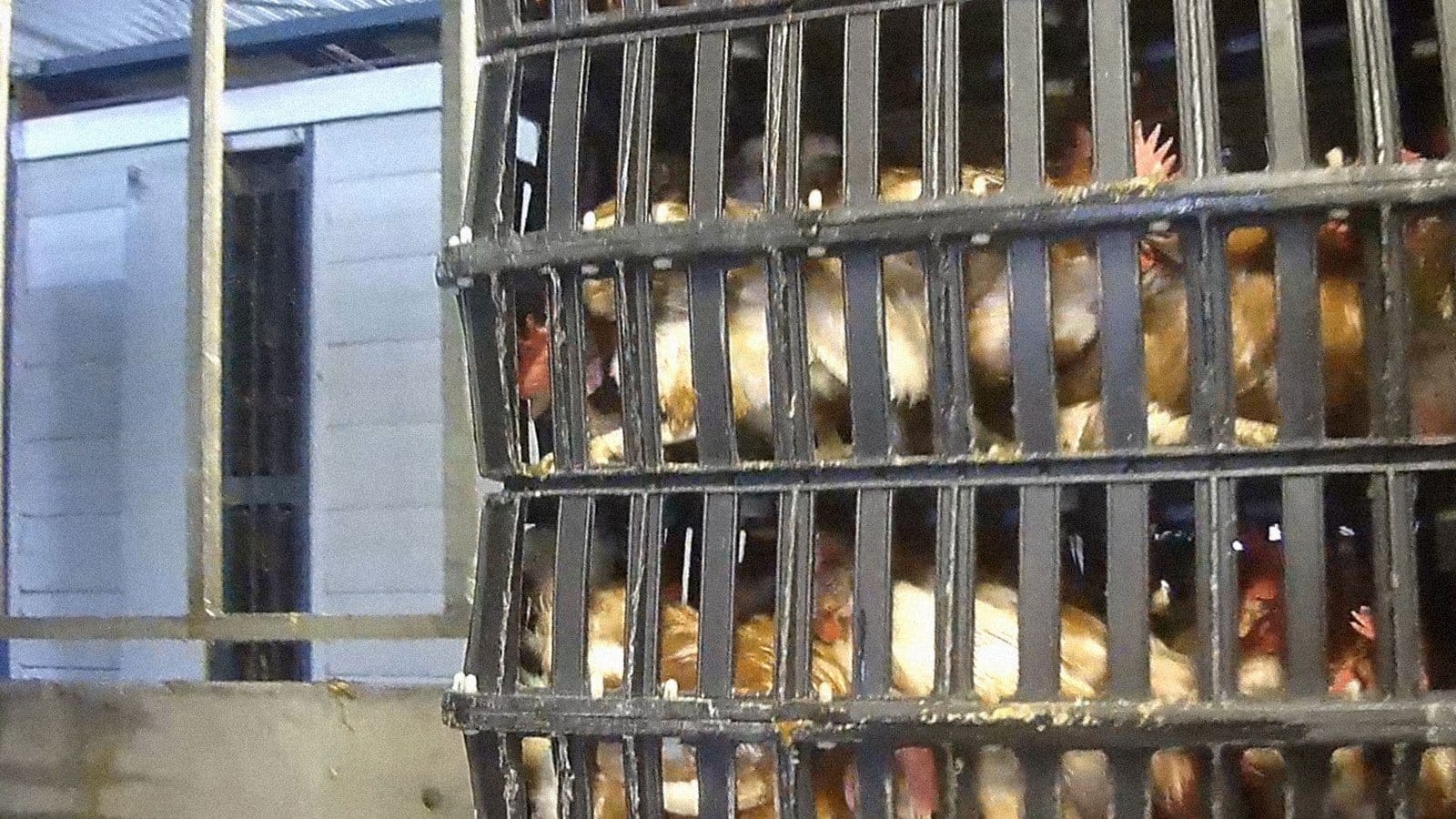
Before chickens are transported to the slaughterhouse, they are deprived of food to empty their stomachs and crops. This practice aims to minimize contamination of transport crates and carcasses on the slaughter line. Typically, the birds receive their last feed on the morning of the day they will be transported to the slaughterhouse (transport occurs in the evening). Occasionally, this feed is skipped, and the birds were last fed the evening before they are captured. Depending on the length of transport and waiting times for unloading at the slaughterhouses, the food deprivation period can be extended. Broilers are fasted for a maximum of 24 hours before slaughter, while laying hens typically experience an average deprivation period of 28 hours. [16] Capturing in the barn occurs in the evening when the chickens are asleep. Emptying a chicken coop takes an average of 2.8 hours and is associated with significant stress and pain. [17] The chickens are picked up by the legs and carried upside down, three to four at a time, before being crammed into a transport crate. This handling can lead to injuries for the chickens. [18] Research conducted by WUR (Wageningen University Research) on capture injuries in broiler chickens found that 5% of the birds had wing hemorrhages, and 2.9% had wing dislocations (where the bones are no longer in their proper position). Additionally, wing fractures (0.1%) and leg dislocations (0.1%) were observed. [19] When calculated over the 600 million broiler chickens slaughtered annually in the Netherlands, this translates to 30 million chickens with wing hemorrhages, over 17 million with wing dislocations, 600,000 with wing fractures, and 600,000 with leg dislocations. No figures are available regarding capture injuries in laying hens. According to the EFSA (European Food Safety Authority), the risk of capture injuries (including injuries, dislocations, and fractures) is higher in laying hens due to their brittle bones (osteoporosis) resulting from the high calcium demand during laying. [20] The Netherlands Food and Consumer Product Safety Authority (NVWA) conducts random checks for injuries sustained during capture in poultry slaughterhouses. If they find that more than 2% of a batch of animals has sustained injuries during capture, they can take enforcement action. However, injuries smaller than 3 centimeters are not included in NVWA inspections. [21] During the journey to the slaughterhouse, chickens experience stress due to unfamiliar surroundings, climatic factors (such as cold, heat, and humidity), deprivation of feed and water, dehydration, vibrations, high stocking densities, and injuries. The level of stress experienced is partly influenced by the animal's condition (for instance, well-feathered chickens are better insulated against cold and heat) and the duration of the transport. [22] According to data from the Netherlands Food and Consumer Product Safety Authority (NVWA), an average of 0.14% of broiler chickens and between 0.15% and 0.17% of laying hens die during transport, resulting in over 800,000 animals arriving dead at Dutch poultry slaughterhouses each year. This figure is even higher abroad due to longer distances. No data are available for laying hens, but the percentage for broiler chickens in slaughterhouses in Poland and Denmark is just over 0.3%, compared to 0.14% in the Netherlands, which is more than double. [23] Upon arrival at the slaughterhouse, there are hours-long waiting times before the chickens are slaughtered. At broiler slaughterhouses, the containers with the animals are removed from the trucks upon arrival and placed in a waiting area. In laying hen slaughterhouses, trucks enter the receiving area, and the crates containing the animals remain on the truck for the entire waiting period. [24] Research by WUR at the W. van der Meer laying hen slaughterhouse found that trucks carrying hens spent an average of 2 hours on the road, followed by 8 hours in the slaughterhouse's receiving area. Because the hens are crammed together in the crates (10 to 15 hens per crate), they struggle to dissipate heat. Although fans were provided in the reception area, it was found that the temperature in the crates exceeded 25 degrees Celsius for a quarter of the waiting period, which can lead to heat stress in laying hens. The investigation was conducted during winter. For animals transported to the slaughterhouse in summer, the risk of heat stress is significantly higher. [25] Heat stress can be fatal for chickens. The animals pant, which alters their blood pH. This can lead to heart problems. Their body temperature also rises sharply. A chicken's normal body temperature is around 41.5°C; if it rises to 44°C, the chicken will not survive. [26] The poultry sector refuses to participate in the official Dutch heat plan for animal transport. The sector continues to adhere to “its own heat protocol on a voluntary basis.” [27] In the summer of 2019, the Netherlands Food and Consumer Product Safety Authority (NVWA) noted poultry transports in which 30 to 40 percent of the animals appeared to have died. The EFSA also identifies heat stress as a serious issue during transport and waiting times in chicken slaughterhouses. In facilities like W. van der Meer, where crates containing chickens remain while they wait for the truck, there is no way to provide the animals with ventilation by spacing the stacks of crates over a larger area. In addition to heat stress, EFSA identifies the following welfare problems during the waiting period: hunger, thirst, lack of space to move, and stress caused by environmental noise (such as machines and noisy staff). [29] Once the waiting period is over, the truck is unloaded, which takes another two hours. The stacks of crates are pulled off the truck and placed on a conveyor belt. According to EFSA, during the unloading and moving of crates, chickens sometimes extend their legs, wings, or heads, resulting in injuries or crushing of body parts. [30] W. van der Meer's undercover footage also shows an employee cleaning the trucks with a high-pressure cleaner before all the chickens have been unloaded. The birds still on the truck are sprayed with water, which compromises their welfare. Laying hens are thin and often poorly feathered, leaving them without natural protection against the water. In principle, trucks may only be cleaned when they are empty, but for practical reasons (to save time and due to lack of space in the waiting area), the cleaning of half-empty trucks is tolerated.
Sources
- 16
Niekerk et al (2015) Food and water during transport of poultry. Wageningen UR Livestock Research. Report 752; p. 20
- 17
Niekerk et al (2014) Welfare of laid hens during capture and transport in the winter period. Wageningen UR Livestock Research. Report 758; p. 28
- 18
- 19
Gerritzen et al (2019 Injuries and damage to broiler chickens resulting from capture, transport and handling on the slaughter line. Wageningen Livestock Research. Report 1107; p. 17 and p. 29
- 20
EFSA Panel on Animal Health and Welfare (2011). Scientific Opinion Concerning the Welfare of Animals during Transport. EFSA Journal; p. 47
- 21
NVWA . K-PL-WLZ-WV-01 Appendix 7, Explanation of the capture injury count; p. 3
- 22
Niekerk et al. (2015) Feed and water during poultry transport. Wageningen UR Livestock Research. Report 752; p. 3
- 23
BuRO Advisory Report on Poultry Supply Chain Risks. March 28, 2018; p. 31
- 24
Niekerk et al. (2015) Feed and water during poultry transport. Wageningen UR Livestock Research. Report 752; p. 20
- 25
Niekerk et al. (2014) Welfare of spent hens during capture and transport during the winter period. Wageningen UR Livestock Research. Report 758; p. 39
- 26
Prevent heat stress in your chickens. ILVO, Poultry Desk.
- 27
Poultry sector sticks to its own heat protocol. Farm, June 2019.
- 29
EFSA Panel on Animal Health and Welfare (2019) Slaughter of animals: poultry. EFSA Journal; p35 and p. 38
- 30
EFSA Panel on Animal Health and Welfare (2019) Slaughter of animals: poultry. EFSA Journal; p. 38