
Chapter 3 / 4
Gassing, electrocution, bleeding to death
In Dutch poultry slaughterhouses, workers use two methods to stun animals before slaughter: gassing and electrocution.
Gasification
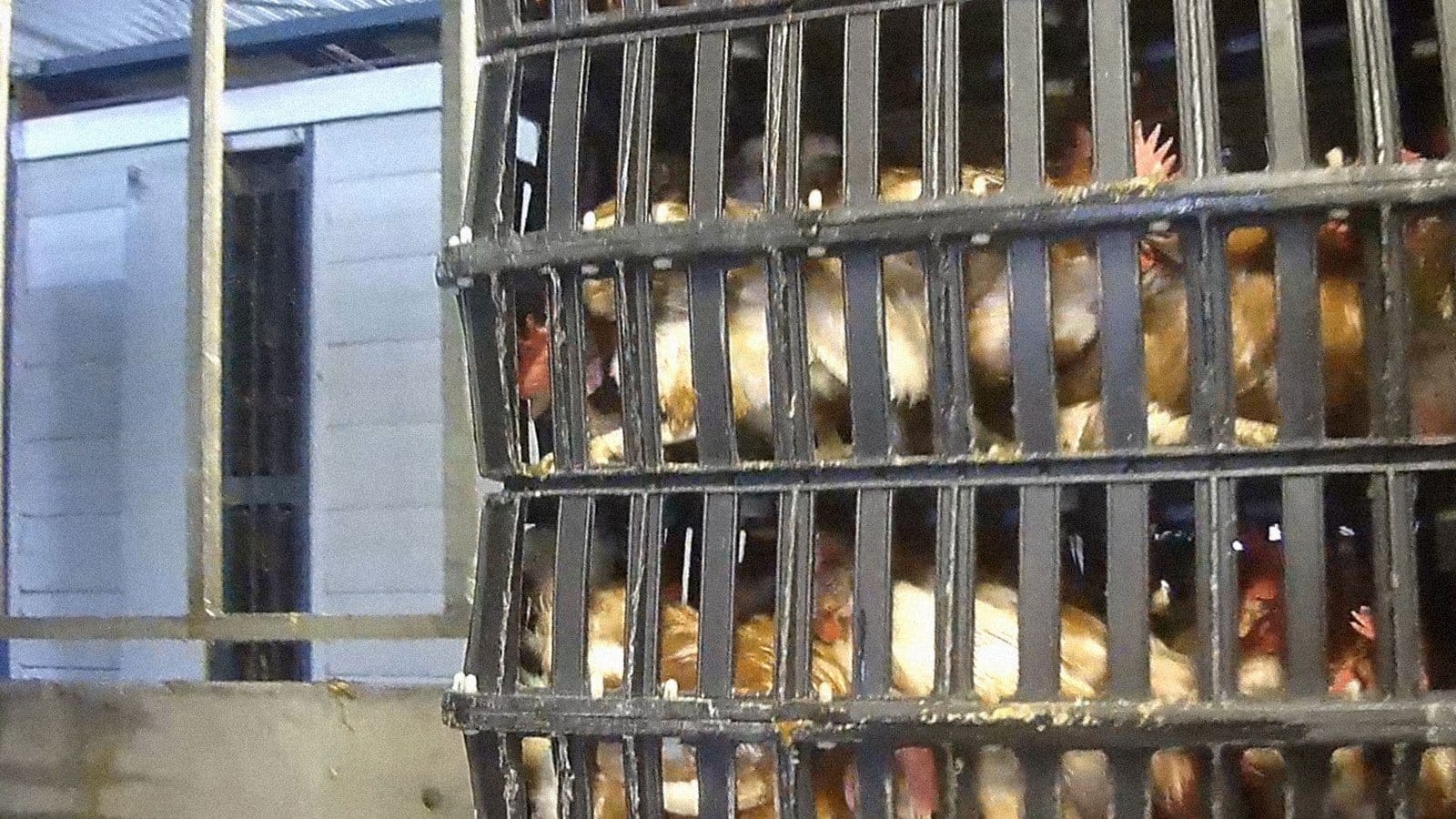
Most large poultry slaughterhouses use the gas method. In some facilities, the containers holding the animals are placed directly on a conveyor belt that transports them into the gas chamber. The animals are only removed from the containers after they have been stunned. However, in many cases (two-thirds of all chickens slaughtered in the Netherlands), the containers are mechanically tipped before stunning, causing the conscious animals to fall onto a conveyor belt. Inspections by the Netherlands Food and Consumer Product Safety Authority (NVWA) have found that tipping the containers at several slaughterhouses is abusive: the animals fall and land on top of one another, which can lead to injuries. It is estimated that at least 13 million animals are subjected to this annually. An advisory report by BuRO (Bureau for Risk Assessment & Research) also concludes that even if the tipping is performed carefully, a significant number of animals can still experience stress and pain. [31] The conveyor belt transports the chickens, whether in containers or not, through the gas chamber. Carbon dioxide gas is used for the gassing process. Inhaling high concentrations of carbon dioxide (over 40%) causes painful irritation of the mucous membranes and symptoms of suffocation, such as shortness of breath. The industry claims to have developed a humane gassing method using a two-phase system. In the first phase, a low concentration of carbon dioxide (18-38%) is administered, which is said to reduce stress and pain. During this phase, the chickens become reversibly stunned (meaning they can still regain consciousness). In the second phase, a high concentration of gas (65%) is administered, leading to irreversible stunning (a stunning that results in death). However, research has shown that even at low carbon dioxide concentrations, stress and suffering occur, evidenced by increased alertness, head shaking, and heavy breathing. The gradual increase in carbon dioxide levels and the duration of exposure also significantly affected the occurrence of stress signals. Within 30 seconds of exposure to 18-20% carbon dioxide, chickens began to lose their balance and become unconscious. [32] Another study by Wageningen University & Research (WUR) demonstrated that chickens became more alert and reacted to carbon dioxide gas even at 2.4% concentration. From 5.6% onwards, their breathing was affected, and from 8.3% onwards, the chickens began shaking their heads, a clear sign of stress. From 9.2% onwards, the chickens started visibly gasping for air and breathing heavily. From 19% carbon dioxide onwards, they lost their balance and became unconscious. [33]
Electric water bath
For commercial reasons, some slaughterhouses continue to use the electric water bath, as gas stunning costs 1 euro cent more per slaughtered chicken. [34] In this stunning method, chickens are manually removed from the crates and hung by their legs on the slaughter line. [35] According to EFSA, manually taking chickens from the crates can lead to pain, bruising, and fractures, particularly when workers grip the chickens by the neck, or by one leg or wing. [36] Blue light is employed when suspending the chickens, which usually has a calming effect on them. However, hanging them on the slaughter line remains a highly stressful experience. The hooks exert pressure on their legs, causing pain. For chickens with existing leg issues (such as joint problems or injuries from catching), this suspension is particularly agonizing. Hanging upside down is an unnatural position that induces fear. Ninety percent of birds flap their wings vigorously right after being hung, in response to the stress. This flapping can result in dislocations and broken wings. Chickens can also injure one another with their flapping since they hang closely together. [37] While the chickens are suspended on the slaughter line, they are plunged headfirst into an electrically charged saltwater bath at a rate of 9,000 birds per hour. [38] When a chicken flaps its wings just before submerging, the wings may touch the electrically charged water, delivering painful shocks before the animal is stunned. The animal only becomes unconscious once its head is submerged in the bath. [39] According to researcher Gerritzen ( WUR ), electric water bath stunning is akin to an epileptic seizure. Initially, there is a muscle spasm, known as the tonic phase. Next, the clonic phase begins, during which the animals thrash violently. This phase again poses the risk of broken wings and bones. [40] Another significant welfare issue with the water bath is that not every chicken is effectively stunned. Since multiple chickens enter the water bath simultaneously and the current follows the path of least resistance, some chickens receive inadequate power. Although the shock can physically paralyze the chickens, making them appear stunned, they remain conscious and can feel everything, often unnoticed by slaughterhouse staff or inspectors. Chickens sometimes raise their heads, preventing them from touching the water bath at all and thus not being stunned. According to the EFSA, 5% of chickens are not effectively stunned when using an electric water bath. [41] In 2006, the electric water bath became a major topic of discussion in the Netherlands after the testimony of former inspector Breunis. He explained in a TV program how, during his 33-year career, he had "often seen animals, even though they should already be dead, raise their heads and look around for a moment." They have endured all the horrors and then they slowly bleed to death.” It was also revealed that slaughterhouses systematically supplied the water bath with insufficient power. [42] Inspector Breunis's revelations sparked social and political debate and led to scientific research by Wageningen University & Research (WUR) on stunning methods in poultry slaughterhouses. In 2009, State Secretary H. Bleker and NEPLUVI (the Dutch poultry processing industry) announced that water bath stunning would be phased out in the Netherlands by January 2011, due to the serious animal welfare issues that had been scientifically proven. In 2010, Bleker and NEPLUVI stated that the phaseout would require some "additional time." [43] As of 2019, the inexpensive but controversial water bath is still utilized in several Dutch poultry slaughterhouses, including W. van der Meer and Sons in Dronryp. This is notable, considering that Wytze van der Meer (director of the slaughterhouse) is a board member of NEPLUVI. [44] At the European level, EFSA advised the European Union to phase out water bath stunning back in 2004. When drafting the European REGULATION (EC) No 1099/2009 on the protection of animals at the time of killing, the Union tightened the regulations on water baths somewhat, but the recommendation to phase it out was not implemented due to economic interests. [45] In many European countries, the water bath remains the most commonly used stunning method for poultry. This is also true in Belgium, where the method faced criticism in 2017 following an investigation by the newspaper "Het Laatste Nieuws." This investigation revealed that 10 million chickens in Belgium were poorly or not stunned when they emerged from the water bath each year. [46]
Cutting and bleeding to death
In slaughterhouses that use gas stunning, chickens are hung on the slaughter line after being stunned. In contrast, those subjected to water bath stunning are hung before the stunning process. The animals are then guided to an electric circular knife along the slaughter line. This knife cuts into their necks, severing a carotid artery or vein (commonly referred to as "cutting"). Following this, the chickens are bled into a blood trough and subsequently immersed in a hot water bath (57°C) to loosen their feathers. Chickens that are not successfully stunned remain conscious when their throats are cut. It can also occur that the cutting fails because conscious chickens flap their wings violently or pull their heads back as they approach the knife. [47] Consequently, they may end up alive and aware in the hot water bath, where they can drown. [48] After the hot water bath, the chickens are automatically plucked by a machine. Laying hens often still have eggs in their vaginas or cloacas, which must be removed manually. European legislation permits laying hen slaughterhouses to sell the eggs extracted from the deceased animals to manufacturers of egg products for the food industry. [49]
Sources
- 31
BuRO Advisory Report on Poultry Supply Chain Risks. March 28, 2018; p. 44
- 32
Gerritzen, M.A. et al (2012) Multistage carbon dioxide gas stunning or broilers. Environment, well-being, and behavior, TBC Poultry Science TBC:1-10, DOI: 10.3382/ps.2012-02551
- 33
Gerritzen, M. et al. (2007) A note on behavior of poultry exposed to increasing carbon dioxide concentrations. Applied Animal Behavior Science 108; p. 179-185
- 34
- 35
Gerritzen. Stunning poultry needs to change. - Animal Welfare 2009.
- 36
EFSA Panel on Animal Health and Welfare (2019) Slaughter of animals: poultry. EFSA Journal; p. 38
- 37
EFSA Panel on Animal Health and Welfare (2019) Slaughter of animals: poultry. EFSA Journal; p. 41-44
- 38
Gerritzen. Stunning poultry needs to change. - Animal Welfare 2009.
- 39
EFSA Panel on Animal Health and Welfare (2019) Slaughter of animals: poultry. EFSA Journal; p. 44
- 40
Gerritzen. Stunning poultry needs to change. - Animal Welfare 2009.
- 41
EFSA Panel on Animal Health and Welfare (2012) Scientific Opinion on electrical requirements for waterbath equipment applicable for poultry. EFSA Journal; p. 31
- 42
Chickens poorly stunned. - Today, October 2006.
- 43
- 44
- 45
REGULATION (EC) No 1099/2009. Introductory text, point 6.
- 46
10 million chickens slaughtered without stunning. The Latest News, June 2017.
- 47
EFSA Panel on Animal Health and Welfare (2019) Slaughter of animals: poultry. EFSA Journal; p. 50
- 48
Slaughtering chickens. Resource WUR . First Volume, December 2006; p. 3
- 49