Chapter 2 / 3
Research on Konzo, the top rabbit farming industry in Belgium
To get a clear view of the Belgian rabbit industry, Ongehoord investigated the largest and most well-known rabbit farm in the country.
Konzo, Yves De Bie's rabbit farm, raises over 20,000 rabbits across two locations. [5] The company has received more than 14,000 euros in subsidies from both European and Flemish governments over the past two years. [6] [7] Their largest and most modern facility is located in Hoogstraten. The rabbits are housed in park cages designed by De Bie, for which he received an innovation award from the Farmers' Union. [8] On the popular VLAM food platform "Lekker van bij ons" (Delicious from here), the Konzo breeding farm is featured as a prime example of Belgian rabbit farming. [9] De Bie asserts that 'animal welfare is always the top priority in his company.' [10] Ongehoord shows that Konzo's advertising starkly contrasts with the reality.
Konzo provides over 105,000 rabbits each year to Lonki, a rabbit slaughterhouse located in Temse. [11] From there, the meat is distributed to Belgian supermarkets, marketed as “Parkkonijn,” a label that the rabbit industry uses to convey trust and animal welfare to consumers. [12]
A research team visited De Bie's farm in Hoogstraten three times in December 2023 to film the rabbits' living conditions. They also installed hidden cameras to investigate how Belgium's most animal-friendly breeder treats animals behind the scenes.
Mother animals
In the section showing female rabbits giving birth and nursing their young, Ongehoord filmed mothers with bald patches on their fur. The young rabbits displayed signs of diarrhea, paralysis, or even death. Instead of being housed in parks, mother rabbits are kept in individual maternity cages.
Although natural sexual behavior is acknowledged by animal welfare experts as a fundamental need for animals, mother rabbits at Konzo are subjected to artificial insemination. This has become a standard practice in the rabbit industry. Due to the animals being housed in large production groups, natural mating has become impractical and economically unfeasible. [13]
A mother rabbit in a breeding facility hardly gets any rest. She is inseminated every six weeks. Ongehoord filmed the inseminator moving from cage to cage. The workers lift mothers out of their cages by their tails. They insert an insemination gun into the rabbits' genitals to inject sperm. Afterward, the workers lift the animals back into their cages by their tails.
About 30 days later, she gives birth to an average of 10 babies. Approximately ten days after giving birth, she is inseminated again. This leads to eight pregnancies and 80 offspring over the course of a year. According to De Bie's business philosophy, 'the stable must always be full to maintain income at the appropriate level.' [14]
The research team took photographs of a calendar that recorded the number of deaths in the farrowing cages. On average, seven rabbits die each week. Professional literature indicates that mother rabbits have a short lifespan in the industry. Typically, a mother is used for breeding for about a year, after which she is sent to the slaughterhouse. Reasons for culling include low fertility (failed inseminations, small litters, or many stillborn young), injuries, abscesses, mastitis, or overall poor health. [15]
Meat rabbits
At five weeks old, young rabbits are separated from their mothers. They are then placed with around thirty other rabbits of the same age in a group cage known as "park housing." In these park cages, the rabbits are fattened up for slaughter over a five-week period.
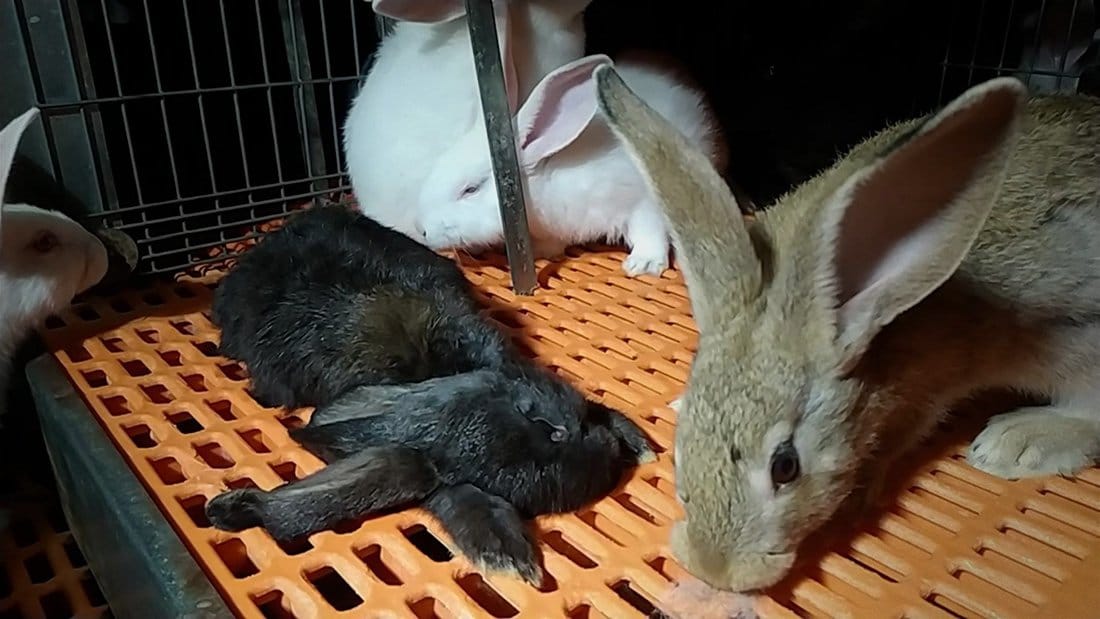
Ongehoord filmed numerous weak, sick, and dead rabbits in Konzo's park cages. The breeder's records indicated that many rabbits die each day. On peak days, mortality in this section reached as high as 40 dead rabbits in one day.
Abuse before transport
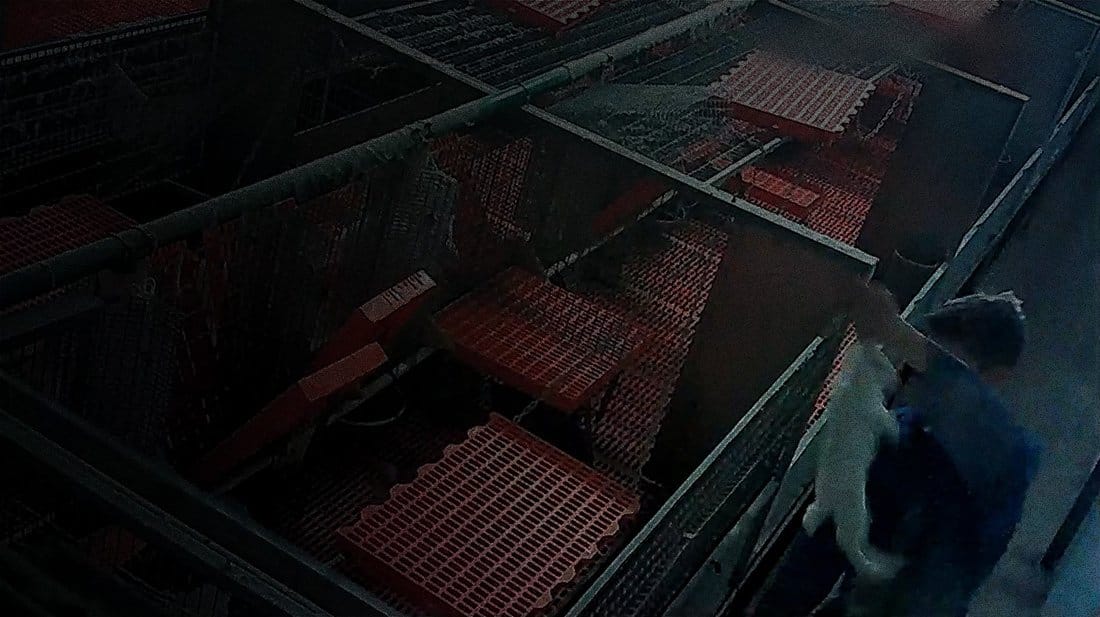
After 10 weeks, the meat rabbits reach slaughter weight. Using a hidden camera, Ongehoord filmed how the industry collected the animals from the cages for transport to the slaughterhouse. During this process, both the staff and manager De Bie applied considerable force.
Workers grabbed rabbits from the park cages by their fur, ears, feet, and heads, often taking two at a time. The animals panicked and attempted to escape. Rabbits that showed signs of illness were tossed aside into a separate cage, while others were stacked on top of each other in a cart. This treatment is stressful and painful, posing a risk of injury for both the rabbits being thrown and those in the cart, who are struck by falling rabbits.
Carts full of rabbits are wheeled to the barn exit. At this point, workers lift the animals by their sensitive body parts and throw them into transport crates.
Sources
- 5
- 6
European Agricultural Support (belpa.be)
- 7
- 8
- 9
Rabbit (Delicious from here)
- 10
Animal welfare is always our top priority. Farmer & gardener (2020)
- 11
- 12
Park rabbit with guaranteed origin. Lonki Slaughterhouse
- 13
Quick scan information set Covenant on Animal-Friendly Livestock Farming. Faculty of Veterinary Medicine, Utrecht University (2022)
- 14
File on animal-friendly housing of rabbits. Farmers' Union, Management & Technology (2014)
- 15
Technical manual rabbit breeding. Hycole (2019)