Chapter 2 / 3
Research on transporting cattle and calves
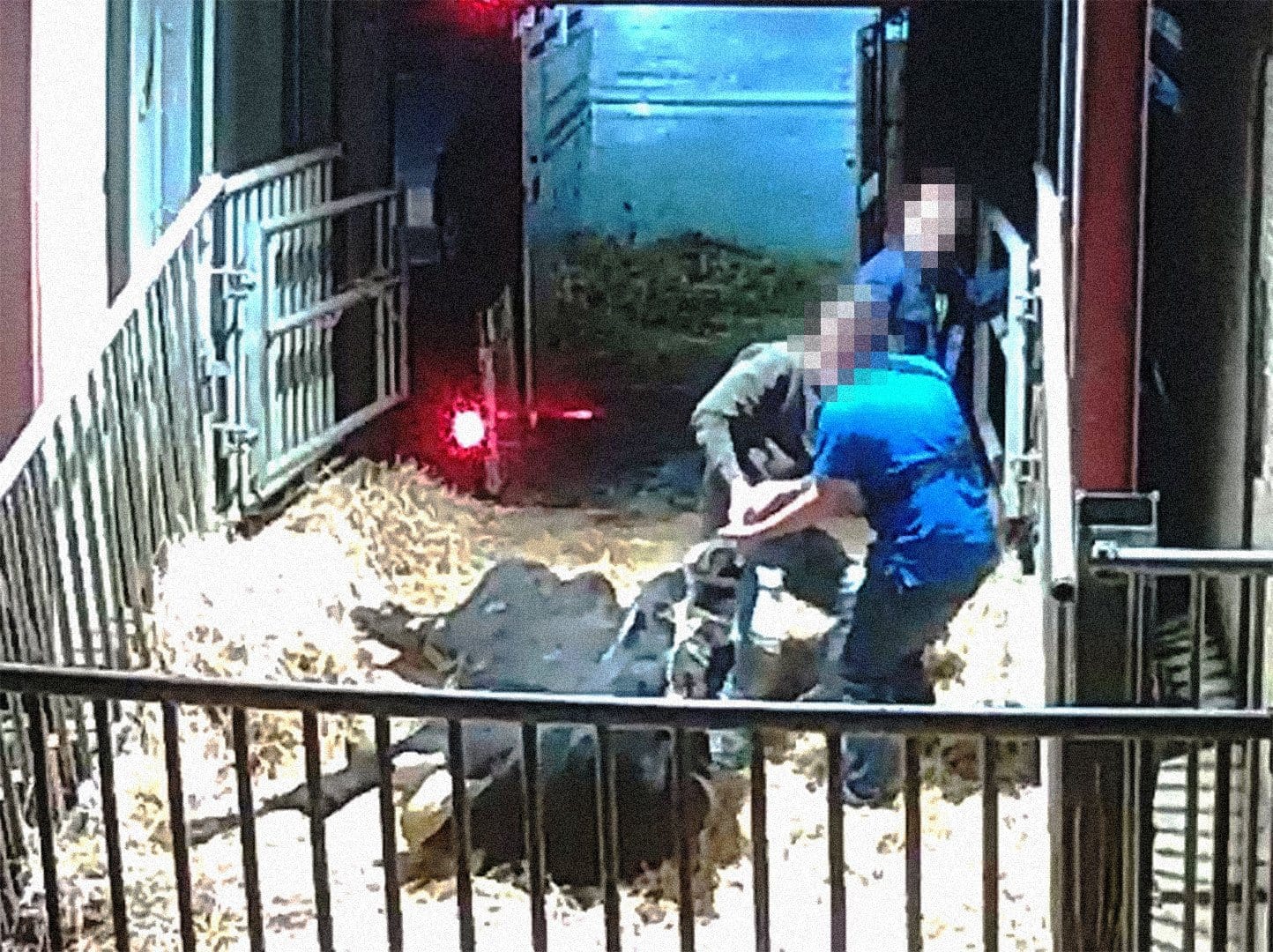
Hidden camera investigation in 4 collection points The Ongehoord research team filmed the loading and unloading of calves and cows. They placed hidden cameras in export collection points. In collection points, animals from various livestock farms are brought together for further transport to breeding farms, fattening farms, or slaughterhouses. Due to the active animal trade between the Netherlands and Belgium, research was conducted in both countries. The transport of animals is subject to legal regulations. For example, according to European animal welfare legislation, only properly trained personnel may handle animals in a collection point. [6] Allowing children to assist with the herding process is prohibited. Scaring, hitting, or kicking animals is prohibited, as is pulling on tails, ears, horns, fur, or heads. Electric shocks (tasers) may not be used on calves. In adult cows, electric shocks may only be administered to the muscles of the hind legs, and not repeatedly. Sick or injured animals must receive "appropriate veterinary treatment" as quickly as possible or, if necessary, "be killed in a manner that does not cause unnecessary suffering." Our images painfully demonstrate that animal welfare laws function primarily on paper: none of the four locations studied enforce the rules.
Origin and destination of animals
Veal fattening started as a way for dairy farming to manage its surplus calves. To produce milk, farmers artificially inseminate mother cows every year. A cow only begins to produce milk after giving birth. Once a calf is born, farmers separate it from its mother to sell the mother's milk. The calves receive artificial milk from buckets with pacifiers. Over 50% of these calves are bull calves, which have no use in dairy farming. Some female calves stay on the original farm to replace older mothers later. The surplus female calves and bull calves are then transported to various fattening farms.
The veal industry operates through integrated groups. Large veal producers buy calves and transport them to veal fattening farms via collection points. These fattening farms usually have contracts with the integrator and fatten the calves using feed provided by the integrator. After about six months, the calves are slaughtered at the integrator's slaughterhouse.
Many fattening farms in Belgium are located in the Kempen region, which borders the Netherlands. Major producers from both Belgium and the Netherlands have contracts for fattening farms in each country. Ongehoord filmed footage at two Belgian export collection points where calves from dairy farms are gathered for transport to the various fattening farms.
Location 1: Collection point Vanlommel, Tielt-Winge
At Binkomstraat 90 in Tielt-Winge (province of Flemish Brabant), you will find the assembly center of Vanlommel, Belgium's largest veal producer. Here, 14-day-old calves are gathered for transport in large groups to Vanlommel's contract fatteners in Belgium and the Netherlands. [7] Over a span of four days, the following abuses were captured on hidden cameras: - calves being systematically herded with tasers - calves being kicked - calves being pushed forward with knee thrusts - a calf being forcefully pushed against the side of the farm with knee thrusts - calves being struck with sticks on sensitive areas such as the head; sticks are slammed against the calves' flanks/ribs - a calf struggling to walk is lifted by the tail and dragged along - a group of calves is cornered, where workers kick them and administer electric shocks - calves falling during herding - a worker intimidating calves with a stick inside a large plastic bag.
About the company
The Belgian veal market is primarily controlled by two producers, with Vanlommel being the largest. The Vanlommel family amassed their wealth through veal production, which is currently estimated at nearly 23 million euros. [8] It is troubling that the abuses at this specific company were captured on film. Vanlommel asserts that it is a leader in animal welfare, promoting its own "Well and Fair" quality scheme. The specifications of Well and Fair include "extra-legal rules" concerning animal health, feed, housing, staff training, and transport. Compliance with Well and Fair's regulations is overseen by an (anonymous) "independent party." [9] [10] Vanlommel states that the transport of the calves “always occurs under optimal conditions, prioritizing the welfare of the calves.” [11] Vanlommel operates its own animal feed factory in the Netherlands (Verveka), an export collection point in Tielt-Winge, its own transport vehicles, and a calf slaughterhouse in Olen. The company has contracted calf fatteners in both Belgium and the Netherlands. It supplies purchased calves and feed from its own factory to its regular calf fatteners. At around six months of age, the calves are gathered for slaughter at Vanlommel's facility. Seventy percent of the meat produced is intended for export. [12] [13] Vanlommel compensates its contract fatteners with a monthly fee. As Belgium's largest volume producer, Vanlommel benefits from indirect government support. In Flanders, contract farmers receive subsidies for “producing veal calves,” funded by European subsidy money. [14] Veal sales are promoted through the government's VLAM campaigns, which are also financed with European subsidies. [15] [16] [17] In 2011, Vanlommel received subsidies for investments aimed at "energy savings or environmental objectives." The specifics of the project and the amount remain undisclosed. The funding originated from the Flemish Agricultural Investment Fund (VLIF) and the European Agricultural Fund for Rural Development. [18] In 2022, the Vanlommel slaughterhouse was awarded €4,500 in Flemish subsidies for training and advice, along with employer support (VOP); an additional €2,500 in VOP was allocated to Vanlommel's transport company. [19] [20]
Location 2: the Kempen Export Stable, Merksplas
The Kempen Export stable, owned by the Van der Walle family, is a Dutch operation that includes many fatteners and livestock traders. It is located at Bosstraat 11 in Merksplas, in the Antwerp province. Over a week and a half, hidden cameras captured several abuses at the Kempen Export Stables, including:
- Calves being pulled by their tails and thrown from wagons
- Calves being struck on sensitive body parts with sticks
- Calves receiving knee blows to push them along
- Calves being kicked
- Calves frequently pulled by their tails while being herded through the assembly area
- Calves being pulled by their ears
- Calves being pushed away from the watering hole
- A child being allowed to help hit and push calves
About the company
The Kempen Export Stables are owned by the Dutch Van der Walle family. Ben van der Walle was a significant figure in the Dutch veal market for many years. He traded calves, managed numerous barns, and had calves fattened under contract. He generated a turnover exceeding 51 million euros. [21] In 2016, Van der Walle sold “a number of activities” to the Dutch Vandrie Group, with whom they had collaborated intensively for years. [22] It is unclear exactly which activities were sold and which remained under the Van der Walle family's ownership. According to the Dutch Chamber of Commerce, “Vee- en kaverhandel Ben van der Walle” is still active at Schaluinen 20, 5111 HB Baarle-Nassau. What is certain is that Ben's calf farm, housing over 2,000 calves, at Ghil 13 in Baarle-Nassau (NL), and the Kempense Exportstal collection center (BE) are still owned by the family. In Hoogstraten (BE), they own the Belgian livestock trading company "Hertog Vee," managed by Ben's daughter Tanja. [23] [24] [25] The Van der Walles receive European subsidies from both the Dutch and Belgian governments. Europe allocates agricultural funds to member states, but it is the national governments that manage and distribute the subsidy money to companies. According to the RVO (Netherlands Enterprise Agency) database, 87,400 euros in European subsidies were paid out over the past two years to "Livestock and Calf Trade Ben van der Walle BV in 5110 AG Baarle-Nassau". [26] The Ben van der Walle cattle and calf trading company is also listed in the Belgian database, but with a different postal code: 5111 HB Baarle-Nassau (NL). In Belgium, the company received an additional €2,800 in European subsidies. [27] The databases do not specify which business locations are receiving subsidies. Postal code 5111 HB corresponds to the address Schaluinen 20, Baarle-Nassau. Postal code 5110 AG, where the majority of subsidies were channeled via the Netherlands, corresponds to a post office box address. [28] We also checked the FTM database (Follow the Money, a Dutch platform for independent investigative journalism). Unlike governments that only publish the last two subsidy years, FTM has subsidy amounts available from 2014 onwards. We discovered via FTM that cattle and calf trader Ben van der Walle received over €230,000 in subsidies between 2014 and 2021, for their post office box address 5110 AG. [29] # Netherlands - lame and sick cows severely abused
Origin and destination of animals
Cows are transported from dairy farms to slaughterhouses when their health and milk production decline. A livestock farmer aims to avoid spending more on feed and medication for a cow than the income she generates from milk. A quarter of the discarded mother cows are sent to slaughter through a collection point. From these collection points, the cows are transported to both domestic and foreign slaughterhouses. According to BuRo (Bureau for Risk Assessment and Research), 4 to 10% of the mother cows are shipped abroad, with Belgium being the primary destination. [30] The meat from these finished cows is tough and is typically used in inexpensive meat products like hamburgers and snacks. Hidden cameras were installed at two Dutch cattle collection points. Both locations are licensed to collect and export breeding cattle, beef bulls, cattle calves, and dairy cattle. During the investigation, primarily finished cows were transported through both collection points.
Location 3: Dane and Son, Oudemolen
The livestock trading company Dane en Zoon has its collection center at Stadsedijk 44 in Oudemolen, North Brabant. They collect and trade cattle for both domestic and international markets. Over two weeks, Ongehoord filmed several abuses, including:
- Delivering seriously ill cows that cannot stand
- Pulling on the ears and snouts of these sick cows
- Dragging a seriously ill animal by its tail and legs, with multiple workers involved
- Administering electric shocks to sensitive areas of seriously ill cows, including their flanks and anus
- Dragging sick animals using ropes
- Tying a cow with straps to a shovel for dragging
- Hoisting a terminally ill cow that was left alone all night with a hip clamp attached to a shovel the next morning
- Killing a cow outside on the property and pushing it away with a forklift
- Herding a group of young cattle with a pitchfork while shouting loudly and beating the animals with it
About the company
Dane en Zoon is a recognized name in the animal industry.
In September 2021, members of the House of Representatives made a pre-announced working visit to the assembly point. Caroline van de Plas expressed her gratitude to Dane for their transparency. [31] Helma Lodders, chair of Vee & Logistiek (the Dutch interest group for livestock traders, collectors, and transporters), also visited and openly commended the Dane family for their "professionalism in livestock." [32] Dane collects cattle for slaughter and breeding intended for both domestic and international exports. In partnership with the Belgian livestock transporter "Vervoer de Backer," Dane supplies milked-out cows to Belgian slaughterhouses. Alongside VAEX, a global livestock trader, he provides pregnant heifers to dairy farms in Russia, Pakistan, and Turkmenistan. [33] [34] [35] Livestock trading is the primary focus of the Dane family, but they also participate in animal husbandry: at Westmiddelweg 1 in Oudemolen, they operate the "Ruigenhilvlees" farm, where they fatten cattle and broilers. The animals are processed, packaged, and sold at their farm butchery. [36] [37] The Dane family also benefits from European subsidies. According to the FTM subsidy database, Dane received over 400,000 euros from 2015 to 2021. During the corona crisis, Dane was granted 8,744 euros in NOW support. [38]
Location 4: Livestock farm Kuiper VOF, Hoogblokland
The livestock transporter Teus Kuiper operates from Beemdweg 5 B in Hoogblokland. Over the course of a week, the following abuses were recorded at the company:
- Delivery of an extremely thin and sick animal
- Delivery of lame cows
- Cows being struck hard with a stick, including sensitive areas like the head
- Sticks being driven into the flanks and ribs of cows
- Cows being kicked
- Animals slipping and falling on the slippery, wet concrete floor
About the company
“Veebedrijf Kuiper V.O.F.” in Hoogblokland operates a livestock transport company and a cattle collection point. [39] [40] Teus Kuiper is the owner, and he collects and transports cattle for various livestock traders and breeders. Similar to Dane en Zoon, we primarily observed the transport of milked-out cows at the Kuiper VOF cattle collection center. Our camera also captured footage of horned cows from organic livestock farming. Kuiper collects all export cattle for Groen Livestock, a major livestock trader that ships cattle to various countries, both within and outside Europe. [41] For Heijdra Vleesvee (the IJsselstein fattening farm that raises milked-out dual-purpose cows), T. Kuiper transports cattle to the Ameco slaughterhouse. [42] [43] According to the FTM database, Veebedrijf Kuiper VOF has received €13,358 in European subsidies since 2014.
Inspection reports show failure of government oversight
Ongehoord invoked the Freedom of Information Act to request inspection documents from the Flemish Animal Welfare Service regarding animal transports between Belgium and the Netherlands. We investigated the violations that occurred during the export of cattle for slaughter in both directions. This represents only a small fraction of the transports, as most animals are moved within national borders. However, it became evident that both the NVWA (Netherlands Food and Consumer Product Safety Authority) and the FAVV (Federation of Belgian Food and Consumer Product Safety Authorities) frequently disregard animal transport regulations. NVWA : Export permits were granted for lame and sick cows from Oudemolen (Dane and Son). Inspection documents reveal that in 2022, the NVWA (Netherlands Food and Consumer Product Safety Authority) approved the transport of lame and sick cattle at the Dane en Zoon collection point in Oudemolen on multiple occasions. Upon arrival at a Belgian slaughterhouse, these animals were observed and reported by the Belgian inspectorate, the FAVV (Federal Agency for the Safety of the Food Chain). FAVV veterinarians documented seven cattle with large abscesses, three with bleeding or suppurating wounds, one severely lame animal, and one cow suffering from suppurative mastitis. Two cattle were unable to stand and were euthanized in the truck. Additionally, a cow that had died en route was discovered in the same truck. Given the severity of the injuries, it is inconceivable that the NVWA overlooked these animals. All these animals originated from Dane en Zoon in Oudemolen and were destined for the Moerbeke slaughterhouse (East Flanders, Belgium). Due to the short duration of this journey, the injuries could not have occurred during transport. The transports were conducted by Vervoer de Backer, a Belgian livestock transporter based in Rumst. The issues surrounding the export of unfit animals have a long-standing history. Since 2019, the NVWA has repeatedly announced stricter measures for export inspections, such as two-eye supervision (where inspections are conducted jointly by two veterinarians) and the implementation of European guidelines for assessing suitability for transport. Inspection documents released by Ongehoord in September 2021 indicated that the NVWA 's measures were ineffective. Even at that time, seriously ill animals were being transported to Belgium. [44] The NVWA 's response was that the reported abuses were outdated because new "stricter rules had been introduced in the meantime to further safeguard animal welfare." [45] However, six months later, in March 2023, a news article on the NVWA website acknowledged that the number of reports of sick Dutch cows in foreign slaughterhouses is not decreasing, despite the implementation of more stringent supervision. [46]
FASFC: dozens of heavily pregnant cows approved for transport to the Netherlands
Ongehoord also requested inspection documents regarding the supply of unfit Belgian animals to Dutch slaughterhouses. We found that veterinarians from the Federal Agency for the Safety of the Food Chain (FASFC) approved dozens of heavily pregnant cows for transport to Dutch slaughterhouses. Dutch NVWA veterinarians who examined the cows at the slaughterhouse determined that the cows were more than 90% through their gestation period (over 8 months). This meant that, according to European regulations, they were not allowed to be transported. [47] After slaughter, unborn calves were removed from the wombs of their deceased mothers. Photos in the inspection reports show calves nearly a meter long. The animals are fully furred and already have incisors. Transporting heavily pregnant cows to slaughterhouses not only causes suffering for the mother during the journey, but also creates a welfare issue for the unborn calf. When the mother is slaughtered, the calf is deprived of oxygen and dies of asphyxiation in the womb. European researchers agree that fetuses can experience pain and stress from as early as six months of gestation. [48] In total, NVWA veterinarians reported around thirty heavily pregnant cows being transported from Belgium to Dutch slaughterhouses in 2021-2022. In addition to the heavily pregnant animals, FAVV veterinarians issued export permits for two sick calves and seven permits for severely lame, injured, or sick cattle.
Sources
- 6
- 7
- 8
- 9
- 10
- 11
- 12
- 13
- 14
- 15
- 16
- 17
- 18
- 19
- 20
- 21
- 22
- 23
- 24
- 25
- 26
- 27
- 28
- 29
- 30
- 31
- 32
- 33
- 34
- 35
- 36
- 37
- 38
- 39
- 40
- 41
- 42
- 43
- 44
- 45
- 46
- 47
- 48