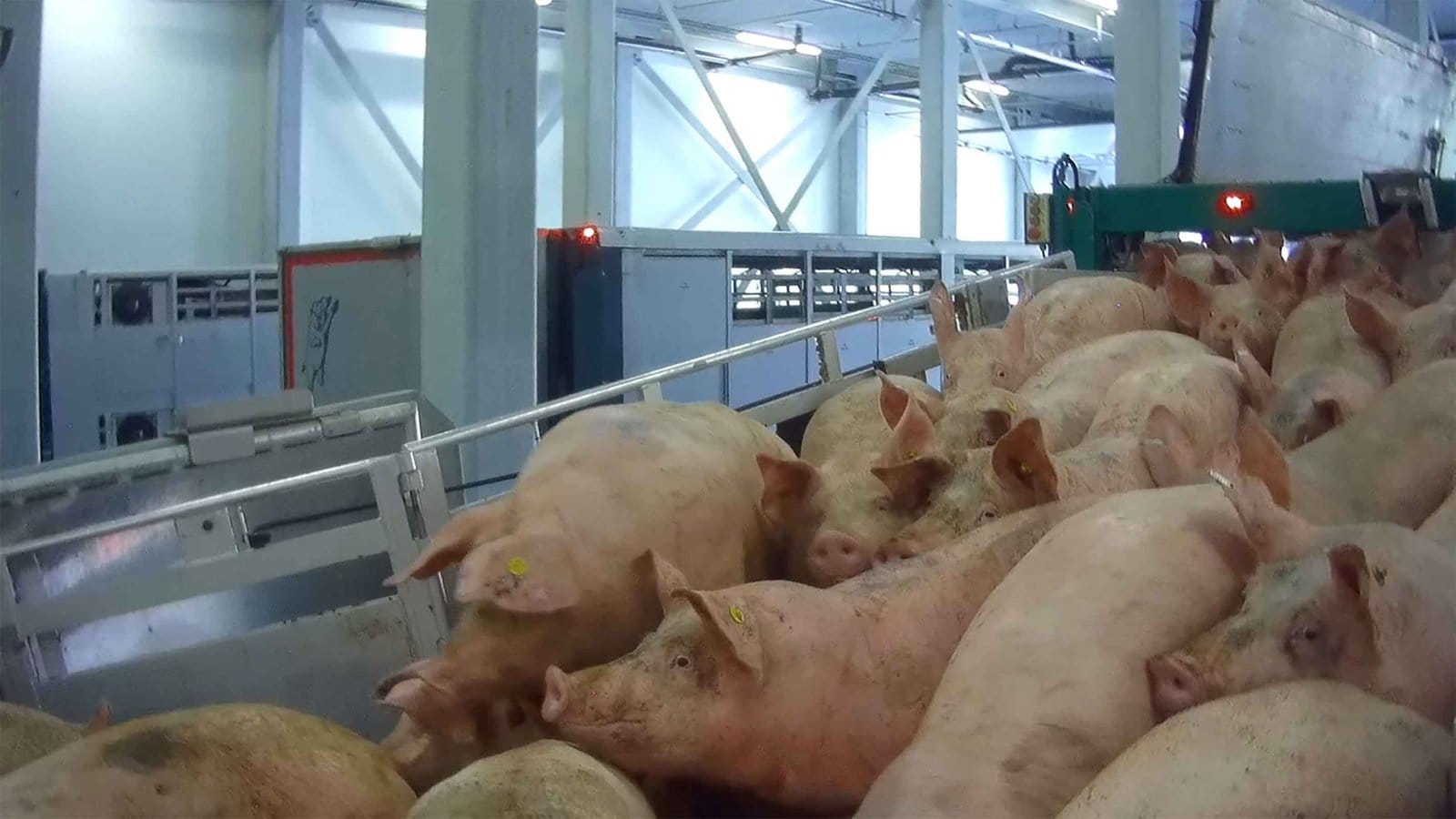
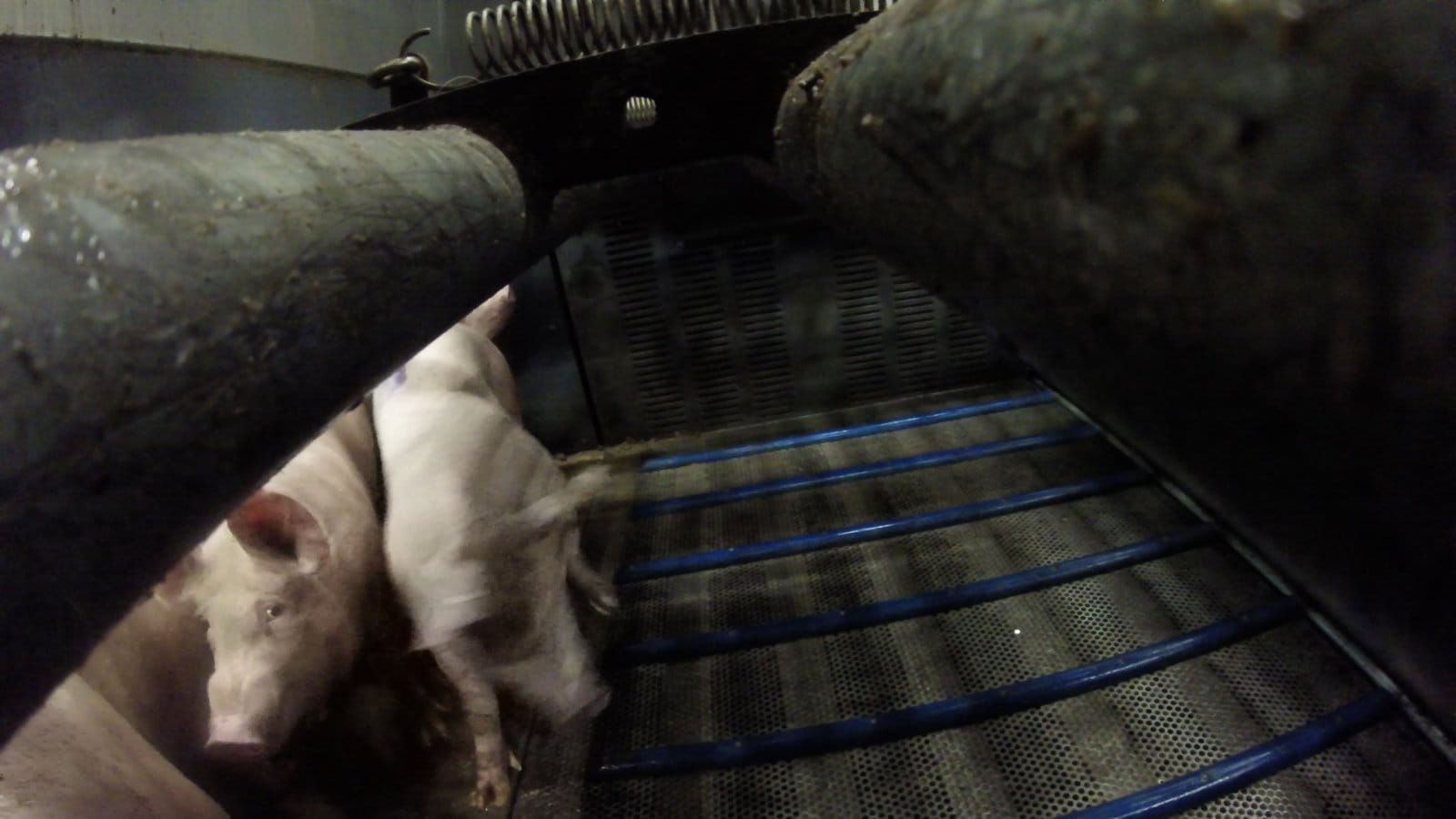
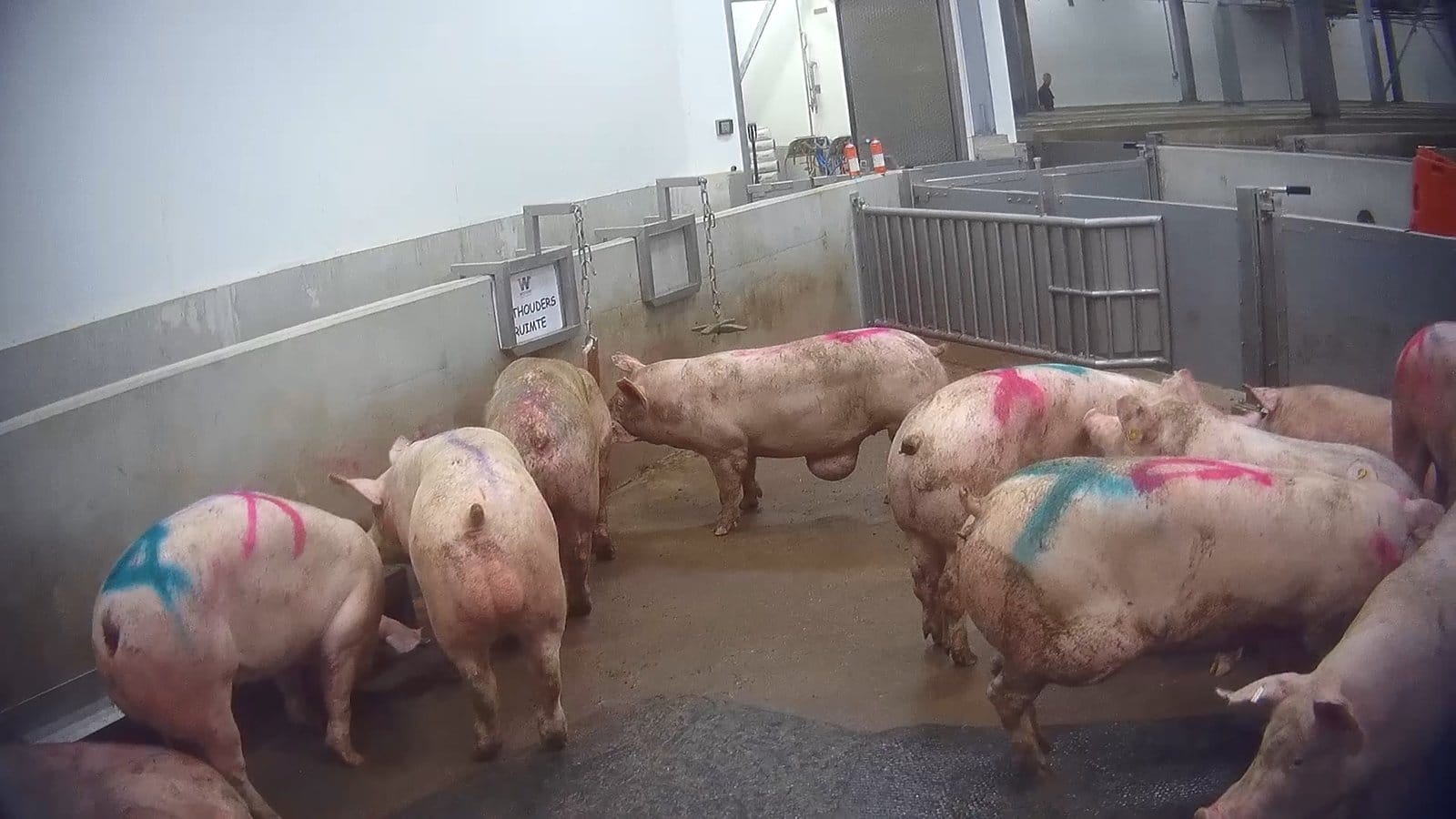
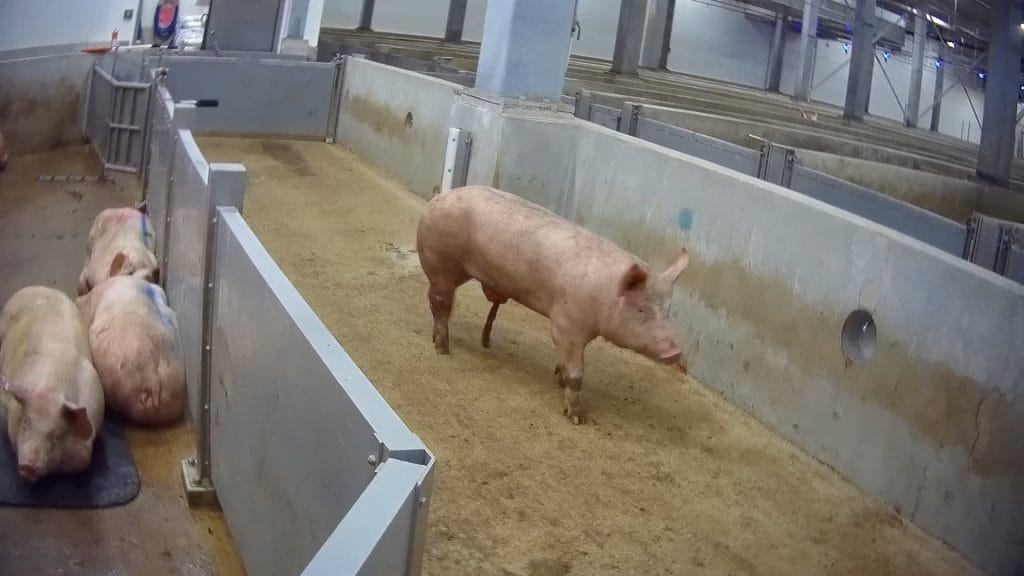
Ongehoord published a detailed investigation into slaughterhouses in January 2020. An undercover employee filmed daily activities at the Westfort pig slaughterhouse in Ijsselstein in August 2019. Each week, this facility slaughters 50,000 pigs for meat production, at a rate of 650 animals per hour. Westfort is the third-largest pig slaughterhouse in the Netherlands, following Vion and Van Rooi Meat. The company is recognized by the NVWA (Netherlands Food and Consumer Product Safety Authority) and holds certifications for producing pork with the EKO (organic), KDV (Sustainable Pork Chain), and Beter Leven welfare certifications.
The undercover investigation reveals that pigs arrive at the slaughterhouse under stressful conditions. Every day, animals with serious health issues, such as abscesses, umbilical hernias, tail-biting wounds, leg defects, heat stress, and exhaustion, are brought in. Workers routinely beat the pigs and grab them roughly by the ears and tails.
Before slaughter, pigs are gassed, electrocuted, or shot in the head with a captive bolt pistol. These painful "stunning methods" do not ensure that all animals are unconscious during the slaughter process. The footage shows a pig, with its throat cut, regaining consciousness and attempting to escape.
Following the undercover investigation, Ongehoord examined scientific literature to see if the footage from Westfort reflects the broader slaughter sector. The literature review indicates that the suffering filmed is typical of the practices found in all Dutch and European pig slaughterhouses. Each year, more than sixteen million pigs are slaughtered in the Netherlands. The transport conditions, the unfamiliar environment of the slaughterhouse filled with movement and noise, encounters with unfamiliar people and other animals, and the rushed, inhumane stunning and killing methods lead to high levels of stress, fear, and pain for these sensitive and intelligent animals.
1 location
Sources
- 1
M.B.M. Bracke (2010) Sowing of pigs and implications for animal welfare. Wageningen UR Livestock Research. Report 381. ISSN 1570-8616; p6.
- 2
Wageningen University & Research. Pigs - Genomic Development. wur.nl/nl/artikel/Varkens-1.htm
- 3
Reimert, Inonge (2014) (Em)pathetic pigs? The impact of social interactions on welfare, health and productivity. PhD thesis, Wageningen University. ISBN: 978-94-6173-996-4.
- 4
P. Keller (2013). Vocalization in Pigs. Ghent University Faculty of Veterinary Medicine; p6.
- 5
Marino & Colvin (2015). Thinking Pigs: A Comparative Review of Cognition, Emotion, and Personality in Sus domesticus. International Journal of comparative psychology; p28.
- 6
M. Root-Bernstein (2019) Context-specific tool use by Sus cebifrons. Mammalian biology, volume 98. sciencedirect.com/science...abs/pii/S1616504719300333
- 7
RDA. Natural Behavior of Pigs. RDA Advisory Report 2006/5; p19-30.
- 8
Animal Health Flanders 2019. Salmonella - delivering pigs ready for slaughter. dgz.be/salmonella-afleveren-slachtrijpe-varkens
- 9
Pork Information Gateway (2019) - Handling Pigs
- 10
Wageningen UR Livestock Research. Annual Report on Animal Welfare Checkpoints Research 2013; p. 12.
- 11
NVWA 2018 - National plan for livestock transport at extreme temperatures 2018
- 13
Animal Health Flanders 2019. How do you make pigs more comfortable in hot weather? dgz.be/nieuwsbericht/hoe-...comfort-bij-extreme-hitte
- 14
T. Grandin (1997). Assessment of Stress During Handling and Transport. Journal of Animal Science volume 75: 249-257.
- 15
F. Leenstra et al. (2011). Distress in cattle, pigs, poultry, mink, and horses. Wageningen UR Livestock Research. Report 456. ISSN 1570-8616; p18.
- 16
Barington et al (2016). Gross and histopathological evaluation of human inflicted bruises in danish slaughter pigs. BMC Veterinary Research.
- 17
Wageningen UR Livestock Research. Final report Animal Welfare Check Points 2014; p13.
- 18
REGULATION (EC) No 1099-2009 on the protection of animals at the time of killing.
- 19
Gerritzen and Reimert (2019). Improving animal welfare during CO2 stunning of pigs for slaughter. Wageningen Livestock Research, Report 1181; p. 8.
- 20
N. Baudoin (2015) Ghent University, Is there still a future for electrical stunning in pigs and poultry?; p9-10.
- 21
Gerritzen and Reimert (2019). Improving animal welfare during CO2 stunning of pigs for slaughter. Wageningen Livestock Research, Report 1181; p19.
- 22
EFSA (2004) Welfare aspects of the main systems of stunning and killing the main commercial species of animals. The EFSA Journal 45; p101.
- 23
NRC 2011. As if regular slaughter is so animal-friendly. nrc.nl/nieuws/2011/12/13/...elijk-is-12131267-a281856
- 24
Trouw 2009. Does pain relief hurt? trouw.nl/nieuws/doet-de-p...3A%2F%2Fwww.google.com%2F
- 25
REGULATION (EC) No 1099-2009 on the protection of animals at the time of killing; Introductory text, point 6. eur-lex.europa.eu/LexUriS...2009:303:0001:0030:EN:PDF
- 26
NVWA Supervision of the welfare of ungulates and farmed game in slaughterhouses WLZVL-017+v1; p11-14.
- 27
REGULATION (EC) No 1099/2009 on the protection of animals at the time of killing (Annex 1, Chapter 1). eur-lex.europa.eu/LexUriS...2009:303:0001:0030:EN:PDF
- 28
Atkinson, S. (2016) Assessment of cattle and pig welfare at stunning in commercial abattoirs. Doctoral Thesis Swedish University of Agricultural Sciences, Uppsala; p38.
- 29
N. Baudoin (2015), Ghent University. Is there still a future for electrical stunning in pigs and poultry? (p 9-10)
- 30
RTL 2018. Animals boiled alive and skinned in Dutch slaughterhouses. rtlz.nl/algemeen/artikel/...-nederlandse-slachthuizen
- 31
REGULATION (EC) No 1/2005 on the protection of animals during transport; Annex I, Chapter 1.
- 32
T. Geudeke. Lame pigs: infection or something else? Pigs 2016 edepot.wur.nl/402860
- 33
Osteochondrosis deserves attention. Pig Business 2016. edepot.wur.nl/370234
- 34
Practical guidelines for determining the suitability of pigs for transport; p15.
- 35
Practical guidelines for determining the suitability for transport of pigs; p27.
- 36
J.J. Zonderland et al. (2011). Financial consequences of tail biting in pigs. Wageningen UR Livestock Research. Report 543. ISSN 1570-8616; p14.
- 37
Practical guidelines for determining the suitability for transport of pigs; p17
- 38
F. Bouwkamp. Prolapses: bulges in the rectum, vagina, uterus, or bladder.
- 39
Practical guidelines for determining the suitability for transport of pigs; p25.
- 40
A. Stinckens (2011). Congenital genetic abnormalities in piglets. KU Leuven.
- 41
Vion inspection results, first quarter 2019.
- 42
RTL 2019, NVWA veterinarians allow the export of seriously ill animals to slaughterhouses in Belgium and Germany. rtlnieuws.nl/nieuws/artik...-ernstig-zieke-dieren-toe
- 43
Westfort. Distinctive pork, concepts. westfort.nl/varkensvlees/
- 44
Daycare Criteria. Currently published version, July 2019
- 45
Daycare introduces antibiotic-free pork. Pig Business 2016. pigbusiness.nl/artikel/22...oticavrij-leven-garantie/
- 47
Beter Leven Criteria. Pig Slaughterhouse, currently published version, valid from 2018.
- 48
Beter Leven Certification. beterleven.dierenbescherm...s/certificatie-instelling
- 49
Criteria for organic meat. skal.nl/veehouderij/
- 50
- 51