
Chapter 1 / 5
Natural pig life
Wild boars are social animals that thrive in wooded areas. Their groups typically have a matriarchal structure, consisting of two to five closely related females and their young. When young adult boars reach 7 to 8 months old, they leave their family groups and often form small groups of 2 to 3 individuals. Adult boars, those older than 3 years, usually prefer to live alone. However, during mating season, these boars temporarily join groups.
A family group of pigs can have a home range that varies from less than 100 hectares to over 2,500 hectares, depending on food availability. They use higher, densely wooded areas for resting and nesting. In contrast, they forage in lower, more open areas.
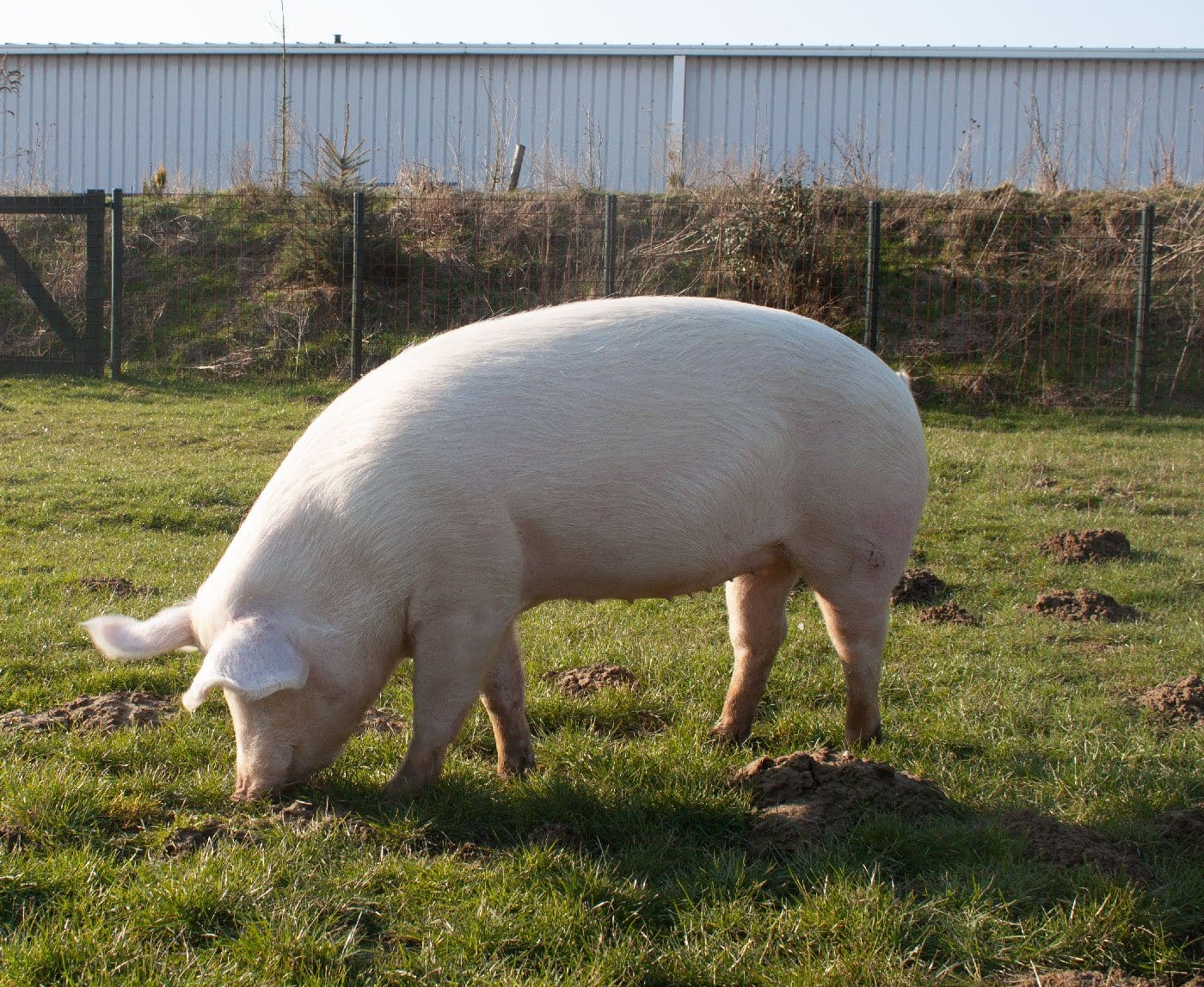
Pigs are mainly active during the day, especially in the morning and evening. Their daily routine revolves around exploring and foraging. With their distinctive snouts, pigs focus on the ground, sniffing, nibbling, and rooting in the soil. They enjoy taking their time while foraging. Their body structure, which includes a relatively heavy trunk, isn’t built for speed. Pigs rarely run, and when they do, it’s usually only for a short distance of a few meters. While they can walk long distances at a brisk pace, it’s primarily young adults and solitary boars that travel these longer distances.
The nose is the most important sense for pigs. It helps them forage for food and explore their surroundings. Pigs have poor eyesight, with limited color vision and trouble judging distances. For instance, they struggle to tell the difference between a dark spot and a shadow or a potential hole. This makes pigs very cautious when entering new areas. They carefully sniff the ground and any obstacles. Besides smell, hearing is also crucial for pigs. Unfamiliar sounds can signal danger and startle them.
In hot weather, pigs enjoy taking mud baths to cool down. This behavior is also known as "soaking." Pigs do not handle summer heat effectively. They lack functional sweat glands, but they do have a layer of fat and skin that can be sensitive to sunburn. In hot weather, pigs pant, but heat loss through panting is limited. Taking a mud bath helps lower their skin and body temperature and reduces the increased breathing rate caused by heat. Pigs typically start panting when temperatures reach around 20 degrees Celsius. [1]
Animals rest and sleep for a significant part of the day, often between 16 to 19 hours. At night, they gather in a communal nest. Pigs value cleanliness in their resting area and will defecate in a separate spot, typically 5 to 15 meters away from the nest.
Within family groups, a hierarchy forms, placing the older and heavier pigs at the top of the pecking order. Pigs build strong social bonds with one another and coordinate their activities. For example, they often sleep together in a communal nest or forage as a group.
Due to the hierarchy in the group, aggression is uncommon. Conflicts over food usually involve some threatening and imposing behavior, after which the socially inferior pig backs off. However, pigs from different groups are rarely accepted. Typically, animals from separate groups stay at least 50 meters apart. Occasionally, confrontations happen, leading to fights. These fights can last between 30 to 60 minutes, but most conflicts are resolved after 2 to 3 quick and intense attacks. The losing pig turns away and flees.
Communication among pigs is essential. Their strong sense of smell enables them to identify one another by scent and also helps them convey information. For instance, if a pig detects the urine of stressed pigs in a specific location, it will steer clear of that area. [2]
Pigs communicate through body language and vocalizations. Body language is mainly used during confrontations. Dominant pigs may scratch with their forelegs, raise their back hairs, or turn their heads toward another pig with a slightly open mouth. In contrast, frightened and submissive pigs will tuck their ears, lower their heads, let their tails droop, and move away. Pigs are also affected by the emotional states of other pigs and even humans, which can be seen as a basic form of empathy. [3]
For identification and coordination of group activities, pigs often communicate using vocalizations. Researchers have identified over twenty distinct pig sounds. These include grunts, which pigs use to convey contentment to one another, grunts that express displeasure, sounds that indicate an animal's location or call group members together, and cries that express fear and pain. Pigs even have a special "warning bark" to alert each other to danger. This ‘bark’ is then picked up by the other group members, after which the animals ‘freeze’ (stand motionless) or flee. [4]
Pigs are recognized for their intelligence. For instance, pigs can differentiate between objects of various colors and shapes; they possess a sense of time; they can recognize different individuals (both pigs and humans); they have a strong long-term memory; and they excel at certain games more than dogs and primates. [5]
Not all of pigs' cognitive abilities are fully understood yet. At the end of 2019, ecologist Meredith Root-Bernstein published research that established for the first time that pigs use tools to build their nests. Root-Bernstein also strongly suspects that pigs can share their knowledge of tool use with other group members and their offspring. [6]
Scientific studies indicate that wild boars and domesticated pigs in the pig industry share similar basic behavioral traits. Meat pigs are typically slaughtered at around six to seven months old, but they can naturally live for 10 to 20 years, depending on the breed.
Other sources: RDA. Natural Behavior of Pigs. RDA Advisory Report 2006/5: pp. 19-30 [7]
Sources
- 1
M.B.M. Bracke (2010) Sowing of pigs and implications for animal welfare. Wageningen UR Livestock Research. Report 381. ISSN 1570-8616; p6.
- 2
Wageningen University & Research. Pigs - Genomic Development. wur.nl/nl/artikel/Varkens-1.htm
- 3
Reimert, Inonge (2014) (Em)pathetic pigs? The impact of social interactions on welfare, health and productivity. PhD thesis, Wageningen University. ISBN: 978-94-6173-996-4.
- 4
P. Keller (2013). Vocalization in Pigs. Ghent University Faculty of Veterinary Medicine; p6.
- 5
Marino & Colvin (2015). Thinking Pigs: A Comparative Review of Cognition, Emotion, and Personality in Sus domesticus. International Journal of comparative psychology; p28.
- 6
M. Root-Bernstein (2019) Context-specific tool use by Sus cebifrons. Mammalian biology, volume 98. sciencedirect.com/science...abs/pii/S1616504719300333
- 7
RDA. Natural Behavior of Pigs. RDA Advisory Report 2006/5; p19-30.