
Chapter 2 / 5
Stress and abuse
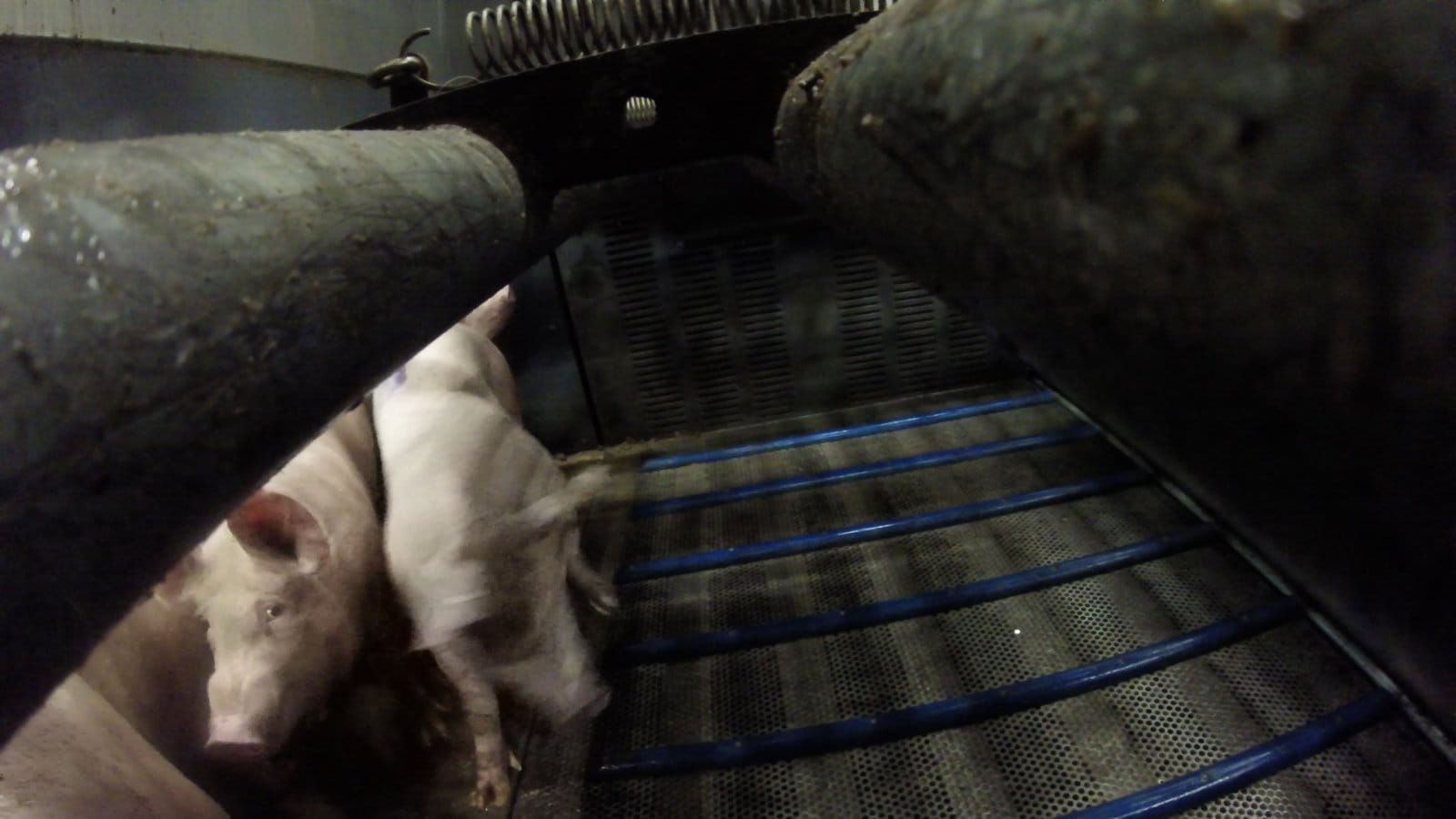
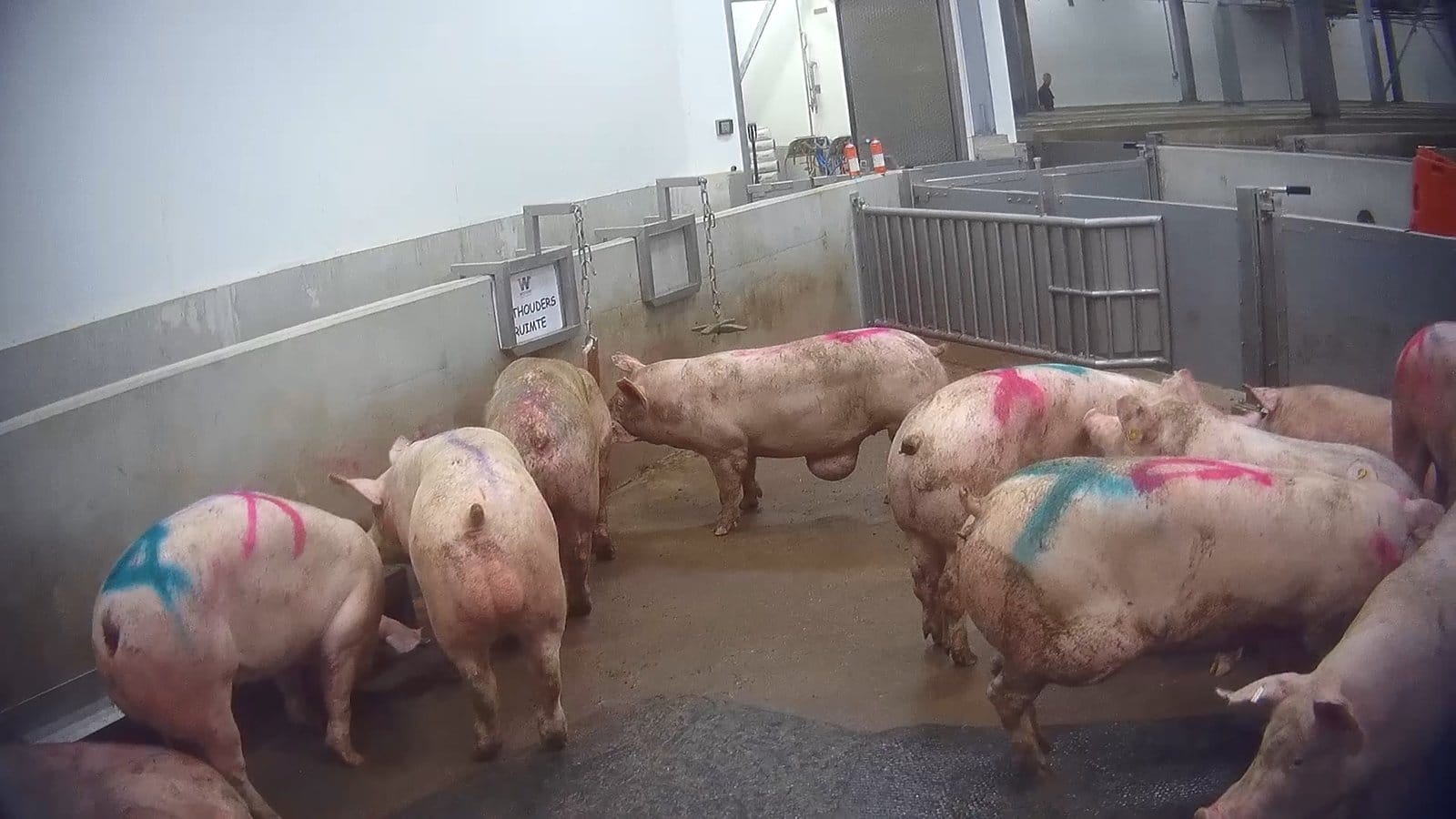
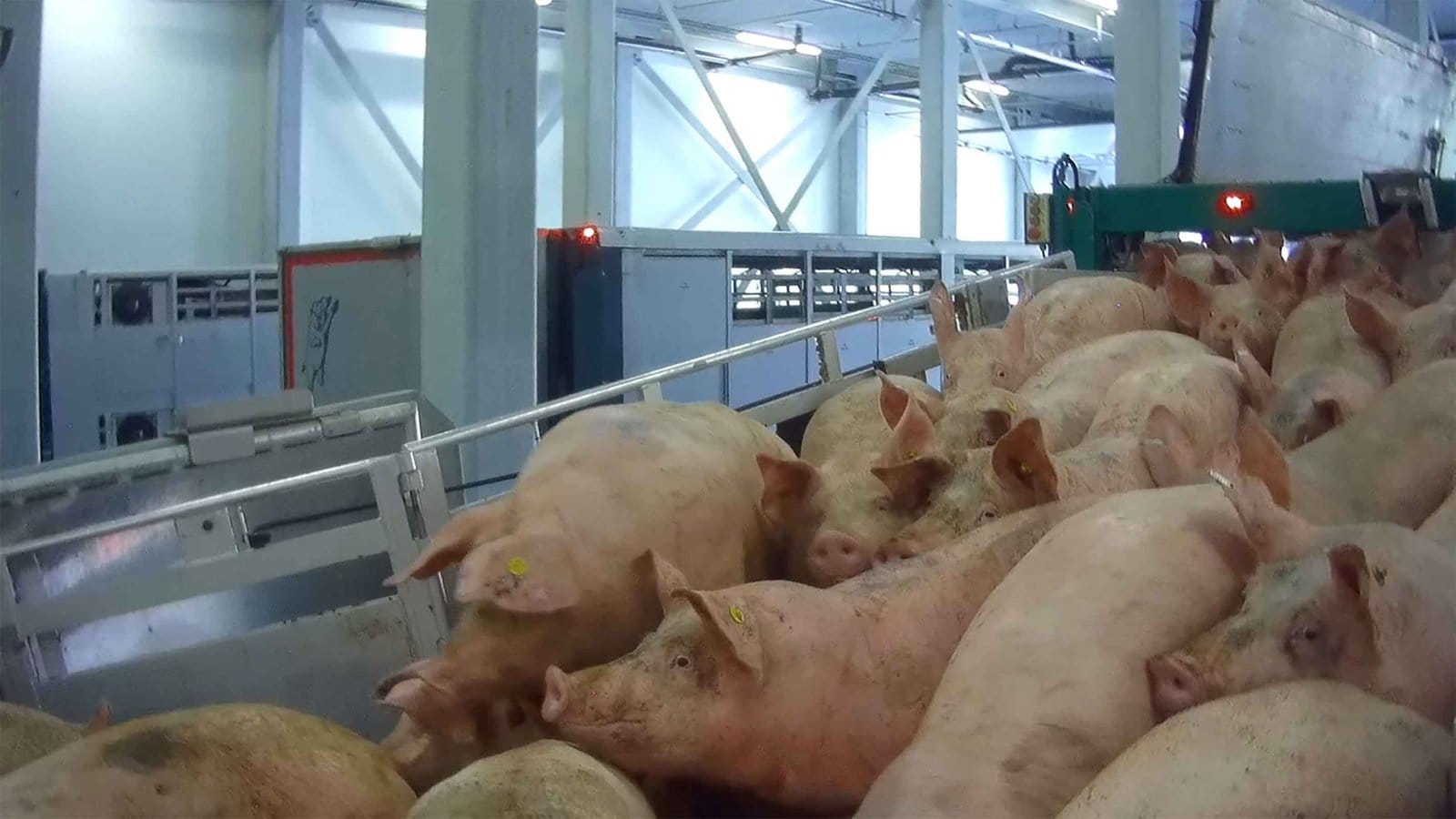
::external-video{url="https://vimeo.com/738230400"} :: Expert literature shows that transporting animals to slaughterhouses is highly stressful. Trucks that can hold up to 205 pigs are transported day and night from pig farms. Before transport, the pigs must fast for 12 to 18 hours to limit manure production and salmonella contamination on the trucks and in the slaughterhouse. [8] The animals have spent their lives in a pen and are confronted with unfamiliar circumstances and new conspecifics (from different pens and farms) during transport and at the slaughterhouse. Pigs are accustomed to slatted floors in barns and are uncomfortable moving across the smoother floors of trucks and loading ramps. Slipping and falling is a common occurrence. [9] Studies have also observed aggressive behavior in pigs during transport, especially when unfamiliar animals are transported together. In trucks, socially vulnerable animals have no space to avoid dominant animals. The animals sustain scratches and bite wounds during these confrontations. Movements of the truck, sudden braking, sharp turns and high speeds also lead to stress, falls and injuries. [10] During the summer months, pigs are at high risk of heat stress during transport. The national plan for livestock transport in extreme temperatures prohibits the transport of pigs at temperatures above 35 degrees Celsius. [11] However, according to experts, the animals can experience heat stress from temperatures of 25 to 27 degrees Celsius, causing them to pant heavily to lose heat. Normally, in hot weather, pigs try to avoid contact with each other and lie down stretched out on the floor to cool off. [12] They do not have these opportunities in trucks. Trucks often have to queue to be unloaded upon arrival at the slaughterhouse, sometimes forcing the animals to spend several hours in the heated loading areas. Severe heat stress can lead to heart failure and death. [13] Upon arrival at the slaughterhouse, pigs are chased out of the trucks with loud firecrackers. Chasing pigs by frightening them cannot be considered humane in any way. Continuously making noise with firecrackers, rapid movements, and also shouting and clapping leads to stress in the pigs. They become excited but have no opportunity to exhibit escape behavior in the slaughterhouse. Sometimes pigs can even literally freeze with fear and refuse to move. Moreover, the firecrackers are primarily used to hit animals. [14] Scientific research by WUR (Wageningen University & Research) indicates that the heart rate of pigs increases sharply during the loading and unloading of trucks, indicating a high level of stress (15). Beating with squeezing agents leads to bubbling in the pigs. Histological examination in slaughterhouses shows that more than 90% of the bruises found on pig carcasses occur in the hours before slaughter, as a result of the hoisting for transport and in the slaughterhouse. [16] Confrontation with unfamiliar pigs in the slaughterhouse is also a stressor. Partly because the animals are already out of their normal state during transport and their stay in the slaughterhouse, and they have little opportunity to avoid confrontation, this leads to a significant level of stress. When pigs that don't know each other are housed together in a holding pen, this leads to unrest and fighting, because the hierarchy has to be re-established. [17] The undercover footage that Ongehoord captured at the Westfort pig slaughterhouse in Ijsselstein confirms the stressful conditions in which pigs are delivered. Animals slip on the feces-smeared floors of trucks and loading ramps, emerge from the loading areas overheated and exhausted, and show welts and wounds. Screaming and hitting during unloading is the norm. Transporters knock pigs out of the trucks, and employees chase the animals violently and at high speed off the loading ramps. Animals too weak to stand are pushed or pulled by the tail. We see how a young child of an employee is allowed to spend a day beating pigs in the slaughterhouse. Pigs found dead in the trucks are thrown into carcass bins as waste. When the pigs are herded into the holding pens, congestion occurs, with animals bumping into and jumping on each other. These congestions are "resolved" by hitting the pigs. Pigs squeal when workers pull their ears while checking ear tags.
Sources
- 8
Animal Health Flanders 2019. Salmonella - delivering pigs ready for slaughter. dgz.be/salmonella-afleveren-slachtrijpe-varkens
- 9
Pork Information Gateway (2019) - Handling Pigs
- 10
Wageningen UR Livestock Research. Annual Report on Animal Welfare Checkpoints Research 2013; p. 12.
- 11
NVWA 2018 - National plan for livestock transport at extreme temperatures 2018
- 13
Animal Health Flanders 2019. How do you make pigs more comfortable in hot weather? dgz.be/nieuwsbericht/hoe-...comfort-bij-extreme-hitte
- 14
T. Grandin (1997). Assessment of Stress During Handling and Transport. Journal of Animal Science volume 75: 249-257.
- 16
Barington et al (2016). Gross and histopathological evaluation of human inflicted bruises in danish slaughter pigs. BMC Veterinary Research.
- 17
Wageningen UR Livestock Research. Final report Animal Welfare Check Points 2014; p13.