
Chapter 3 / 5
Gassing, electrocution, and bleeding to death
Gassing or electrocuting
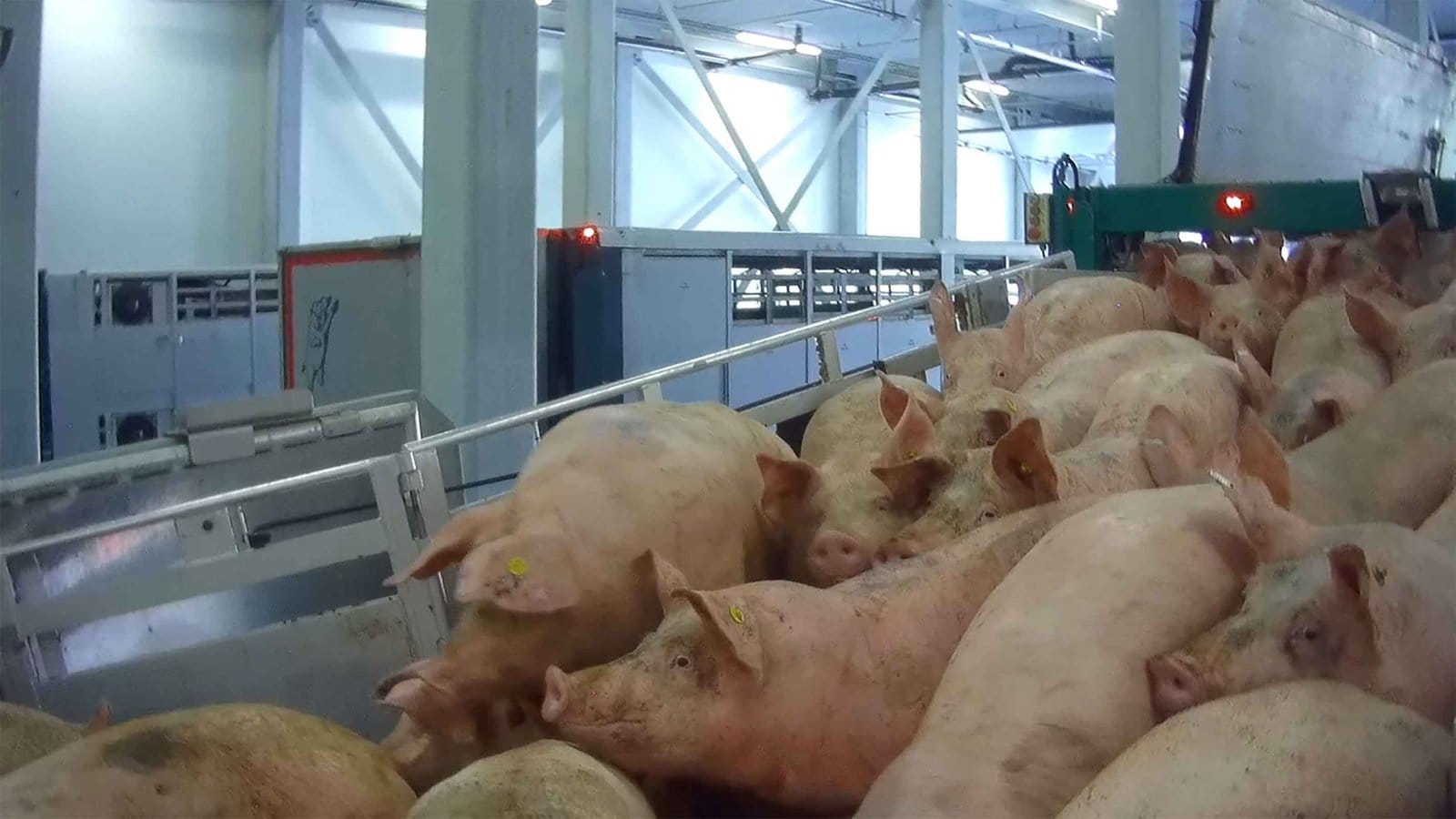
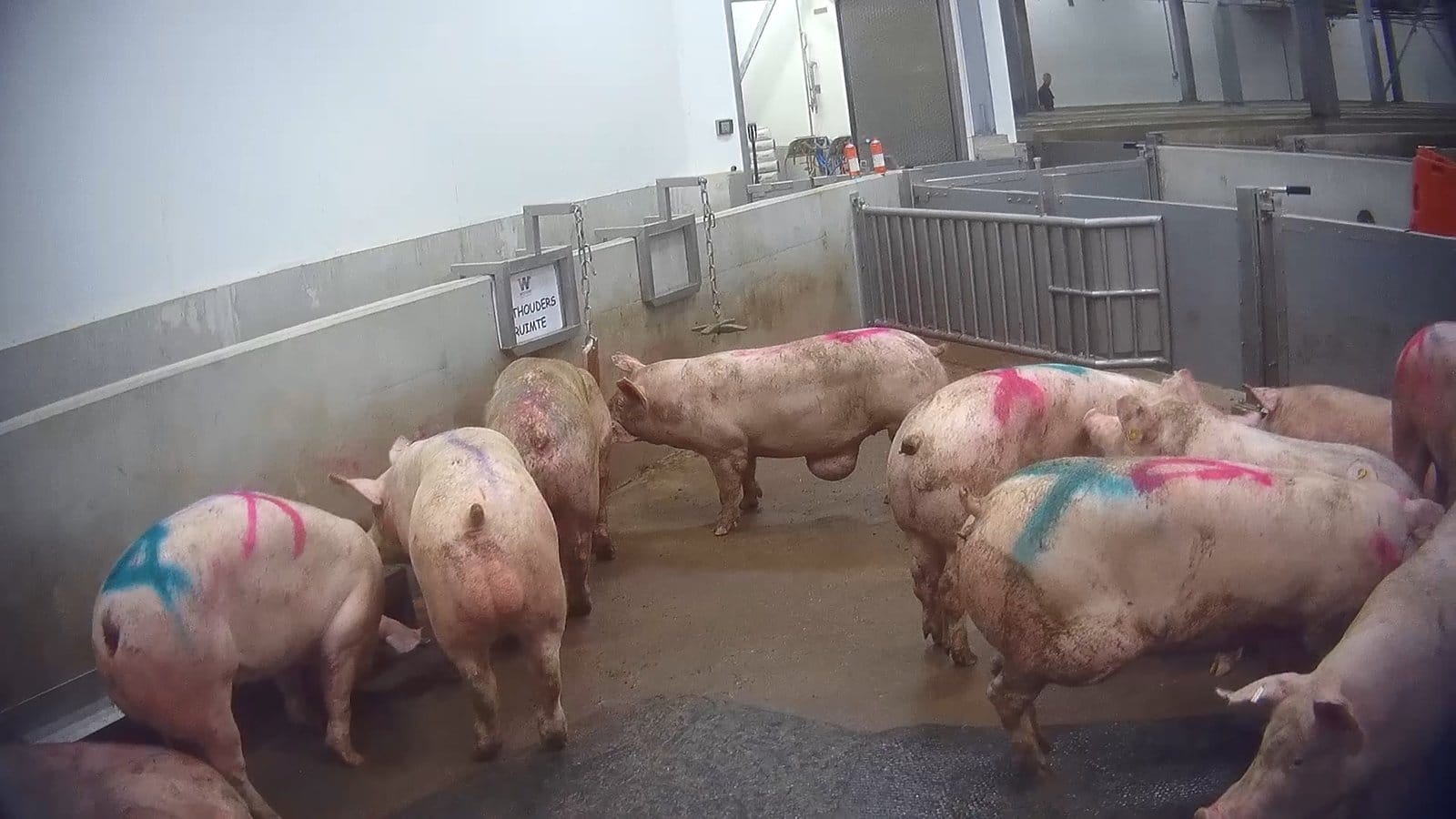
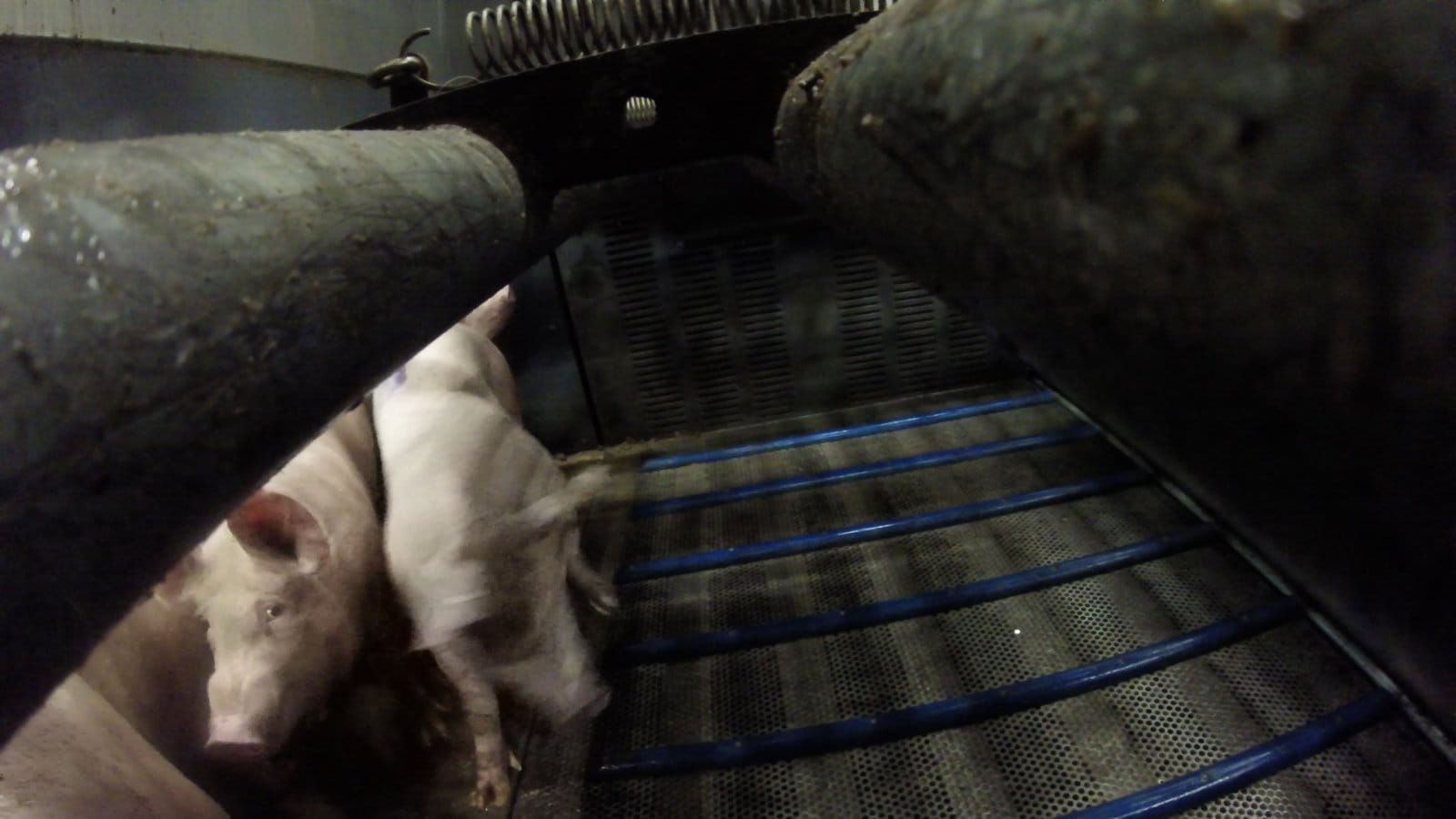
According to European regulations (REGULATION (EC) No 1099/2009), animals must be stunned (anaesthetised) before slaughtering. [18] Stunning refers to the process of rendering animals unconscious and insensible. Dutch slaughterhouses typically use two methods for stunning pigs: electrical stunning or CO2 stunning. The automated electrical stunning systems can cause significant stress and anxiety for pigs during herding and restraint prior to the stunning procedure. From the holding pens, pigs are herded in groups to the stunning system. Upon arrival, the animals must be separated from the group and restrained in a row. Since pigs are social animals, this situation is very unnatural and stressful for them. Due to the challenges in herding and restraining the animals, the overall stress period during the electrical stunning process can last from 60 to 120 seconds. Once restrained, the pigs are moved into the system on a conveyor belt. There, electrodes are placed against their heads to conduct an electric current through their brains. This triggers an epileptic seizure, rendering the animal unconscious and insensible. In practice, especially with the current high slaughter speed, it can occur that the electrodes are not positioned correctly, leading to painful electric shocks and burns. [19] In addition to serious welfare issues for the animals, electric stunning results in poorer meat quality, such as bleeding in the meat. [20] ::external-video{url="https://vimeo.com/655684665"} :: Most large pig slaughterhouses utilize a gassing plant to stun pigs before slaughter. The pigs are placed in groups of about eight individuals in a gas lift. The gas lift then lowers the animals into a pit filled with a high concentration of CO2 gas. Regulations mandate a CO2 concentration of at least 80%, but in the Netherlands, slaughterhouses usually employ concentrations of 90%. Wageningen University & Research (WUR) conducted scientific studies to determine how long it takes for pigs to lose consciousness in a gassing plant. The animals' brain activity was measured using EEG research. At a gas concentration of 95%, it took 20 seconds for the pigs to become unconscious, while at a concentration of 85%, brain activity was observed for up to 32 seconds. [21] The use of high CO2 concentrations is controversial. According to EFSA (European Food Safety Authority), CO2 concentrations above 30% are already aversive (a pig tries to avoid it), causing hyperventilation and painful irritation of the mucous membranes before unconsciousness occurs. [22] Veterinarian Hans Nieuwendijk tested this by inhaling high concentrations of CO2 gas himself and described it as follows: "It gives a burning sensation, as if a liter of cola is being forced up your nose." [23] Veterinarian and stunning expert Reinder Hoenderken studied CO2 stunning as early as 1979 by placing a pig into a transparent plexiglass cage filled with 80% CO2. Colleagues and administrators who observed were so shocked by what they witnessed that CO2 intoxication was banned in the Netherlands in 1981. [24] However, with the implementation of EU regulations, it has been permitted again since 1993. When drafting the more recent European regulations (REGULATION (EC) No. 1099/2009), EFSA recommended that the European Union prohibit the use of CO2 gas due to its serious impact on animal welfare. However, this recommendation was not included in the regulation for economic reasons. [25] The undercover investigation at Westfort demonstrates how gas stunning operates. The pigs are roughly herded from the holding pens to the gasification plant. Automatically shifting walls push the animals into a gas lift, which is accompanied by fear and stress. A camera installed in the gas lift captured footage of the gassing process. We observe how the animals exhibit signs of asphyxiation as they descend into the gas pit. It takes mere seconds for all the pigs to become motionless. The gas lift then brings the gassed animals back up, where they are placed on a conveyor belt that transports them to the slaughter line.
Electronarcosis forceps and captive bolt pistol
In addition to stunning in automated electrical systems and gasification plants, slaughterhouses also utilize electro-narcotic forceps and captive bolt pistols. These portable stunning devices are employed for pigs that require emergency slaughter upon arrival at the slaughterhouse. This situation applies to animals that are unable to walk independently and painlessly, such as those suffering from severe lameness. These animals are killed after unloading using electro-narcotic forceps. The forceps are first placed against the head to stun the animal, and then positioned against the heart to induce death. Another method of emergency slaughter is the captive bolt pistol. A captive bolt pistol fires a pin through the animal's skull and brain. After the shot, the pin retracts into the barrel of the pistol. The impact to the skull causes a concussion, which, if enough kinetic energy is transferred, results in immediate unconsciousness and insensibility. Additionally, the captive bolt inflicts brain damage that maintains unconsciousness, provided the damage is extensive enough. Compared to other animal species, stunning pigs with a captive bolt pistol is relatively challenging. The brain is situated quite deep within the head, and there are sinuses between the forehead and brain, complicating the stunning process. If a captive bolt shot proves ineffective, the animal must be shot again, which leads to additional suffering. After the shot, the animal's throat is slit open to bleed to death. [26] Undercover footage from Westfort reveals pigs being killed with electrosedation forceps during unloading. Smoke is sometimes visible, indicating that the animal's skin is being burned. Electrocuting with the forceps is not always successful on the first attempt. Often, animals are electrocuted in plain sight of other pigs, or pigs are forced to step over electrocuted individuals. There is also footage of pigs being shot with a captive bolt pistol. One pig is shot and struggles for several minutes while bleeding to death. In another instance, the captive bolt remains lodged in the animal's skull. Removing the device involves pulling and kicking the animal's head.
(Un)drowsy bleeding to death
After stunning, the pigs are hoisted with a chain around their hind legs. A rail system transports the animals to the slaughterhouses where they are stabbed, severing their carotid arteries. The animal must then bleed out until death occurs. After bleeding out, the pigs are transported via the rail system to a hot water bath. The water bath, heated to 60 degrees Celsius, helps loosen the pigs' hairs, making them easier to remove. Conventional stunning methods in slaughterhouses cannot ensure that animals remain unconscious throughout the entire slaughter process. CO2 gasification is a reversible method. It does not directly cause death, meaning the animals can regain consciousness. The effectiveness of CO2 stunning is influenced by five crucial parameters: CO2 concentrations, gas quality, gas temperature, exposure duration, and the maximum time interval between stunning and stabbing. [27] Unforeseen malfunctions on the slaughter line can extend the time interval between gassing and stabbing, causing the stunning to wear off before the animals have bled to death. Other factors that can lead to insufficient stunning include overcrowding in the gondola, which limits space for deep breathing, inadequate CO2 intake, and poor system maintenance, resulting in too low a CO2 concentration. The installation is often equipped with an alarm, but this is set to the legal minimum of 80%, which requires a longer retention time than the higher concentrations (90%) typically used in Dutch slaughterhouses. [28] Electric stunning also carries risks for slaughter without stunning. Incorrect electrode placement can lead to ineffective stunning. When correctly positioned, heart fibrillation and cardiac arrest are induced, but during the hanging of the animals on the slaughter line, the heart may resuscitate itself, allowing the animal to regain consciousness. [29] Due to these known risks, European regulations (REGULATION (EC) No 1099/2009) mandate checks to ensure effective stunning of animals. If inspections reveal that an animal shows signs of consciousness (such as rhythmic breathing, a corneal reflex, or an eyelid reflex), intervention is required by administering a backup stunning device (e.g., electro-anesthesia forceps). However, checks for effective stunning at the slaughter line are only mandatory for "a representative sample of the animals." Following undercover footage in Belgium (Exportslachthuis Tielt, 2017), RTL requested inspection reports from Dutch slaughterhouses (NVWA) in 2018. Inspectors found that the cutting of the carotid arteries had been performed poorly on up to sixteen occasions, preventing the animals from bleeding out. Several pigs ended up alive and conscious in the hot water bath, where they died a painful drowning death. [30] The undercover investigation at Westfort reveals how restrained pigs are stabbed and left to bleed out. The footage shows pigs that are not effectively stunned during the bleeding process. We see a stabbed pig moving its mouth and then beginning to struggle violently. Another pig further down the slaughter line is electrocuted with electro-narcotic forceps because it was found conscious and bleeding out.
Sources
- 18
REGULATION (EC) No 1099-2009 on the protection of animals at the time of killing.
- 19
Gerritzen and Reimert (2019). Improving animal welfare during CO2 stunning of pigs for slaughter. Wageningen Livestock Research, Report 1181; p. 8.
- 20
N. Baudoin (2015) Ghent University, Is there still a future for electrical stunning in pigs and poultry?; p9-10.
- 21
Gerritzen and Reimert (2019). Improving animal welfare during CO2 stunning of pigs for slaughter. Wageningen Livestock Research, Report 1181; p19.
- 22
EFSA (2004) Welfare aspects of the main systems of stunning and killing the main commercial species of animals. The EFSA Journal 45; p101.
- 23
NRC 2011. As if regular slaughter is so animal-friendly. nrc.nl/nieuws/2011/12/13/...elijk-is-12131267-a281856
- 24
Trouw 2009. Does pain relief hurt? trouw.nl/nieuws/doet-de-p...3A%2F%2Fwww.google.com%2F
- 25
REGULATION (EC) No 1099-2009 on the protection of animals at the time of killing; Introductory text, point 6. eur-lex.europa.eu/LexUriS...2009:303:0001:0030:EN:PDF
- 26
NVWA Supervision of the welfare of ungulates and farmed game in slaughterhouses WLZVL-017+v1; p11-14.
- 27
REGULATION (EC) No 1099/2009 on the protection of animals at the time of killing (Annex 1, Chapter 1). eur-lex.europa.eu/LexUriS...2009:303:0001:0030:EN:PDF
- 28
Atkinson, S. (2016) Assessment of cattle and pig welfare at stunning in commercial abattoirs. Doctoral Thesis Swedish University of Agricultural Sciences, Uppsala; p38.
- 29
N. Baudoin (2015), Ghent University. Is there still a future for electrical stunning in pigs and poultry? (p 9-10)
- 30
RTL 2018. Animals boiled alive and skinned in Dutch slaughterhouses. rtlz.nl/algemeen/artikel/...-nederlandse-slachthuizen